
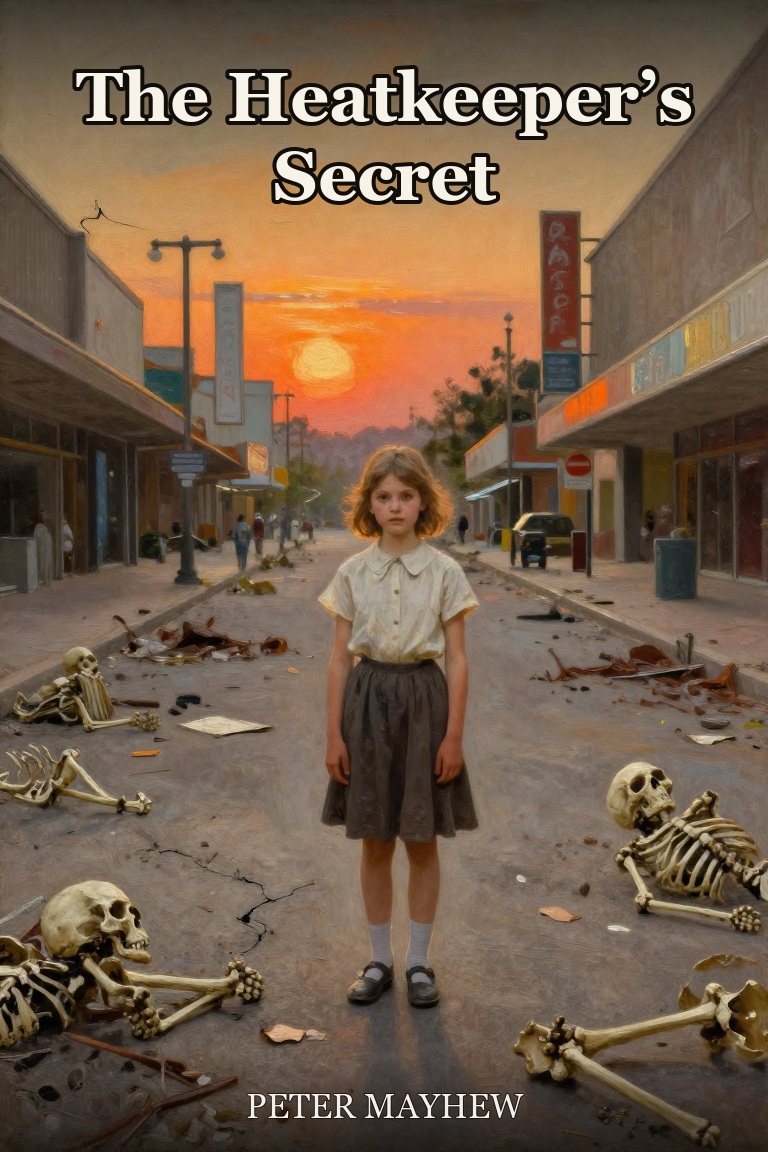
When a mysterious brass weather instrument transports four British children into a sweltering future Britain, they uncover the dark truth about air conditioning's double-edged sword: saving lives while fuelling inequality.
Chapter One
The Playground Nobody Used
Maya gazed out at the playground, her eyes squinting against the glare of the sun-baked tarmac. The heatwave had been going on for what felt like forever – weeks, maybe even months? She'd lost count. The usually vibrant colours of the swings and slides seemed dulled, as if the paint was melting off them. The grass beneath her feet was dry and crackly, like a sheet of parchment.
"Maya, drink some water," Mrs Bennett called out from the shade of the school building. "It's not just nice weather outside – it can be really bad for you."
Maya nodded, taking a swig from her refillable bottle. She watched as Noah tried to climb the metal frame, but quickly retreated with a yelp of pain. "Ow, too hot!" he exclaimed.
Elliot stood nearby, eyes fixed on the thermometer in the old classroom window. "I'm going to measure the room temperature," he said, his voice steady and serious. Amira hovered beside him, frowning. "Mrs Khan's not doing well, Elliot. She's really struggling with this heat."
Maya felt a pang of worry for her neighbour. Mrs Khan was always so kind, always making sure they had enough sugar in their tea or borrowing them fresh vegetables from her garden. This heatwave seemed to be hitting the elderly especially hard.
As she gazed back at the thermometer, Maya noticed something odd. The red line on the dial seemed to be moving – not just a little bit, but noticeably. She frowned, feeling a shiver run down her spine. It was cracked and old, like everything else in this school. But…but it looked like it was working.
The thermometer clicked, its metal body vibrating slightly. Maya's heart skipped a beat as she stared at the dial. The red line stopped moving, but only for a moment. Then it started again – slowly, incrementally – as if counting down to something.
"What's going on with that thing?" Noah asked, pointing at the thermometer.
Elliot shook his head. "I don't know, but I think we should tell Mr Alder about it."
Amira's eyes met Maya's, and for a moment they just looked at each other – a silent understanding passing between them. Something was off. And Maya had a feeling that this old school thermometer was only the beginning of something much bigger than any of them could imagine.
Maya's eyes wandered back to the cracked old classroom window, where the thermometer seemed to be ticking away like a clock. She felt an inexplicable pull towards it, as if it was trying to tell her something. "Guys, look at this," she said, beckoning Elliot and Amira over.
Elliot's eyes lit up behind his glasses as he approached the window. "That thing's ancient! I'm surprised it still works."
Amira frowned, her brow furrowed with concern. "Mrs Khan's not doing well, guys. She's really struggling with this heat."
Maya nodded sympathetically. "I know. I was just thinking about how hot our flat gets at night too. My mum says we need to get some more fans or something."
Noah, who had been lounging on the edge of the group, suddenly piped up. "Hey, can we go inside? It's like a furnace out here!"
Mrs Bennett appeared at their side, her voice firm but gentle. "Not right now, children. We need to stay in the shade and drink plenty of water. This heat is not just nice weather – it can be really bad for you."
Maya felt a shiver run down her spine as she looked around at the parched playground. The grass was dry and yellow, the metal climbing frame too hot to touch, and even the swings seemed to creak in protest.
Elliot pulled out his phone and checked the temperature on the screen. "It's still over 30 degrees Celsius," he said, frowning. "And it's not just the daytime – the nights are staying warm too."
Amira's eyes met Maya's, and they both knew what this meant. Hot nights were when people and buildings really struggled to cool down.
As if on cue, a faint click echoed from the old classroom window. The thermometer seemed to vibrate slightly, its metal body humming with an otherworldly energy.
"What was that?" Noah asked, his voice full of wonder.
Maya's heart skipped a beat as she stared at the dial. The red line had stopped moving – but only for a moment. Then it started again, incrementally counting down to…something.
The group fell silent, transfixed by the mysterious movement on the thermometer. Maya felt her mind racing with questions: What was going on with this old instrument? Was it really working? And what did it have to do with the strange heatwave that seemed to be gripping their community?
As they stood there, frozen in fascination, the air around them seemed to grow heavier – as if the very atmosphere itself was holding its breath, waiting for something to happen.
Maya gazed out at the desolate playground, the dry grass and cracked tarmac seeming to stretch on forever. The air was heavy with heat, making every breath feel like a chore. She wiped the sweat from her forehead, feeling it trickle down her back like a slow-moving river.
"Ugh, this is ridiculous," Noah complained, flopping onto the ground beside her. "I'm melting."
Elliot chuckled and pulled out his phone to check the temperature. "It's still over 30 degrees Celsius," he said, frowning. "And it's not just the daytime – the nights are staying warm too."
Maya nodded in agreement, thinking about how she'd struggled to sleep the night before. The warmth had seeped into her bedroom, making her feel like she was stuck in a sauna.
Amira joined them on the ground, her eyes scanning the playground as if searching for something – or someone. "I'm worried about Mrs Khan," she said quietly. "She's not doing well with this heat."
Maya felt a pang of concern. She'd visited Mrs Khan the day before, and the elderly woman had looked exhausted. Maya's mum had been trying to help her get some fans and shades for their flat, but it was hard to find anything that worked.
Mrs Bennett appeared at their side, her voice firm but gentle. "Children, please remember to drink plenty of water and stay in the shade. This heat is not just nice weather – it can be really bad for you."
Maya nodded, feeling a shiver run down her spine as she looked around at the parched playground. The metal climbing frame seemed to gleam with an otherworldly intensity, making her skin prickle.
Elliot pulled out his phone again and began to measure the temperature in the room. "It's still really hot in here," he said, frowning at the reading on his screen. "We should probably get some fans or something."
Maya nodded in agreement, but before she could say anything, her eyes landed on the old classroom thermometer in the window. It was cracked and worn, but its red line seemed to be moving – incrementally counting down to…something.
She felt a shiver run down her spine as she stared at it, her mind racing with questions. What was going on with this old instrument? Was it really working?
The group fell silent, transfixed by the mysterious movement on the thermometer. Maya's heart skipped a beat as she watched it tick away – and then, suddenly, it clicked.
Even though nobody had touched it, the thermometer seemed to have moved of its own accord. Maya felt a surge of excitement mixed with fear. What was happening? And what did it have to do with the strange heatwave that seemed to be gripping their community?
As they stood there, frozen in fascination, the air around them seemed to grow heavier – as if the very atmosphere itself was holding its breath, waiting for something to happen.
Maya's eyes met Amira's, and she saw a spark of understanding there. They both knew that this heatwave was more than just a hot spell – it was a warning sign, a reminder that their world was changing in ways they couldn't yet understand.
And then, as if on cue, the classroom door creaked open behind them…
Maya's eyes snapped back into focus as she stared at the old classroom thermometer. It was still moving, its red line ticking away with a steady rhythm. She felt a shiver run down her spine as she watched it, her mind racing with questions.
"What's going on?" Noah asked, his voice low and curious.
Maya shook her head, trying to clear the cobwebs. "I don't know," she admitted. "But look at that."
Elliot's eyes flicked towards the thermometer, and he pulled out his phone to measure the temperature in the room. "It's still really hot in here," he said, frowning at the reading on his screen.
Amira leaned forward, her brow furrowed with concern. "I'm worried about Mrs Khan," she said quietly. "She's not doing well with this heat."
Maya nodded, feeling a pang of worry for their elderly neighbour. She'd visited Mrs Khan the day before, and the woman had looked exhausted.
Mrs Bennett appeared at their side, her voice firm but gentle. "Children, please remember to drink plenty of water and stay in the shade. This heat is not just…unpleasant," she said carefully. "It can be really bad for you if you don't take care."
Maya felt a surge of understanding. She'd been so caught up in her own worries about Mrs Khan that she hadn't realized how serious this heatwave was.
As they stood there, frozen in fascination, the air around them seemed to grow heavier – as if the very atmosphere itself was holding its breath, waiting for something to happen.
And then, without warning, the old thermometer clicked. Maya's heart skipped a beat as she stared at it, her mind reeling with questions.
"What just happened?" Noah asked, his voice full of wonder.
Maya shook her head, feeling a thrill of excitement mixed with fear. "I don't know," she admitted. "But I think we should find out."
The group fell silent, transfixed by the mysterious movement on the thermometer. Maya's eyes met Amira's, and she saw a spark of understanding there.
They both knew that this heatwave was more than just a hot spell – it was a warning sign, a reminder that their world was changing in ways they couldn't yet understand.
As they stood there, frozen in fascination, the classroom door creaked open behind them. A faint whisper of cool air wafted into the room, carrying with it the promise of secrets waiting to be uncovered…
Maya gazed out at the deserted playground, the heat radiating up from the tarmac like a living thing. The grass was dry and yellow, the metal climbing frame too hot to touch without flinching. She squinted against the glare, feeling the sweat trickle down her face.
"Come on, guys," Noah said, sauntering over with a water bottle in hand. "Let's find some shade."
Elliot nodded, already heading towards the school building. "I'm going to check the temperature in here again. It feels like it's getting worse by the minute."
Amira trailed behind them, her eyes fixed on the ground. "I'm worried about Mrs Khan," she said quietly. "She's not doing well with this heat."
Maya nodded sympathetically. She'd visited Mrs Khan the day before, and the woman had looked exhausted. The old lady lived in a flat with no air conditioning, and Maya knew how hard it was to keep cool without proper ventilation.
As they walked towards the school building, Mrs Bennett appeared beside them, her voice firm but gentle. "Children, please remember to drink plenty of water and stay in the shade. This heat is not just…unpleasant," she said carefully. "It can be really bad for you if you don't take care."
Maya felt a surge of understanding. She'd been so caught up in her own worries about Mrs Khan that she hadn't realized how serious this heatwave was.
As they entered the classroom, Maya's eyes landed on the old thermometer on the wall. It was cracked and worn, but its red line seemed to move on its own, ticking away with a steady rhythm. She felt a shiver of curiosity run through her – what was going on?
"Maya, look at that," Elliot said, pointing at the thermometer.
But Maya's attention was already fixed on it. "It's moving," she whispered, feeling a thrill of excitement mixed with fear.
The classroom door creaked open behind them, and a faint whisper of cool air wafted into the room, carrying with it the promise of secrets waiting to be uncovered…
And then, without warning, the old thermometer clicked. Maya's heart skipped a beat as she stared at it, her mind reeling with questions.
"What just happened?" Noah asked, his voice full of wonder.
Maya shook her head, feeling a sense of trepidation wash over her. "I don't know," she admitted. "But I think we're about to find out."
The group fell silent, transfixed by the mysterious movement on the thermometer. Maya's eyes met Amira's, and she saw a spark of understanding there.
They both knew that this heatwave was more than just a hot spell – it was a warning sign, a reminder that their world was changing in ways they couldn't yet understand.
As they stood there, frozen in fascination, the classroom door creaked open again, this time wider. A figure stood in the doorway, watching them with an enigmatic gaze…
Chapter Two
Red Warning
As Mrs Bennett wrote on the board, a Red Extreme Heat Warning, the classroom fell silent. Maya's eyes widened in surprise – red warnings were for storms or snow, not heatwaves. Elliot's brow furrowed as he scribbled notes in his book. Amira's gaze drifted to the window, her mind already racing with thoughts of Mrs Khan.
"What does it mean?" Noah asked, his voice laced with a hint of unease.
Mrs Bennett's expression turned serious. "It means there's a real risk to health and disruption. We need to take extra precautions to stay safe."
Maya felt a shiver run through her – not just because of the heat, but because she knew how vulnerable some people were. She thought of Mrs Khan, struggling to keep cool in her flat without air conditioning.
Elliot looked up from his notes, his eyes sparkling with curiosity. "How does it work? Do we get special instructions or something?"
Mrs Bennett nodded. "Yes, the Met Office will send out updates and advice on how to stay safe during this heatwave. But for now, let's focus on what we can do in school."
As she spoke, Mr Alder slipped into the classroom, his eyes scanning the room before landing on Maya at the broken thermometer. He smiled wryly and said quietly, "That thing always wakes up when the weather turns wrong."
Maya felt a thrill of excitement mixed with trepidation. What did he mean? And why was the thermometer acting so strangely?
Amira's voice cut through her thoughts. "But what about Mrs Khan? She can't even afford fans, let alone air conditioning."
Mrs Bennett's expression softened. "We'll do our best to help her, Amira. But we need to focus on staying safe ourselves too."
As the class continued to discuss the heatwave and its implications, Maya noticed Elliot recording temperatures on his phone. Noah still joked about skipping PE, but his eyes darted nervously towards the window.
Mr Alder leaned in, his voice low. "You know, that old thermometer was installed during the 1976 heatwave, which was one of the worst in British history. It's been stuck in this classroom ever since."
Maya's heart skipped a beat as she met Mr Alder's gaze. What secrets lay hidden in the past, waiting to be uncovered?
As Mrs Bennett continued to explain the Red Extreme Heat Warning, Maya felt a shiver run down her spine. She had never seen anything like it before – the red color seemed so intense, so serious. Elliot's brow furrowed as he scribbled more notes in his book, while Amira's gaze drifted back to the window, her mind still on Mrs Khan.
"What about our homes?" Noah asked, his voice laced with a hint of unease. "Will they be okay?"
Mrs Bennett nodded sympathetically. "Some homes will stay cool, but others might trap heat. It depends on how well-insulated they are and whether you have air conditioning or fans."
Maya thought of Mrs Khan's flat, which was small and poorly insulated. She couldn't afford air conditioning or even a fan, let alone the electricity to run them.
Elliot looked up from his notes, his eyes sparkling with curiosity. "How do we know who's at risk? What about people who have to work outside?"
Mrs Bennett's expression turned grave. "Outdoor workers are especially vulnerable during heatwaves. They need to take extra precautions to stay safe."
As she spoke, Mr Alder slipped into the classroom, his eyes scanning the room before landing on Maya at the broken thermometer. He smiled wryly and said quietly, "That thing always wakes up when the weather turns wrong."
Maya felt a thrill of excitement mixed with trepidation. What did he mean? And why was the thermometer acting so strangely?
Amira's voice cut through her thoughts. "But what about Mrs Khan? She can't even afford fans, let alone air conditioning. What if she gets sick?"
Mrs Bennett's expression softened. "We'll do our best to help her, Amira. But we need to focus on staying safe ourselves too."
As the class continued to discuss the heatwave and its implications, Maya noticed Elliot recording temperatures on his phone. Noah still joked about skipping PE, but his eyes darted nervously towards the window.
Mr Alder leaned in, his voice low. "You know, that thermometer was found in the school cellar after the 1976 heatwave."
As Mrs Bennett continued to explain the Red Extreme Heat Warning, Maya felt a sense of unease settle over her. She had never seen anything like it before – the red color seemed so intense, so serious. Elliot's brow furrowed as he scribbled more notes in his book, while Amira's gaze drifted back to the window, her mind still on Mrs Khan.
"What about our homes?" Noah asked, his voice laced with a hint of unease. "Will they be okay?"
Mrs Bennett nodded sympathetically. "Some homes will stay cool, but others might trap heat. It depends on how well-insulated they are and whether you have air conditioning or fans."
Maya thought of Mrs Khan's flat, which was small and poorly insulated. She couldn't afford air conditioning or even a fan, let alone the electricity to run them.
Elliot looked up from his notes, his eyes sparkling with curiosity. "How do we know who's at risk? What about people who have to work outside?"
Mrs Bennett's expression turned grave. "Outdoor workers are especially vulnerable during heatwaves. They need to take extra precautions to stay safe."
As she spoke, Mr Alder slipped into the classroom, his eyes scanning the room before landing on Maya at the broken thermometer. He smiled wryly and said quietly, "That thing always wakes up when the weather turns wrong."
Maya felt a thrill of excitement mixed with trepidation. What did he mean? And why was the thermometer acting so strangely?
Amira's voice cut through her thoughts. "But what about Mrs Khan? She can't even afford fans, let alone air conditioning. What if she gets sick?"
Mrs Bennett's expression softened. "We'll do our best to help her, Amira. But we need to focus on staying safe ourselves too."
As the class continued to discuss the heatwave and its implications, Maya noticed Elliot recording temperatures on his phone. Noah still joked about skipping PE, but his eyes darted nervously towards the window.
Mr Alder leaned in, his voice low. "You know, that thermometer was found in the school cellar after the 1976 heatwave."
Maya's mind whirled with questions. What did he mean by "when the weather turns wrong"? And what secrets lay hidden in the past, waiting to be uncovered?
Just then, Mrs Bennett stood up and wrote on the board: "Temperature forecast for tomorrow: 32C. We need to take this seriously." The class fell silent, their eyes fixed on the red numbers.
Maya felt a shiver run down her spine as she gazed out the window at the sweltering streets below. She knew they had to act fast – not just to stay safe themselves, but to help those who were struggling the most. And she had a feeling that the mysterious thermometer was about to reveal its secrets.
As Mrs Bennett wrote "Temperature forecast for tomorrow: 32C" on the board, the class fell silent. Maya felt a sense of unease settle over her, like a weight had been dropped onto their shoulders. Elliot's brow furrowed as he scribbled more notes in his book, while Amira's gaze drifted back to the window, her mind still on Mrs Khan.
"What about our homes?" Noah asked, his voice laced with a hint of unease. "Will they be okay?"
Mrs Bennett nodded sympathetically. "Some homes will stay cool, but others might trap heat. It depends on how well-insulated they are and whether you have air conditioning or fans."
Maya thought of Mrs Khan's flat, which was small and poorly insulated. She couldn't afford air conditioning or even a fan, let alone the electricity to run them.
Elliot looked up from his notes, his eyes sparkling with curiosity. "How do we know who's at risk? What about people who have to work outside?"
Mrs Bennett's expression turned grave. "Outdoor workers are especially vulnerable during heatwaves. They need to take extra precautions to stay safe."
As she spoke, Mr Alder slipped into the classroom, his eyes scanning the room before landing on Maya at the broken thermometer. He smiled wryly and said quietly, "That thing always wakes up when the weather turns wrong."
Maya felt a thrill of excitement mixed with trepidation. What did he mean? And why was the thermometer acting so strangely?
Amira's voice cut through her thoughts. "But what about Mrs Khan? She can't even afford fans, let alone air conditioning. What if she gets sick?"
Mrs Bennett's expression softened. "We'll do our best to help her, Amira. But we need to focus on staying safe ourselves too."
As the class continued to discuss the heatwave and its implications, Maya noticed Elliot recording temperatures on his phone. Noah still joked about skipping PE, but his eyes darted nervously towards the window.
Mr Alder leaned in, his voice low. "You know, that thermometer was found in the school cellar after the 1976 heatwave."
Maya's mind whirled with questions. What did he mean by "when the weather turns wrong"? And what secrets lay hidden in the past, waiting to be uncovered?
Just then, Mrs Bennett stood up and began to explain the Red Extreme Heat Warning in more detail. "It means we need to take extra precautions to stay safe. We'll be having a special assembly tomorrow to discuss heatwave safety and how to help those who are struggling."
As she spoke, Maya felt a sense of determination rise within her. She knew they had to act fast – not just to stay safe themselves, but to help those who were struggling the most.
The class continued to discuss the heatwave, but Maya's mind was elsewhere. She couldn't shake off the feeling that something was off about the thermometer, and she was determined to find out what it was.
Mrs Bennett's expression turned grave as she wrote "Red Extreme Heat Warning" on the board in bold letters. The class fell silent, their eyes scanning the words as if searching for a hidden meaning.
"What does it mean?" Elliot asked, his brow furrowed with concern.
"It means we're facing real risk to health and disruption," Mrs Bennett explained. "The Met Office has issued this warning because temperatures are forecast above 30C and near records. We need to take extra precautions to stay safe."
Maya felt a shiver run down her spine as she glanced out the window at the sweltering heat. She had never seen anything like it before.
"But what about people who can't afford fans or air conditioning?" Amira asked, her voice laced with worry.
Mrs Bennett nodded sympathetically. "That's exactly why we need to be careful. Some homes will stay cool, but others might trap heat. We need to check on our neighbors, especially the elderly and those with young children."
Noah still joked about skipping PE, but his eyes darted nervously towards the window.
"I'm going to record some temperatures," Elliot said, pulling out his phone. "We should keep track of how hot it gets."
As Elliot began to type away, Mr Alder slipped into the classroom, his eyes scanning the room before landing on Maya at the broken thermometer.
"That thing always wakes up when the weather turns wrong," he said quietly, nodding towards the instrument.
Maya's mind whirled with questions. What did he mean by "when the weather turns wrong"? And what secrets lay hidden in the past?
Mr Alder continued to check the blinds, his eyes flicking between Maya and the thermometer as if searching for something.
"Did you know that this school was built during a heatwave?" he said suddenly, his voice low. "The 1976 heatwave, to be exact."
Maya's heart skipped a beat as she glanced at the broken thermometer. Could it really be connected to that event?
Mr Alder smiled wryly and continued to check the blinds, but Maya knew she had to investigate further. She felt a sense of determination rising within her – they were on the cusp of uncovering something big.
As the class continued to discuss the heatwave, Maya's mind was elsewhere. She couldn't shake off the feeling that there was more to the thermometer than met the eye…
Chapter Three
The Thermometer in the Cellar
As the class continued to discuss the heatwave, Maya's mind was elsewhere. She couldn't shake off the feeling that there was more to the thermometer than met the eye. Mrs Bennett's words about the Red Extreme Heat Warning still lingered in her thoughts, but it was Mr Alder's enigmatic comment that had really piqued her interest.
"Let's go help Mr Alder with those boxes," Maya said, nudging Elliot and Amira towards the door. Noah trailed behind them, his eyes fixed on the thermometer as if mesmerized by its steady tick-tock.
In the cellar, the air was cool and musty, a welcome respite from the sweltering heat above. Mr Alder led them to a stack of old boxes, their labels worn and faded. "Time for us to sort through some school archives," he said, his eyes twinkling with excitement.
As they began to carry the boxes into the cellar, Maya noticed an old wooden case tucked away on a shelf. It was adorned with intricate carvings and a brass plaque that read: "Chrono-Thermograph – 1957-2080".
Elliot's eyes widened as he picked up the case. "This is some sort of museum object, isn't it?" he asked, his voice full of wonder.
Maya's heart skipped a beat as she approached the case. The Chrono-Thermograph itself was a strange combination of instruments: a thermometer, barometer, and clock all in one. But what caught her attention was the ring around the dial – years, not numbers. 1957, 1976, 2022, 2026, 2040, 2055, 2080.
"Look at that," Amira said, her voice barely above a whisper. "Why are future years marked on it?"
Maya's eyes locked onto the pointer, which was trembling over 2026. She felt a shiver run down her spine as she realized the significance of this moment. The heatwave outside seemed to be connected to something much bigger – and older.
The cellar air grew thick with anticipation as they all leaned in to examine the Chrono-Thermograph more closely. Noah, however, was already making his way back upstairs, muttering something about needing a break from the "weird stuff".
"Let's test it," Elliot said, his eyes shining with scientific curiosity. "See if we can get it working."
Maya nodded in agreement, her mind racing with possibilities. But as they began to fiddle with the instrument, the pointer suddenly jerked from 2026 to 2055. The cellar walls around them began to glow a soft white light.
"What's happening?" Amira breathed, her eyes wide with wonder.
As one, they turned to Mr Alder, who was watching the scene unfold with an enigmatic smile on his face. "I think it's time we found out," he said, his voice low and mysterious.
Maya's eyes locked onto the Chrono-Thermograph as she carefully opened the wooden case. The instrument itself was a strange combination of parts, with a thermometer, barometer, and clock all in one. But what caught her attention was the ring around the dial – years, not numbers. 2019, 2022, 2026, 2040, 2055, 2080.
Elliot's eyes widened as he peered over Maya's shoulder. "This is some sort of museum object, isn't it?" he asked, his voice full of wonder. Maya nodded, her mind racing with possibilities. Why would a school have such an unusual instrument?
Amira leaned in closer, her brow furrowed. "Why are future years marked on it?"
Maya's gaze drifted back to the pointer, which was trembling over 2026. She felt a shiver run down her spine as she realized the significance of this moment. The heatwave outside seemed to be connected to something much bigger – and older.
Noah, who had been quietly observing from the side, suddenly spoke up. "Can we just leave it alone? I don't want to get in trouble."
Maya's eyes met Elliot's, and she saw a spark of scientific curiosity there. "Let's test it," he said, his voice filled with excitement. "See if we can get it working."
Mr Alder, who had been watching the scene unfold, nodded thoughtfully. "I think that's a good idea, Elliot. But be careful – we don't know what this thing does."
As Maya carefully lifted the Chrono-Thermograph out of its case, Noah turned and made his way back upstairs, muttering something about needing a break from the "weird stuff". The others continued to examine the instrument, trying to understand its strange markings.
Elliot's eyes were fixed on the pointer as he began to fiddle with the dial. Maya watched, her heart pounding in her chest. Suddenly, the pointer jerked from 2026 to 2055.
The cellar walls around them began to glow a soft white light. Amira gasped, her eyes wide with wonder. "What's happening?" she breathed.
Maya felt a thrill of excitement mixed with fear. What was this thing doing? And where were they going?
Mr Alder's voice cut through the silence, his words low and mysterious. "I think it's time we found out."
As they descended into the cool, dimly lit cellar, the air grew thick with the scent of old books and dusty memories. Mr Alder led the way, his footsteps echoing off the stone walls as he expertly navigated the narrow aisles between towering shelves of crates and boxes. The children followed closely behind, their eyes adjusting to the soft light.
Maya's gaze wandered over the stacks of old furniture, yellowed papers, and forgotten trinkets, her mind racing with possibilities. What secrets lay hidden among these relics? She spotted a faded photograph on a nearby crate, its subjects smiling in the midst of a lush summer garden. A faint memory tickled the edge of her consciousness – hadn't Mrs Khan mentioned something about her own family's garden during the 1976 heatwave?
Elliot, meanwhile, had already begun to explore the shelves, his fingers trailing over the spines of old books and the curves of antique clockwork mechanisms. "Hey, look at this!" he exclaimed, holding up a small, intricately carved wooden box. "This must be from the 19th century!"
Mr Alder chuckled, his eyes twinkling with amusement. "Ah, yes, that's an old treasure indeed. But we're not here to dig through the past just yet. We have a task at hand – moving these boxes into storage."
As they worked, Maya's attention drifted back to the wooden case on the nearby shelf. The Chrono-Thermograph lay nestled within its velvet-lined interior, its brass exterior glinting in the dim light. She felt an inexplicable pull towards it, her fingers itching to touch the intricate engravings that danced across its surface.
Amira leaned in beside her, her voice barely above a whisper. "Maya, why are future years marked on this thing?"
Maya's eyes met Elliot's, and she saw a spark of scientific curiosity there. "I think it might be some sort of…time-keeping device?" he ventured, his brow furrowed in concentration.
Noah, who had been quietly observing from the side, suddenly spoke up. "Can we just leave it alone? I don't want to get in trouble."
Maya's eyes met Mr Alder's, and she saw a hint of understanding there – but also a warning not to push their luck. She hesitated for a moment before turning back to Elliot.
"Let's test it," he said, his voice filled with excitement. "See if we can get it working."
With a quiet nod from Mr Alder, the children began to carefully lift the Chrono-Thermograph out of its case. As they did, the pointer on the dial began to tremble, its movement almost imperceptible at first. Maya's heart quickened as she watched, her mind racing with possibilities.
And then, in a sudden jerk, the pointer leapt from 2026 to 2055…
As they worked, Maya's attention drifted back to the wooden case on the nearby shelf. The Chrono-Thermograph lay nestled within its velvet-lined interior, its brass exterior glinting in the dim light. She felt an inexplicable pull towards it, her fingers itching to touch the intricate engravings that danced across its surface.
"Hey, what's this thing?" Elliot asked, his eyes scanning the case as he carefully lifted out the Chrono-Thermograph.
"It looks like a museum piece," Mr Alder said, his voice filled with a hint of nostalgia. "I remember when it was first installed in this school. It was meant to be some sort of…temperature gauge, I suppose."
Maya's eyes met Elliot's, and she saw a spark of scientific curiosity there. "But why are future years marked on it?" Amira asked, her brow furrowed in concentration.
Noah shook his head. "Can we just leave it alone? I don't want to get in trouble."
Maya hesitated for a moment before turning back to Elliot. "Let's test it," he said, his voice filled with excitement. "See if we can get it working."
With a quiet nod from Mr Alder, the children began to carefully lift the Chrono-Thermograph out of its case. As they did, the pointer on the dial began to tremble, its movement almost imperceptible at first.
Maya's heart quickened as she watched, her mind racing with possibilities. "Look," Elliot whispered, his eyes fixed intently on the instrument. "It's moving."
The pointer jerked and stuttered, its motion becoming more erratic by the second. Maya felt a shiver run down her spine as she realized that something was happening – but what?
And then, in a sudden, jarring movement, the pointer leapt from 2026 to 2055.
As they watched, transfixed, the cellar walls began to glow with a soft, white light. The air seemed to vibrate with an electric tension, as if the very fabric of time itself was shifting and reforming around them.
"What's going on?" Noah whispered, his voice barely audible over the pounding of Maya's heart.
Mr Alder's face was pale, his eyes fixed intently on the Chrono-Thermograph. "I think it's…activated," he breathed, his words trailing off into a stunned silence.
As they stood there, frozen in wonder and fear, the light from the walls grew brighter, illuminating the dusty shelves and forgotten trinkets that lined the cellar. The air seemed to thicken and swirl around them, as if reality itself was bending and warping to accommodate this strange, impossible event…
As they carried the boxes into the cool, musty cellar, Maya couldn't help but feel a sense of excitement. She loved exploring hidden spaces like this, and the air was thick with the scent of old books and dust. Mr Alder led them to a corner of the room where a wooden case sat on a shelf, adorned with intricate carvings.
"Ah, here we are," he said, his eyes twinkling as he opened the lid. Inside, nestled in velvet-lined compartments, lay an assortment of instruments: a thermometer, a barometer, and a clock. Maya's eyes widened as she took in the brass instrument's gleaming surface. It was unlike anything she had ever seen before.
"What is this?" Elliot asked, his voice filled with curiosity.
Mr Alder smiled. "It's one of our school's treasures. A Chrono-Thermograph, I believe it's called."
Maya's gaze darted to the dial, where numbers were replaced by years: 1957, 1976, 2022, 2026, 2040, 2055, and 2080. She felt a shiver run down her spine as she realized that this device was more than just a museum piece.
"Why are there future years on it?" Amira asked, her brow furrowed in concentration.
Noah shook his head. "Can we just leave it alone? I don't want to get in trouble."
Maya hesitated for a moment before turning back to Elliot. "Let's test it," he said, his voice filled with excitement. "See if we can get it working."
With a quiet nod from Mr Alder, the children carefully lifted the Chrono-Thermograph out of its case. As they did, the pointer on the dial began to tremble, its movement almost imperceptible at first.
Maya's heart quickened as she watched, her mind racing with possibilities. "Look," Elliot whispered, his eyes fixed intently on the instrument. "It's moving."
The pointer jerked and stuttered, its motion becoming more erratic by the second. Maya felt a sense of trepidation building inside her as she realized that something was happening – but what?
And then, in a sudden, jarring movement, the pointer leapt from 2026 to 2055.
As they watched, transfixed, the cellar walls began to glow with a soft, white light. The air seemed to vibrate with an electric tension, as if the very fabric of time itself was shifting and reforming around them.
"What's going on?" Noah whispered, his voice barely audible over the pounding of Maya's heart.
Mr Alder's face was pale, his eyes fixed intently on the Chrono-Thermograph. "I think it's…activated," he breathed, his words trailing off into a stunned silence.
As they stood there, frozen in wonder and fear, the light from the walls grew brighter, illuminating the dusty shelves and forgotten trinkets that lined the cellar. The air seemed to thicken and swirl around them, as if reality itself was bending and warping to accommodate this strange, impossible event…
The glow intensified, casting an otherworldly light on the children's faces. Maya felt her heart racing with excitement and fear as she gazed at the Chrono-Thermograph, its pointer still fixed on 2055.
"What just happened?" Elliot asked, his voice barely above a whisper.
Maya's eyes met Amira's, and she saw a spark of understanding there. "I think we're going somewhere," Maya said, her voice trembling with anticipation.
As they stood there, suspended in the heart of this strange, glowing space, the children knew that their lives would never be the same again…
As the Chrono-Thermograph's pointer continued to quiver, the air around them began to vibrate with an electric tension. The cellar walls seemed to stretch and yawn like a living creature, their dusty surfaces rippling as if reality itself was being rewritten.
The sounds of the present – school bells, weather forecasts, sirens in the distance – blended with the hum of buzzing fans and the creaks of old wooden shelves. But now, an eerie silence fell over the cellar as if the very fabric of time had been torn apart.
Maya felt her heart pounding in her chest like a drumbeat, but she stood tall, her eyes fixed on the Chrono-Thermograph. "What's happening?" Noah whispered, his voice trembling with fear.
Elliot's gaze darted from the instrument to the cellar walls, his brow furrowed in concentration. "I think we're moving through time," he said, his voice barely above a whisper.
Amira's eyes widened as she took in their surroundings. The air was thick and heavy, like a physical presence that pressed against her skin. She felt parched and dry, her throat constricting with thirst.
As they watched, the cellar walls began to transform before their very eyes. Reinforced steel beams appeared, encasing the old wooden shelves in a lattice of metal. Emergency cooling pipes sprouted from the ceiling like a network of metallic veins, pulsating with a soft blue light.
Warning signs flickered to life on the walls, reading HEATWAVE PROTOCOL LEVEL 5 in bold red letters. Maya's eyes widened as she took in the new surroundings. "We're not in our school anymore," she said, her voice barely above a whisper.
Elliot's gaze snapped back to the Chrono-Thermograph, his eyes scanning the dial for any sign of their destination. "I think we've jumped forward in time," he said, his voice filled with wonder.
Amira's eyes roved over the cellar, taking in the rows of children sleeping on mats in a cooled hall. Her gaze landed on a small child, no more than five years old, curled up on a thin blanket. "What about them?" she asked, her voice laced with concern.
As they stood there, frozen in wonder and fear, a school alarm blared to life above the cellar's entrance. The words "OUTDOOR TEMPERATURE NOW 43C" echoed through the air, followed by a stern announcement: "ALL EXTERNAL DOORS SEALED."
The cellar fell silent once more, as if the very presence of the future had sucked all sound and movement from its walls. Maya felt her heart racing with excitement and fear as she gazed at the Chrono-Thermograph's pointer, still fixed on 2055.
"We're here," Elliot whispered, his eyes locked on the instrument. "We've arrived."
As the Chrono-Thermograph's pointer continued to quiver, the air around them began to shift and swirl like a living entity. The cellar walls seemed to stretch and yawn, their dusty surfaces rippling as if reality itself was being rewritten. The sounds of the present – school bells, weather forecasts, sirens in the distance – blended with the hum of buzzing fans and the creaks of old wooden shelves.
Maya felt her heart pounding in her chest like a drumbeat, but she stood tall, her eyes fixed on the Chrono-Thermograph. "What's happening?" Noah whispered, his voice trembling with fear.
Elliot's gaze darted from the instrument to the cellar walls, his brow furrowed in concentration. "I think we're moving through time," he said, his voice barely above a whisper.
Amira's eyes widened as she took in their surroundings. The air was thick and heavy, like a physical presence that pressed against her skin. She felt parched and dry, her throat constricting with thirst.
As they watched, the cellar walls began to transform before their very eyes. Reinforced steel beams appeared, encasing the old wooden shelves in a lattice of metal. Emergency cooling pipes sprouted from the ceiling like a network of metallic veins, pulsating with a soft blue light.
Warning signs flickered to life on the walls, reading HEATWAVE PROTOCOL LEVEL 5 in bold red letters. Maya's eyes widened as she took in the new surroundings. "We're not in our school anymore," she said, her voice barely above a whisper.
Elliot's gaze snapped back to the Chrono-Thermograph, his eyes scanning the dial for any sign of their destination. "I think we've jumped forward in time," he said, his voice filled with wonder.
Amira's eyes roved over the cellar, taking in the rows of children sleeping on mats in a cooled hall. Her gaze landed on a small child, no more than five years old, curled up on a thin blanket. "What about them?" she asked, her voice laced with concern.
Noah stumbled forward, his face pale and sweaty. "We have to get out of here," he whispered, panic creeping into his voice.
Maya reached out and grabbed his arm, holding him steady. "Wait, Noah. We need to understand what's happening."
Elliot was already scanning the walls for any clues. "Look at this," he said, pointing to a sign on the wall. "It says 2055. We've jumped forward in time."
Amira's eyes widened as she took in the rows of sleeping children. "This is a school, isn't it?" she asked, her voice barely above a whisper.
As they stood there, frozen in wonder and fear, a school alarm blared to life above the cellar's entrance. The words "OUTDOOR TEMPERATURE NOW 43C" echoed through the air, followed by a stern announcement: "ALL EXTERNAL DOORS SEALED."
The cellar fell silent once more, as if the very presence of the future had sucked all sound and movement from its walls. Maya felt her heart racing with excitement and fear as she gazed at the Chrono-Thermograph's pointer, still fixed on 2055.
"We're here," Elliot whispered, his eyes locked on the instrument. "We've arrived."
But as they looked around, they realized that they were not alone in this future school. There were people moving through the corridors above them, their footsteps echoing through the air. And then, a voice spoke out from the intercom system.
"Attention, students and staff. We are currently experiencing extreme heat conditions outside. Please remain calm and stay within the sealed areas until further notice."
Maya's eyes met Elliot's, and she knew that they had to act fast. They couldn't just sit back and wait for someone else to solve their problems. They had to take control of their own destiny.
"Let's go," Maya said, her voice firm and determined. "We need to explore this school and find out what's going on."
But as they turned to leave the cellar, they realized that something was terribly wrong. The air outside was thick with heat, and the sun beat down relentlessly. And then, they saw it – a sign on the wall that read: "HEATWAVE PROTOCOL LEVEL 5".
They had arrived in a world where the temperature had reached catastrophic levels, and the very fabric of society was beginning to unravel. But Maya, Elliot, Amira, and Noah were not just passive observers. They were here to take action, to make a difference, and to change their future.
And so, with hearts pounding and minds racing, they set out into this strange new world, ready to face whatever challenges lay ahead.
As they stepped out of the cellar, the blistering heat slapped them like a wet towel. Maya shielded her eyes from the bright sunlight that reflected off the pavement. The air was heavy with moisture, making every breath feel like inhaling a warm mist.
Elliot squinted at the Chrono-Thermograph's dial, his brow furrowed in concentration. "We're definitely in 2055," he said, pointing to the date on the instrument.
Amira's gaze swept over the transformed school, her eyes lingering on the rows of children sleeping on mats in a cooled hall. "This is…this is insane," she whispered, her voice barely audible above the din of sirens and emergency broadcasts.
Noah stumbled forward, his face pale and sweaty. "We have to get out of here," he muttered, panic creeping into his voice. "It's too hot."
Maya reached out and grabbed his arm, holding him steady. "Wait, Noah. We need to understand what's happening."
As they stood there, frozen in wonder and fear, a school alarm blared to life above the entrance. The words "OUTDOOR TEMPERATURE NOW 43C" echoed through the air, followed by a stern announcement: "ALL EXTERNAL DOORS SEALED."
The cellar fell silent once more, as if the very presence of the future had sucked all sound and movement from its walls. Maya felt her heart racing with excitement and fear as she gazed at the Chrono-Thermograph's pointer, still fixed on 2055.
Elliot's eyes scanned the walls for any clues, his fingers tracing the dates etched into the metal. "Look at this," he said, pointing to a sign on the wall. "It says 'Heatwave Protocol Level 5'. Whatever that means."
Amira's gaze landed on the rows of sleeping children once more. "What about them?" she asked, her voice laced with concern.
Maya's eyes met Elliot's, and she knew they had to act fast. They couldn't just sit back and wait for someone else to solve their problems. They had to take control of their own destiny.
"Let's go," Maya said, her voice firm and determined. "We need to explore this school and find out what's going on."
As they turned to leave the cellar, a figure emerged from the shadows. A woman with a kind face and a clipboard approached them, her eyes scanning the group before focusing on Maya.
"Welcome, students," she said, her voice firm but gentle. "I'm Dr. Patel, the school counselor. I see you're…ah…new to our school. Can I help you find your way?"
Maya's eyes narrowed as she took in the woman's words. Something didn't add up.
"Who are you?" Maya asked, her voice firm but polite.
Dr. Patel smiled, her eyes crinkling at the corners. "I'm a counselor here at the school. But I think there's been some…miscommunication. You see, this is a heat refuge, designed to keep our students safe during extreme weather events."
Maya's eyes met Elliot's, and she knew they had stumbled into something much bigger than themselves.
"What do you mean?" Maya asked, her voice laced with curiosity.
Dr. Patel's expression turned serious. "This school has been transformed into a heat refuge for the past five years. We've seen temperatures rise to catastrophic levels, and our students need a safe place to learn."
As she spoke, the alarm above the entrance blared once more, its words echoing through the air like a warning.
"OUTDOOR TEMPERATURE NOW 45C. ALL EXTERNAL DOORS SEALED."
Maya's eyes met Elliot's, and they knew they had to act fast. They couldn't just sit back and wait for someone else to solve their problems. They had to take control of their own destiny.
But as they turned to leave the cellar, they realized that something was terribly wrong. The air outside was thick with heat, and the sun beat down relentlessly. And then, they saw it – a sign on the wall that read: "HEATWAVE PROTOCOL LEVEL 5".
The future had arrived, and it was not what they expected.
But Maya, Elliot, Amira, and Noah were ready to face whatever challenges lay ahead. They took a deep breath, their hearts pounding with excitement and fear, and stepped into the unknown.
As the Chrono-Thermograph's pointer continued to spin, the air around them began to change. The cellar, once a damp and musty space, was transformed into a sweltering oven. The sound of school bells, weather forecasts, and sirens blended together in a cacophony that made it hard to think.
Noah stumbled forward, his face pale and sweaty. "What's happening?" he shouted above the din.
Maya grabbed his arm, her eyes fixed on the Chrono-Thermograph. "I don't know, but we have to get out of here!"
The air seemed to vibrate with heat, making it hard to breathe. Elliot squinted at the instrument, his brow furrowed in concentration. "We're definitely in 2055," he said, pointing to the date on the dial.
Amira's gaze swept over the cellar, her eyes lingering on the rows of children sleeping on mats in a cooled hall. "This is…this is insane," she whispered, her voice barely audible above the noise.
As they stood there, frozen in wonder and fear, a future emergency broadcast crackled to life from the speakers. "Heatwave Protocol Level 5 activated. All external doors sealed. Temperature now 43C."
The cellar's walls seemed to stretch and contract like a tunnel, the air thick with heat and humidity. Maya felt her heart racing with excitement and fear as she gazed at the Chrono-Thermograph's pointer, still fixed on 2055.
Elliot's eyes scanned the walls for any clues, his fingers tracing the dates etched into the metal. "Look at this," he said, pointing to a sign on the wall. "It says 'Heatwave Protocol Level 5'. Whatever that means."
Amira's gaze landed on the rows of sleeping children once more. "What about them?" she asked, her voice laced with concern.
Maya's eyes met Elliot's, and she knew they had to act fast. They couldn't just sit back and wait for someone else to solve their problems. They had to take control of their own destiny.
As they turned to leave the cellar, a sign on the wall caught Maya's eye: "Emergency Cooling Pipes Activated". The pipes snaked across the ceiling, hissing with compressed air as they cooled the space.
Noah stumbled forward again, his face even paler. "This is too much," he muttered, panic creeping into his voice.
Maya reached out and grabbed his arm once more. "We're okay, Noah. We just need to understand what's happening."
But as they stood there, frozen in uncertainty, the future school alarm blared to life above the entrance. The words "OUTDOOR TEMPERATURE NOW 45C" echoed through the air, followed by a stern announcement: "ALL EXTERNAL DOORS SEALED".
The cellar fell silent once more, as if the very presence of the future had sucked all sound and movement from its walls. Maya felt her heart racing with excitement and fear as she gazed at the Chrono-Thermograph's pointer, still fixed on 2055.
Elliot's eyes scanned the walls for any clues, his fingers tracing the dates etched into the metal. "We need to find out what's going on," he said, his voice firm but determined.
Amira nodded in agreement. "And we need to help those kids," she said, her gaze lingering on the rows of sleeping children.
Maya's eyes met Elliot's, and they knew they had a long journey ahead of them. But as they stood there, frozen in uncertainty, one thing was clear: they couldn't turn back now.
As the Chrono-Thermograph's pointer continued its frantic dance, the air around them began to shimmer and expand. The cellar, once a cramped and dimly lit space, stretched out like a tunnel, its walls seeming to melt and reform in front of their eyes. Maya felt her stomach drop as she stumbled forward, her hand grasping for something solid.
The cacophony of sounds grew louder, more chaotic: school bells clanged, weather forecasts crackled through the speakers, sirens wailed in the distance, and fans buzzed with a maddening intensity. The air itself seemed to vibrate with heat, making it hard to breathe, hard to think. Noah stumbled forward, his face pale and sweaty.
"What's happening?" he shouted above the din, panic creeping into his voice.
Maya grabbed his arm, her eyes fixed on the Chrono-Thermograph. "I don't know, but we have to get out of here!" she yelled back, but it was no use. The sounds were too loud, the heat too oppressive.
Elliot squinted at the instrument, his brow furrowed in concentration. "We're definitely in 2055," he said, pointing to the date on the dial. Amira's gaze swept over the cellar, her eyes lingering on the rows of children sleeping on mats in a cooled hall.
"This is…this is insane," she whispered, her voice barely audible above the noise.
As they stood there, frozen in wonder and fear, a future emergency broadcast crackled to life from the speakers. "Heatwave Protocol Level 5 activated. All external doors sealed. Temperature now 43C."
The cellar's walls seemed to stretch and contract like a living thing, the air thick with heat and humidity. Maya felt her heart racing with excitement and fear as she gazed at the Chrono-Thermograph's pointer, still fixed on 2055.
Elliot's eyes scanned the walls for any clues, his fingers tracing the dates etched into the metal. "Look at this," he said, pointing to a sign on the wall. "It says 'Heatwave Protocol Level 5'. Whatever that means."
Amira's gaze landed on the rows of sleeping children once more. "What about them?" she asked, her voice laced with concern.
Maya's eyes met Elliot's, and she knew they had to act fast. They couldn't just sit back and wait for someone else to solve their problems. They had to take control of their own destiny.
As they turned to leave the cellar, a sign on the wall caught Maya's eye: "Emergency Cooling Pipes Activated". The pipes snaked across the ceiling, hissing with compressed air as they cooled the space.
Noah stumbled forward again, his face even paler. "This is too much," he muttered, panic creeping into his voice once more.
Maya reached out and grabbed his arm, her grip firm but gentle. "We're okay, Noah. We just need to understand what's happening."
But as they stood there, frozen in uncertainty, the future school alarm blared to life above the entrance. The words "OUTDOOR TEMPERATURE NOW 45C" echoed through the air, followed by a stern announcement: "ALL EXTERNAL DOORS SEALED".
The cellar fell silent once more, as if the very presence of the future had sucked all sound and movement from its walls. Maya felt her heart racing with excitement and fear as she gazed at the Chrono-Thermograph's pointer, still fixed on 2055.
Elliot's eyes scanned the walls for any clues, his fingers tracing the dates etched into the metal. "We need to find out what's going on," he said, his voice firm but determined.
Amira nodded in agreement. "And we need to help those kids," she said, her gaze lingering on the rows of sleeping children.
Maya's eyes met Elliot's, and they knew they had a long journey ahead of them. But as they stood there, frozen in uncertainty, one thing was clear: they couldn't turn back now. The future was here, and it was up to them to navigate its dangers and find a way home.
As they ventured deeper into the 2055 school, the air grew thick with the hum of machinery and the soft murmur of conversations. The children's footsteps echoed off the walls as they navigated through rows of classrooms transformed into makeshift cooling rooms. Elliot's eyes widened as he took in the sight of elderly residents and families huddled together on mats, their faces pale and exhausted.
"What is this place?" Maya asked a nearby student, her voice barely above a whisper. The girl, dressed in a crisp white uniform, looked up from her phone with a mixture of curiosity and concern.
"This is our school's emergency cooling center," she explained, her eyes darting towards the rows of sleeping bodies. "We have to seal off the external doors during heatwaves to keep the heat out."
Amira's gaze fell upon an elderly woman struggling to find her way through the crowded room. She rushed over, helping the woman locate a water station and guiding her to a nearby seat.
"Thank you," the woman said weakly, her eyes locking onto Amira's with gratitude.
Elliot wandered off towards a bank of solar panels on the ceiling, his fingers tracing the intricate wiring as he examined the school's energy system. Maya watched him for a moment before turning back to the student who had spoken earlier.
"Extreme heat is just part of life now," she said matter-of-factly, her voice tinged with resignation. "We've learned to adapt."
Noah trailed behind the group, his eyes scanning the room as if searching for an escape route. But as he caught sight of a group of children huddled around a battery-powered fan, something shifted within him. He felt a pang of unease, and his usual joking demeanor faltered.
The student who had spoken earlier turned to Maya with a hint of surprise in her voice. "You don't know what it's like here? Heatwaves are just…usual."
Maya exchanged a glance with Elliot, her eyes locking onto the rows of sleeping bodies. She felt a shiver run down her spine as she realized that this future was one where heat survival had become the norm.
The school's intercom crackled to life once more, its voice laced with an air of urgency. "Cooling system alert: 20% capacity remaining."
As the children turned towards the speaker, the lights in the room began to flicker ominously. The hum of machinery grew louder, and for a moment, everyone froze.
"Wait," Elliot said, his eyes fixed on the solar panels above. "What's happening?"
The lights dipped lower, casting long shadows across the room as the school's cooling system teetered on the brink of collapse.
The air was heavy with tension as the children stood frozen, their eyes fixed on the flickering lights above. Elliot's gaze darted towards the solar panels, his mind racing with calculations. "How can a system that's supposed to be self-sustaining fail like this?" he muttered.
Maya's hand instinctively reached for her phone, but she hesitated, unsure if it would even work in this future world. She glanced around at the rows of sleeping bodies, their faces pale and exhausted. This was not what she had expected. Heatwaves were supposed to be unusual, something that happened only occasionally.
The student who had spoken earlier, the one with the crisp white uniform, stepped forward. "We're used to it," she said matter-of-factly. "Heatwaves are just part of life now. We've learned to adapt."
Amira's eyes locked onto the elderly woman she had helped earlier, and she felt a pang of concern. The woman was still sitting on her mat, looking frail and vulnerable. Amira made her way over, helping the woman to her feet.
"We have to get out of here," the woman said weakly. "It's not safe."
As they navigated through the crowded room, Noah fell back, his eyes scanning the space with a mixture of unease and fear. He had never seen anything like this before – rows of people sleeping on mats, the air thick with the hum of machinery.
"What's going to happen if the cooling system fails?" he asked, his voice barely above a whisper.
The student who had spoken earlier turned to him, her expression serious. "If it fails, we'll have to evacuate the building. It's not safe for people to be in here when the temperature is this high."
Maya exchanged a glance with Elliot, and they both knew that they had to get out of there – but where? The school was their only hope, but what if it failed too?
As they pondered their next move, the lights above flickered again, casting long shadows across the room. The hum of machinery grew louder, and for a moment, everyone froze.
"Wait," Elliot said, his eyes fixed on the solar panels above. "What's happening?"
The student who had spoken earlier stepped forward, her voice laced with urgency. "We're running low on power. If we don't get more energy soon, the cooling system will collapse completely."
As she spoke, the lights dipped lower, casting an eerie gloom over the room. The children stood frozen, their hearts pounding in unison as they waited for what would happen next.
And then, just as suddenly as it had started, everything went black.
The darkness was oppressive, a heavy blanket that suffocated all sound. Elliot's voice was barely audible as he whispered, "What's happening?" The question hung in the air like a challenge, but no one answered.
Maya felt her way through the darkness, her hands outstretched in front of her. She stumbled over someone's feet and muttered an apology under her breath. The person didn't respond, and she wondered if they were okay.
Amira's voice cut through the silence, calm and reassuring. "Everyone, stay still. We need to conserve energy."
Noah's nervous laughter echoed through the darkness, but it was quickly stifled by Amira's stern warning. "Not now, Noah."
As their eyes adjusted to the dim light, they saw that the room had changed. The rows of sleeping bodies were still there, but now they were surrounded by makeshift cooling stations. Battery-powered fans hummed softly, and water bottles lined the tables.
Elliot stumbled towards a nearby console, his fingers flying across the keyboard as he tried to reboot the system. "Come on," he muttered, "come on."
Maya wandered over to one of the cooling stations, where an elderly woman sat sipping from a cup. Amira had helped her earlier, and Maya was relieved to see that she seemed okay.
As they waited for something – anything – to happen, the children began to notice the little things about their new surroundings. The air was thick with the smell of sweat and disinfectant. The fans whirred softly, but they couldn't drown out the sound of people's ragged breathing.
Noah's eyes landed on a group of future pupils huddled in the corner, their faces pale and worried. "What are they doing here?" he whispered to Maya.
"They're waiting for remote lessons," she replied quietly. "Their school is closed because of the heat."
The pupils looked up as Noah approached them, and one of them spoke up, her voice laced with a mixture of fear and resignation. "Heatwaves like this are normal now. We've learned to adapt."
Maya felt a shiver run down her spine as she processed what they were saying. Adapt? They'd adapted to living in a world where the temperature was always too high, where schools closed and people slept on mats in cooling rooms.
As if sensing their unease, Amira stepped forward, her voice steady and calm. "We need to get out of here," she said firmly. "The school's cooling system is failing."
But as they turned to leave, the lights flickered again, and the fans faltered. The room plunged into darkness once more, and this time, it stayed that way.
Everyone froze, holding their breath as they waited for something – anything – to happen next.
As they waited in darkness, Amira's voice cut through the silence once more. "We need to find a way out of here," she said firmly. "The school's cooling system is failing."
Elliot, still hunched over the console, muttered under his breath as he frantically tried to reboot the system. Maya wandered over to him, peering at the screens in confusion.
"What's going on?" she whispered.
"It's not just the fans," Elliot explained, his eyes scanning the readings. "The entire cooling system is shutting down."
Maya felt a shiver run down her spine as she realized the gravity of their situation. They were trapped in a school that was supposed to be a safe haven from the heat, but it seemed they were now at risk themselves.
As if on cue, the lights flickered back to life, and the fans coughed into motion once more. The room brightened slightly, revealing the makeshift cooling stations and rows of sleeping bodies.
But Maya's attention was drawn to a young girl sitting in one corner, her eyes fixed on them with a mixture of curiosity and concern. She looked about their age, but there was something different about her – a quiet resilience that Maya couldn't quite put her finger on.
"Hi," the girl said softly, as if sensing Maya's gaze. "I'm Ava."
Maya smiled, feeling a spark of connection. "I'm Maya. What's it like living here?"
Ava's expression turned somber. "It's normal now. Heatwaves are just part of life. We've learned to adapt."
As they spoke, Elliot stood up from the console, his face pale. "We need to get out of here," he said firmly. "The system is failing again."
Amira nodded in agreement. "Let's find a way to escape."
But as they turned to leave, Noah stumbled over his own feet, causing Ava to gasp in alarm.
"Sorry!" Noah exclaimed, laughing nervously. "I'm just… um…"
Maya shot him a warning glance. This wasn't the time for jokes.
As they made their way through the darkened corridors, Maya realized that this future was organized around heat survival – every aspect of life seemed to revolve around staying cool in a world where temperatures were always too high.
She glanced at Ava, who was walking beside her with a quiet determination. This girl had grown up in a world where heatwaves were normal, but she still showed a spark of hope and resilience that Maya couldn't help but admire.
The group moved cautiously through the darkened corridors, their footsteps echoing off the walls as they searched for an escape from this sweltering future Britain.
But as they turned a corner, the lights flickered once more, plunging them into darkness. And this time, it seemed they might not come back on again…
As they moved through the darkened corridors, Ava led them to a room that seemed to be some sort of makeshift shelter. The air was thick with the smell of disinfectant and sweat. Maya's eyes adjusted slowly to the dim light, and she saw rows of cots lined up against the walls, each one occupied by a person trying to catch their breath.
"Welcome to our summer emergency shelter," Ava said softly, her voice barely above a whisper. "We call it the Cooling Centre."
Maya felt a pang of sadness as she looked around at the people huddled together for comfort. Some were elderly, others young families with children clinging to them in desperation.
Elliot wandered over to one of the cots, where an elderly woman lay shivering under a thin blanket. "Excuse me," he said gently, "but do you need some water?"
The woman's eyes flickered open, and she nodded weakly. Amira helped Elliot fetch her a bottle from the nearby water station, and as the old woman took a sip, Maya saw a glimmer of hope in her eyes.
"This is…this is what we have to do every summer now," Ava said, watching them with a mixture of sadness and resignation. "We set up these Cooling Centres in schools and community centres, so people can at least get out of their own homes for a while."
Maya's mind reeled as she took in the scene before her. This was what the future held – a world where heatwaves were not just occasional events, but a regular part of life.
As they stood there, the lights flickered once more, and the fans coughed into motion. The room brightened slightly, revealing the makeshift beds and the people huddled together for comfort.
But Maya's attention was drawn to Elliot, who was studying the cooling system with a look of intense concentration on his face. "Elliot, what are you doing?" she asked softly.
"I'm trying to understand how it works," he replied, not looking up. "We need to know if we can fix it."
Maya nodded, but her eyes were drawn back to Ava, who was watching them with a quiet determination in her eyes. This girl had grown up in a world where heatwaves were normal, but she still showed a spark of hope and resilience that Maya couldn't help but admire.
As they stood there, Noah spoke up for the first time since they'd entered the Cooling Centre. "You know, I never thought about it before," he said softly, "but this is what we're fighting against. This is what climate change does."
Maya shot him a glance, and for once, she saw no jest in his eyes. He looked serious, almost sombre.
But as they stood there, frozen in the dim light of the Cooling Centre, the school's cooling system flickered once more…
As they stood in the dimly lit Cooling Centre, Maya felt a shiver run down her spine. She had never seen anything like this before – rows of people huddled together for comfort, elderly women and young families struggling to breathe under thin blankets. The air was thick with the smell of disinfectant and sweat.
Elliot wandered over to one of the cots, where an elderly woman lay shivering under a blanket. "Excuse me," he said gently, "but do you need some water?" Maya watched as Amira helped Elliot fetch a bottle from the nearby water station, and the old woman took a sip, her eyes flickering open with gratitude.
Maya's mind reeled as she took in the scene before her. This was what the future held – a world where heatwaves were not just occasional events, but a regular part of life. She felt a pang of sadness as she looked around at the people huddled together for comfort.
Ava, the young girl who had led them to this shelter, watched them with a quiet determination in her eyes. "This is what we have to do every summer now," she said softly. "We set up these Cooling Centres in schools and community centres, so people can at least get out of their own homes for a while."
Maya's eyes met Elliot's, and she saw the same shock and concern reflected back at her. They had come from a world where heatwaves were rare, but here it seemed like they were an everyday occurrence.
As they stood there, Noah spoke up for the first time since they'd entered the Cooling Centre. "You know, I never thought about it before," he said softly, "but this is what we're fighting against. This is what climate change does."
Maya shot him a glance, and for once, she saw no jest in his eyes. He looked serious, almost sombre.
But as they stood there, frozen in the dim light of the Cooling Centre, the school's cooling system flickered once more. The lights above them began to strobe, and the fans coughed into motion. The room brightened slightly, revealing the makeshift beds and the people huddled together for comfort.
Maya felt a surge of fear as she watched the cooling system struggle to reboot. "What's happening?" she asked Ava, her voice barely above a whisper.
Ava's face was grim. "The cooling system is failing," she said. "We're running on backup power now. We don't have much time before it collapses completely."
Maya's eyes met Elliot's, and they exchanged a look of alarm. They knew they had to get out of there – but how?
As they stepped out of the school's Cooling Centre, Maya felt the stifling heat envelop her like a damp shroud. The streets were transformed into a battleground for survival. Signs plastered on every available surface advertised emergency air conditioning installation services, promising to "Beat the Heat" and "Stay Cool in Style." Shops that had once sold fans and portable air conditioners now stood empty, their shelves bare and dusty.
Elliot's eyes widened as he took in the chaos. "It's like they're rationing air," he muttered, his voice laced with concern.
Amira's face twisted in anger. "They are," she spat. "Some people get to stay cool while others are left to rot."
Noah trailed behind them, his eyes scanning the crowds for any sign of fun or adventure. But all he saw were people huddled together, clutching portable fans and struggling to breathe.
Ava led them through the throngs, pointing out the stark contrasts between wealth and poverty. "Look," she said, gesturing towards a row of gleaming townhouses with shaded gardens and efficient air conditioning units humming in every window. "That's what it means to be 'cool.' You get to stay safe while others are left to suffer."
Maya felt a pang of guilt as they passed by a block of flats where the windows were open, revealing rows of sweltering rooms with old portable fans or nothing at all.
As they walked, Lila, Ava's friend from school, chattered excitedly about her own "cool rights." "My parents have a top-of-the-line air conditioning system," she said proudly. "It's like having our own personal cloud."
Elliot raised an eyebrow. "Cool rights?" he repeated, his voice tinged with skepticism.
Lila nodded seriously. "Yeah, it means we get to stay cool while others are left to suffer. It's not fair, but that's just how the world is now."
Maya exchanged a glance with Elliot, and for once, they were both speechless.
As they turned a corner, Noah stumbled upon a scene that made his heart sink. A young child, no more than ten years old, lay exhausted in a hot flat window, surrounded by empty water bottles and discarded clothes. Maya felt a jolt of horror as she realized the truth: some people were being left behind.
The public screen above them flashed "GRID STRESS WARNING — REDUCE COOLING USE BETWEEN 5PM AND 9PM." The words seemed to hang in the air like a death sentence, a reminder that even in this sweltering future, there was no escape from the consequences of climate change.
As they walked through the streets, Lila pointed out the rows of gleaming townhouses with shaded gardens and efficient air conditioning units humming in every window. "That's what it means to be 'cool'," she said proudly. Maya felt a pang of guilt as they passed by a block of flats where the windows were open, revealing rows of sweltering rooms with old portable fans or nothing at all.
Elliot's eyes widened as he took in the stark contrasts between wealth and poverty. "It's like they're rationing air," he muttered, his voice laced with concern. Amira's face twisted in anger. "They are," she spat. "Some people get to stay cool while others are left to rot."
Noah trailed behind them, his eyes scanning the crowds for any sign of fun or adventure. But all he saw were people huddled together, clutching portable fans and struggling to breathe. He stumbled upon a scene that made his heart sink – a young child, no more than ten years old, lay exhausted in a hot flat window, surrounded by empty water bottles and discarded clothes.
Maya felt a jolt of horror as she realized the truth: some people were being left behind. She exchanged a glance with Elliot, and for once, they were both speechless. Lila chattered excitedly about her own "cool rights," but Maya's attention was fixed on the child in the window.
As they turned a corner, a group of people argued outside an appliance store. "It's not fair!" someone shouted. "I've been waiting for weeks to get my hands on a new air conditioning unit!" A delivery drone hovered overhead, carrying a cooling unit across town. Maya watched as it landed in front of a wealthy-looking house, where the residents were already installing a shiny new system.
Elliot frowned. "It's like they're treating air conditioning like a luxury item," he said. Amira nodded in agreement. "And what about those who can't afford it?" she asked, her voice rising. Lila looked at them uncertainly, but Ava just shrugged. "That's just how the world is now."
As they continued through the streets, Maya noticed something else – people were talking about "heat debt." It seemed that some households had to pay extra fees for using air conditioning during heatwaves, while others got special discounts or even free units. The public screen above them flashed "GRID STRESS WARNING — REDUCE COOLING USE BETWEEN 5PM AND 9PM." Maya felt a shiver run down her spine as she realized the true cost of this "cool" world.
"We need to get out of here," Amira said, tugging on Maya's arm. "This is getting too much to handle." But Maya hesitated, her eyes fixed on the child in the window. She knew they had to do something – but what?
As they walked through the streets, Lila pointed out the rows of gleaming townhouses with shaded gardens and efficient air conditioning units humming in every window. "That's what it means to be 'cool'," she said proudly, her voice dripping with a sense of entitlement. Maya felt a pang of discomfort, noticing that Elliot's eyes had narrowed slightly as he took in the contrast between these homes and the poverty-stricken flats they'd seen earlier.
Amira's face twisted in anger. "It's like they're rationing air," she spat. Noah trailed behind them, his eyes scanning the crowds for any sign of fun or adventure. But all he saw were people huddled together, clutching portable fans and struggling to breathe.
Lila chattered excitedly about her own "cool rights," but Maya's attention was fixed on a young child lying exhausted in a hot flat window, surrounded by empty water bottles and discarded clothes. She exchanged a glance with Elliot, who looked troubled.
As they turned a corner, a group of people argued outside an appliance store. "It's not fair!" someone shouted. "I've been waiting for weeks to get my hands on a new air conditioning unit!" A delivery drone hovered overhead, carrying a cooling unit across town. Maya watched as it landed in front of a wealthy-looking house, where the residents were already installing a shiny new system.
Elliot frowned. "It's like they're treating air conditioning like a luxury item," he said. Amira nodded in agreement. "And what about those who can't afford it?" she asked, her voice rising. Lila looked at them uncertainly, but Ava just shrugged. "That's just how the world is now."
Maya felt a shiver run down her spine as she noticed something else – people were talking about "heat debt." It seemed that some households had to pay extra fees for using air conditioning during heatwaves, while others got special discounts or even free units. The public screen above them flashed "GRID STRESS WARNING — REDUCE COOLING USE BETWEEN 5PM AND 9PM."
Noah stumbled upon a scene that made his heart sink – a young child, no more than ten years old, lay exhausted in a hot flat window, surrounded by empty water bottles and discarded clothes. Maya felt a jolt of horror as she realized the truth: some people were being left behind.
As they continued through the streets, Lila pointed out the rows of gleaming townhouses with shaded gardens and efficient air conditioning units humming in every window. "That's what it means to be 'cool'," she said proudly. Maya felt a pang of discomfort, noticing that Elliot's eyes had narrowed slightly as he took in the contrast between these homes and the poverty-stricken flats they'd seen earlier.
Amira's face twisted in anger. "It's like they're rationing air," she spat. Noah trailed behind them, his eyes scanning the crowds for any sign of fun or adventure. But all he saw were people huddled together, clutching portable fans and struggling to breathe.
Suddenly, a loud argument erupted outside an appliance store. A group of people shouted at each other, their voices rising in frustration. "It's not fair!" someone yelled. "I've been waiting for weeks to get my hands on a new air conditioning unit!"
Maya felt a surge of determination. She knew they had to do something – but what?
As they walked through the streets, Lila pointed out the rows of gleaming townhouses with shaded gardens and efficient air conditioning units humming in every window. "That's what it means to be 'cool'," she said proudly, her voice dripping with a sense of entitlement.
Maya felt a pang of discomfort, noticing that Elliot's eyes had narrowed slightly as he took in the contrast between these homes and the poverty-stricken flats they'd seen earlier. Amira's face twisted in anger. "It's like they're rationing air," she spat.
Noah trailed behind them, his eyes scanning the crowds for any sign of fun or adventure. But all he saw were people huddled together, clutching portable fans and struggling to breathe. The smell of sweat and ozone hung heavy over the streets.
Lila chattered excitedly about her own "cool rights," but Maya's attention was fixed on a young child lying exhausted in a hot flat window, surrounded by empty water bottles and discarded clothes. Elliot exchanged a worried glance with her, his brow furrowed.
As they turned a corner, a group of people argued outside an appliance store. "It's not fair!" someone shouted. "I've been waiting for weeks to get my hands on a new air conditioning unit!" A delivery drone hovered overhead, carrying a cooling unit across town.
Maya watched as it landed in front of a wealthy-looking house, where the residents were already installing a shiny new system. Elliot frowned. "It's like they're treating air conditioning like a luxury item," he said.
Amira nodded in agreement. "And what about those who can't afford it?" she asked, her voice rising. Lila looked at them uncertainly, but Ava just shrugged. "That's just how the world is now."
The public screen above them flashed "GRID STRESS WARNING — REDUCE COOLING USE BETWEEN 5PM AND 9PM." Maya felt a surge of determination. She knew they had to do something – but what?
As they continued through the streets, Noah stumbled upon a scene that made his heart sink. A young child, no more than ten years old, lay exhausted in a hot flat window, surrounded by empty water bottles and discarded clothes. Maya's eyes met Elliot's, and she saw her own fear reflected back.
"What's going on?" Noah asked, his voice barely above a whisper. Lila looked at him uncertainly, but Ava just shook her head. "It's not our problem," she said.
Maya felt a spark of anger ignite within her. This wasn't just about air conditioning; it was about people being left behind. She knew they had to act – but how?
As they walked through the streets, Lila chattered excitedly about her own "cool rights." Maya's eyes narrowed slightly as she took in the contrast between these homes and the poverty-stricken flats they'd seen earlier. Elliot's brow furrowed, his mind racing with calculations of energy demand and supply.
Amira's face twisted in anger. "It's like they're rationing air," she spat, her voice carrying over the din of delivery drones and vans carrying cooling units across town. Noah trailed behind them, his eyes scanning the crowds for any sign of fun or adventure. But all he saw were people huddled together, clutching portable fans and struggling to breathe.
Maya's attention was fixed on a young child lying exhausted in a hot flat window, surrounded by empty water bottles and discarded clothes. Elliot exchanged a worried glance with her, his eyes darkening with concern. Lila looked at them uncertainly, but Ava just shrugged. "That's just how the world is now."
As they turned a corner, a group of people argued outside an appliance store. "It's not fair!" someone shouted. "I've been waiting for weeks to get my hands on a new air conditioning unit!" A delivery drone hovered overhead, carrying a cooling unit across town.
Maya watched as it landed in front of a wealthy-looking house, where the residents were already installing a shiny new system. Elliot frowned. "It's like they're treating air conditioning like a luxury item," he said. Amira nodded in agreement. "And what about those who can't afford it?" she asked, her voice rising.
Lila looked at them uncertainly, but Ava just shrugged again. Maya felt a surge of determination. She knew they had to do something – but what? The public screen above them flashed "GRID STRESS WARNING — REDUCE COOLING USE BETWEEN 5PM AND 9PM."
Noah stumbled upon the scene that made his heart sink. A young child, no more than ten years old, lay exhausted in a hot flat window, surrounded by empty water bottles and discarded clothes. Maya's eyes met Elliot's, and she saw her own fear reflected back.
"What's going on?" Noah asked, his voice barely above a whisper. Lila looked at him uncertainly, but Ava just shook her head. "It's not our problem," she said. Maya felt a spark of anger ignite within her. This wasn't just about air conditioning; it was about people being left behind.
As they continued through the streets, Elliot suddenly stopped in front of a small park. The trees were sparse and withered, their leaves parched and dry. A group of children sat on a bench, fanning themselves weakly. Maya's eyes met Elliot's, and she saw her own realization reflected back – this was what climate change looked like.
"It can't be just about air conditioning," Elliot said, his voice barely above a whisper. "There has to be more to it." Amira nodded in agreement. "We need to find out what's really going on here." Maya felt a surge of determination. They had to uncover the truth behind this dystopian world – and they had to act fast.
As they walked through the streets, the group couldn't help but notice the stark contrast between the wealthier and poorer areas of town. Lila chattered excitedly about her own "cool rights," while Maya's eyes narrowed slightly as she took in the sight of air conditioning units being installed on every other house.
"Look at that one!" Noah exclaimed, pointing to a sleek, silver unit on the side of a large mansion. "It's like they're trying to cool an entire football stadium!"
Elliot's brow furrowed as he calculated the energy demands of such a system. "That thing must be using up half the power in this neighborhood," he muttered.
Amira's face twisted in anger as she watched people struggling to breathe on the hot pavement. "It's like they're rationing air," she spat, her voice carrying over the din of delivery drones and vans carrying cooling units across town.
Maya's attention was fixed on a young child lying exhausted on a bench outside a small park. The child's eyes were sunken, their skin pale, and their chest rising and falling with each labored breath. Maya felt a pang of recognition – it was the same look she had seen in Mrs. Khan's eyes just that morning.
Lila looked at them uncertainly, but Ava just shrugged. "That's just how the world is now," she said, her voice devoid of emotion.
As they turned a corner, a group of people argued outside an appliance store. "It's not fair!" someone shouted. "I've been waiting for weeks to get my hands on a new air conditioning unit!"
A delivery drone hovered overhead, carrying a cooling unit across town. Maya watched as it landed in front of a wealthy-looking house, where the residents were already installing a shiny new system.
Elliot frowned. "It's like they're treating air conditioning like a luxury item," he said.
Amira nodded in agreement. "And what about those who can't afford it?" she asked, her voice rising.
Lila looked at them uncertainly, but Ava just shrugged again. Maya felt a surge of determination. She knew they had to do something – but what?
The public screen above them flashed "GRID STRESS WARNING — REDUCE COOLING USE BETWEEN 5PM AND 9PM." Noah stumbled upon the scene that made his heart sink – a young child, no more than ten years old, lying exhausted on a bench outside a small park.
Maya's eyes met Elliot's, and she saw her own fear reflected back. "What's going on?" Noah asked, his voice barely above a whisper.
Lila looked at him uncertainly, but Ava just shook her head. "It's not our problem," she said.
Maya felt a spark of anger ignite within her. This wasn't just about air conditioning; it was about people being left behind.
As they continued through the streets, Elliot suddenly stopped in front of a small park. The trees were sparse and withered, their leaves parched and dry. A group of children sat on a bench, fanning themselves weakly.
Maya's eyes met Elliot's, and she saw her own realization reflected back – this was what climate change looked like. "It can't be just about air conditioning," Elliot said, his voice barely above a whisper.
Amira nodded in agreement. "We need to find out what's really going on here." Maya felt a surge of determination. They had to uncover the truth behind this dystopian world – and they had to act fast.
As they stood there, frozen in shock, the public screen flashed again: "GRID STRESS WARNING — REDUCE COOLING USE BETWEEN 5PM AND 9PM." The words seemed to echo through the streets, a stark reminder of the consequences of their actions. Or lack thereof.
As they stood frozen in shock, the public screen above them flashed again: "GRID STRESS WARNING — REDUCE COOLING USE BETWEEN 5PM AND 9PM." The words seemed to echo through the streets, a stark reminder of the consequences of their actions. Or lack thereof.
Elliot's eyes were fixed on the screen as he muttered to himself, "This can't be good." He had always been fascinated by the power grid and how it worked, but this was something else entirely. He felt a surge of determination and turned to the others. "We need to find out what's going on here."
Maya nodded in agreement, her eyes scanning the crowd as they followed Elliot through the streets. They walked for several blocks until they came to a large public information centre. The building was sleek and modern, with a sign above the entrance that read: "Energy Information Hub".
Inside, the centre was bustling with people trying to stay cool. Elliot led the group to a display board that showed a graph of electricity demand rising steadily throughout the day. "Look at this," he said, his voice barely above a whisper.
The graph showed a steep spike in demand as millions of air conditioners switched on, followed by a second peak in the evening when everyone wanted cooling again. Maya's eyes widened as she took in the numbers. "This is crazy," she whispered back to Elliot.
A future engineer, dressed in a crisp white shirt and standing behind a counter, noticed their interest and approached them. "Welcome to our energy hub," he said with a smile. "I see you're interested in our grid situation."
Elliot nodded eagerly. "We were just wondering what's going on with the grid warning."
The engineer nodded sympathetically. "Well, as you can see from the graph, we're experiencing some tight margins due to high demand for cooling. But it's not just about air conditioning. Some heatwaves bring low wind, which reduces our ability to generate power. And when equipment gets overheated, efficiency drops and backup power may be needed if planning is poor."
Maya's eyes met Elliot's, and she saw her own fear reflected back. "So what happens if the grid fails?" Noah asked suddenly, his voice trembling.
The engineer's expression turned serious. "If the grid fails, we could see widespread power outages. And in a heatwave like this… well, it's not just about losing electricity. It's about losing lives."
The group fell silent as the weight of the engineer's words sank in. Elliot felt a shiver run down his spine as he realized that every machine, every device, was part of a much bigger system.
Just then, a siren sounded outside, and the public screen above them flashed again: "COOLING OUTAGE IN DISTRICT 3. PLEASE STAY COOL AND FOLLOW LOCAL GUIDANCE."
The group exchanged worried glances as the engineer's expression turned grim. "It looks like we're about to find out what happens when the grid fails."
As they stood in front of the display board, Elliot's eyes scanned the graph, taking in the sheer scale of the electricity demand. "This is insane," he whispered to Maya. "We're talking about millions of air conditioners switching on at once."
The engineer nodded sympathetically. "Yes, it's a challenge for our grid. But we're working hard to manage it. You see, clean energy helps, but some heatwaves bring low wind, which reduces our ability to generate power."
Elliot's brow furrowed as he tried to understand the complex system. "So what happens if…?" Noah started to ask, his voice trembling.
The engineer's expression turned serious. "If the grid fails, we could see widespread power outages. And in a heatwave like this… well, it's not just about losing electricity. It's about losing lives."
Maya's eyes met Elliot's, and he saw her concern reflected back. Amira took a step forward, her voice steady. "What can people do to help?"
The engineer smiled. "Well, we're trying to promote smart rationing. Some buildings automatically cut cooling for short periods, but it's not always easy. Older buildings suffer more because they don't have the same level of insulation or air conditioning."
Elliot felt a shiver run down his spine as he realized that every machine, every device, was part of a much bigger system. "So it's not just about turning off the air con," he said, his voice barely above a whisper.
The engineer nodded. "Exactly. It's about understanding how our actions affect the grid and the people around us."
Just then, a siren sounded outside, and the public screen above them flashed again: "COOLING OUTAGE IN DISTRICT 3. PLEASE STAY COOL AND FOLLOW LOCAL GUIDANCE." The group exchanged worried glances as the engineer's expression turned grim.
"It looks like we're about to find out what happens when the grid fails," he said, his voice low and serious.
As they stood there, frozen in uncertainty, Elliot felt a sense of dread creeping over him. What would happen if the grid failed? Would they be able to escape the heatwave? And what would become of Mrs. Khan, their elderly neighbor who was struggling to stay cool?
The engineer's words echoed in his mind: "It's about losing lives." Elliot knew that he had to do something, but what?
As they stood frozen in uncertainty, Elliot felt a surge of determination. He had to know more about what was happening with the grid. Maya nodded in agreement, and together they followed the engineer out of the public information centre.
They walked through the sweltering streets, the air thick with heat haze. The display board's message still echoed in their minds: "COOLING OUTAGE IN DISTRICT 3." Elliot quickened his pace, his eyes scanning the crowds for any sign of trouble.
The engineer led them to a smaller building, tucked away between two larger structures. Inside, a team of technicians and engineers were huddled around a bank of computer screens, their faces tense with concern.
"Welcome," one of the engineers said, gesturing to a display on the wall. "This is our grid management system. As you can see, electricity demand is rising rapidly."
Elliot's eyes widened as he took in the data streaming across the screen. Millions of air conditioners were switching on at once, straining the grid to its limits.
"Noah, look," Elliot whispered, pointing to a graph showing the evening peak. "That's when everyone wants cooling at once. It's like a tidal wave of demand."
Noah's eyes went wide as he took in the numbers. "But what happens if…?" he started to ask, his voice trembling.
The engineer's expression turned grim. "If we can't manage the demand, we risk widespread power outages. And during a heatwave like this… well, it's not just about losing electricity. It's about losing lives."
Maya's face set in determination. "What can we do to help?"
The engineer smiled, but his eyes were serious. "We're trying to promote smart rationing. Some buildings automatically cut cooling for short periods, but older buildings suffer more because they don't have the same level of insulation or air conditioning."
Elliot felt a shiver run down his spine as he realized that every machine, every device, was part of a much bigger system.
"And what about backup power?" Noah asked, his voice barely above a whisper.
The engineer's expression turned grave. "We're working on it, but it's not easy. We need to balance the grid with clean energy sources, but some heatwaves bring low wind, high demand… and reduced efficiency from overheated equipment."
As he spoke, a siren sounded outside, its wail piercing through the air. The display board above them flashed once more: "COOLING OUTAGE IN DISTRICT 3. PLEASE STAY COOL AND FOLLOW LOCAL GUIDANCE."
The group exchanged worried glances as the engineer's expression turned even graver.
"It looks like we're about to find out what happens when the grid fails," he said, his voice low and serious.
Elliot felt a sense of dread creeping over him. What would happen if the grid failed? Would they be able to escape the heatwave? And what would become of Mrs. Khan, their elderly neighbor who was struggling to stay cool?
As they stood there, frozen in uncertainty, Elliot knew that he had to do something. But what?
As they entered the public information centre, Elliot's eyes widened at the rows of screens displaying real-time data on electricity demand. The engineer led them to a large display, its surface etched with graphs and charts that seemed to pulse with energy.
"Welcome," the engineer said, gesturing to the display. "This is our grid management system. As you can see, electricity demand is rising rapidly."
Maya leaned in, her brow furrowed as she studied the data. "How does it work?" she asked.
The engineer smiled. "It's a complex system, but I'll try to break it down simply. When people use air conditioning, it creates a huge spike in demand. We have fans too, which use much less energy, but they're not enough on their own during extreme heatwaves."
Elliot's eyes scanned the graphs, his mind racing with questions. "What about wind power?" he asked.
The engineer nodded. "Wind generation does help, but it can be affected by weather conditions. During a heatwave like this, there's often low wind, which reduces efficiency and pushes up demand even more."
Noah's voice trembled as he spoke up. "But what happens if… the grid fails?"
The engineer's expression turned grave. "If we can't manage the demand, we risk widespread power outages. And during a heatwave like this… well, it's not just about losing electricity. It's about losing lives."
Maya's face set in determination. "What can we do to help?"
The engineer hesitated before answering. "We're trying to promote smart rationing. Some buildings automatically cut cooling for short periods, but older buildings suffer more because they don't have the same level of insulation or air conditioning."
Elliot felt a shiver run down his spine as he realized that every machine, every device, was part of a much bigger system.
As they stood there, studying the data and listening to the engineer's words, the display board above them flashed once more: "COOLING OUTAGE IN DISTRICT 3. PLEASE STAY COOL AND FOLLOW LOCAL GUIDANCE."
The siren outside wailed louder now, its sound piercing through the air as the group exchanged worried glances.
"It looks like we're about to find out what happens when the grid fails," the engineer said, his voice low and serious.
Elliot felt a sense of dread creeping over him. What would happen if the grid failed? Would they be able to escape the heatwave? And what would become of Mrs. Khan, their elderly neighbor who was struggling to stay cool?
As the group stood there, frozen in uncertainty, Elliot knew that he had to do something. But what?
As they stood in the public information centre, Elliot's eyes scanned the rows of screens displaying real-time data on electricity demand. The engineer led them to a large display, its surface etched with graphs and charts that seemed to pulse with energy.
"Welcome," the engineer said, gesturing to the display. "This is our grid management system. As you can see, electricity demand is rising rapidly."
Maya leaned in, her brow furrowed as she studied the data. "How does it work?" she asked.
The engineer smiled. "It's a complex system, but I'll try to break it down simply. When people use air conditioning, it creates a huge spike in demand. We have fans too, which use much less energy, but they're not enough on their own during extreme heatwaves."
Elliot's eyes scanned the graphs, his mind racing with questions. "What about wind power?" he asked.
The engineer nodded. "Wind generation does help, but it can be affected by weather conditions. During a heatwave like this, there's often low wind, which reduces efficiency and pushes up demand even more."
Noah's voice trembled as he spoke up. "But what happens if… the grid fails?"
The engineer's expression turned grave. "If we can't manage the demand, we risk widespread power outages. And during a heatwave like this… well, it's not just about losing electricity. It's about losing lives."
Maya's face set in determination. "What can we do to help?"
The engineer hesitated before answering. "We're trying to promote smart rationing. Some buildings automatically cut cooling for short periods, but older buildings suffer more because they don't have the same level of insulation or air conditioning."
Elliot felt a shiver run down his spine as he realized that every machine, every device, was part of a much bigger system.
As they stood there, studying the data and listening to the engineer's words, the display board above them flashed once more: "COOLING OUTAGE IN DISTRICT 3. PLEASE STAY COOL AND FOLLOW LOCAL GUIDANCE."
The siren outside wailed louder now, its sound piercing through the air as the group exchanged worried glances.
"It looks like we're about to find out what happens when the grid fails," the engineer said, his voice low and serious.
Elliot felt a sense of dread creeping over him. What would happen if the grid failed? Would they be able to escape the heatwave? And what would become of Mrs. Khan, their elderly neighbor who was struggling to stay cool?
As the group stood there, frozen in uncertainty, Elliot knew that he had to do something. But what?
The engineer's words echoed in his mind: "It's not just about losing electricity. It's about losing lives." He felt a surge of responsibility, knowing that they were witnessing the consequences of climate change firsthand.
Maya turned to him, her eyes filled with concern. "Elliot, we have to do something. We can't just stand here and watch."
Noah nodded in agreement. "Yeah, what can we do to help?"
Amira spoke up, her voice steady. "We need to go back to our own time and tell people about this. We need to warn them about the dangers of air conditioning and the importance of smart rationing."
Elliot hesitated, unsure if they could make a difference. But as he looked at his friends, he knew that they had to try.
"Okay," he said finally. "Let's do it."
As they walked out of the public information centre, Elliot felt like he was walking into a nightmare. The display board above them flashed one last time: "COOLING OUTAGE IN DISTRICT 3. PLEASE STAY COOL AND FOLLOW LOCAL GUIDANCE." The siren outside wailed louder now, its sound piercing through the air.
"What's happening?" Noah asked, his voice trembling.
The engineer who had explained the grid management system to them earlier nodded gravely. "It looks like we're about to experience a cooling outage in District 3. It's not just a matter of losing electricity, it's about losing lives."
Maya's face set in determination. "We have to do something. We can't just stand here and watch."
Amira spoke up, her voice steady. "We need to go back to our own time and tell people about this. We need to warn them about the dangers of air conditioning and the importance of smart rationing."
Elliot hesitated, unsure if they could make a difference. But as he looked at his friends, he knew that they had to try.
"Okay," he said finally. "Let's do it."
As they turned to leave, Elliot noticed something on the display board that caught his eye. A graph showed electricity demand rising rapidly, with two peaks: one in the hottest part of the day and another in the evening. He pointed it out to the engineer.
"What does this mean?" he asked.
The engineer nodded. "This is our grid's biggest challenge during heatwaves like this. Everyone wants cooling at once, and that puts a huge strain on the system."
Elliot felt a shiver run down his spine as he realized just how fragile their energy system was. "Is there anything we can do to prevent this from happening?"
The engineer sighed. "We're trying to promote smart rationing, but it's not easy. Some buildings automatically cut cooling for short periods, but older buildings suffer more because they don't have the same level of insulation or air conditioning."
As they walked away from the public information centre, Elliot felt a sense of dread creeping over him. What would happen if the grid failed? Would they be able to escape the heatwave?
The engineer's words echoed in his mind: "It's not just about losing electricity. It's about losing lives." He felt a surge of responsibility, knowing that they were witnessing the consequences of climate change firsthand.
As they turned a corner, Elliot saw something that made his heart sink. The streets were filled with people staring at their phones, looking worried and scared. Some were holding fans, while others had umbrellas to shield themselves from the sun.
"This is it," Amira said softly. "This is what happens when the grid fails."
Elliot's eyes scanned the crowd, searching for Mrs. Khan, his elderly neighbor who was struggling to stay cool. He knew they had to act fast, but he also knew that they couldn't do it alone.
"We need a plan," Maya said, her voice firm. "We can't just stand here and watch."
Elliot nodded in agreement. "Let's go back to our own time and tell people about this. We can warn them about the dangers of air conditioning and the importance of smart rationing."
But as they turned to leave, Elliot saw something that made him hesitate. A street sign caught his eye: "Welcome to the Street of Hot Windows".
As they walked down the street, the air grew thick with heat. The sign above them seemed to mock their efforts: "Welcome to the Street of Hot Windows". Elliot's eyes scanned the block of old flats, his mind racing with the engineer's words about poor building design and insulation. He felt a pang of guilt for not understanding the severity of the situation sooner.
Maya pushed forward, her determination clear on her face. "We need to see what's happening in there," she said, nodding towards the entrance of one of the flats.
Amira hesitated, but Noah took charge, grabbing a few bottles of water from his backpack and handing them out to the residents they met along the way. "Here, take this," he said, offering a bottle to an elderly woman who was sitting by a fan in the corridor.
The air inside the flat was stale and trapped, making it hard to breathe. Amira's eyes adjusted slowly to the dim light, and she spotted an elderly man sitting on a chair, his face pale and sweaty.
"Excuse me," she said softly, approaching him. "Do you need some help?"
The old man looked up at her, his eyes clouding over. "My air conditioner…it's broken again," he said, his voice barely above a whisper.
Amira's heart went out to him. She remembered Mrs. Khan's struggles with the heat, and this man reminded her of her elderly neighbor in every way. "We'll help you get some water," she said, turning to Noah.
Noah nodded, handing the old man a bottle of water. "Here, take this," he said gently.
The old man took a sip, his eyes closing in relief. "Thank you," he said weakly.
Maya approached them, her phone out. "We need to get him outside," she said, scanning the area for any signs of help.
That's when they saw it: a mobile cooling bus parked across the street, its engine humming softly. Amira's eyes lit up with an idea. "We can take him on that bus!" she exclaimed.
The old man looked at them uncertainly, but Noah reassured him. "It'll be okay, mate," he said, helping the old man to his feet.
As they made their way towards the bus, Elliot noticed something that made his heart sink. The old man's portable air conditioner had failed, and there was no sign of a new efficient unit in sight. He felt a surge of anger at the system that allowed this to happen.
The old man stopped them just before they reached the bus. "Wait," he said, his eyes clouding over again. "We were warned when I was your age. We thought there was still plenty of time."
Amira's face fell, and she looked at Elliot with a determined glint in her eye. She knew what this meant: they had to go back to their own time and warn people about the dangers of air conditioning and the importance of smart rationing.
But as they stood there, surrounded by the heat and the desperation of the residents, Elliot realized that it was more than just a warning they needed to bring back. It was a message of hope – and a chance to change the future.
As they helped the elderly man onto the cooling bus, Amira's eyes locked onto his frail figure. She remembered Mrs. Khan, her own elderly neighbor who struggled to cope with the heat. The old man's words echoed in her mind: "We were warned when I was your age. We thought there was still plenty of time." A shiver ran down her spine as she realized that this wasn't just a problem for their community today – it was a warning sign for the future.
Maya, ever the observer, took note of the old man's worn shoes and threadbare clothes. "How do you afford to live here?" she asked him gently.
The old man sighed, his eyes clouding over. "It's not easy. The rent is high, and I'm on a fixed income. But what choice do we have?"
Elliot's expression turned grim as he listened. He knew that poor building design and lack of insulation made heatwaves like this one even more deadly.
Noah, still carrying water bottles, handed one to the old man. "Here, take this," he said with a smile. "We'll make sure you're okay."
The old man's face softened slightly as he took the bottle. "Thank you, kids. You're kind souls."
As they stood on the bus, Amira turned to her friends. "We can't just leave him behind," she said firmly. "We have to take action."
Maya nodded in agreement. "But what can we do?"
Amira's eyes sparkled with determination. "We need to go back in time and warn people about this. About air conditioning, about poor building design…about the consequences of climate change."
Elliot's face lit up with a mix of excitement and trepidation. "Do you think it'll work?" he asked.
Maya shrugged. "I don't know, but we have to try. We can't just sit back and watch as people suffer like this."
Noah looked at his friends, his expression serious. "We're not going to fix everything by ourselves," he said quietly. "But we can make a difference. One step at a time."
As the cooling bus drove off into the distance, Amira's thoughts turned to their own community. She remembered Mrs. Khan's words: "The heat is like a thief in the night – it steals our peace of mind and our sense of security." Amira knew that they had to act fast, before more people suffered the consequences of climate change.
But as they stood there, surrounded by the sweltering heat, Elliot felt a growing sense of unease. What if they couldn't change anything? What if their actions were too little, too late?
The old man's words echoed in his mind once more: "We were warned when I was your age. We thought there was still plenty of time."
Elliot's eyes locked onto Amira's determined face, and he knew that they had to try. They had to take a chance on changing the future – no matter how uncertain it seemed.
As they stepped off the cooling bus and onto the sweltering pavement, Amira's eyes scanned the row of hot windows. The once-white facades now seemed to radiate heat like a furnace, as if trying to trap every last degree of warmth inside. She felt a shiver run down her spine as she gazed up at the block of old flats.
"This is where they live," Elliot said quietly, his eyes scanning the rows of balconies and windows. "People who can't afford air conditioning."
Amira's gaze fell on an elderly man sitting by a fan in one of the corridors. He was wetting a towel with water from a plastic bottle, then wringing it out to cool himself down. She felt a pang of recognition – this man reminded her of Mrs Khan.
"Let's go talk to him," Amira said, already moving towards the elderly man.
As they approached, Noah handed him a water bottle from his backpack. "Here, take a drink," he said with a smile.
The old man looked up at them gratefully and took a sip of water before speaking in a weak voice. "Thank you, kids…I'm afraid my portable air conditioner has given out on me."
Amira's eyes widened as she listened to his explanation – how he couldn't afford a new unit, how the heat was making him feel like he was going to pass out.
"We can help you," Amira said firmly. "Let us take you outside to get some fresh air and find a way to cool down."
But as they helped the old man onto the cooling bus that had dropped them off, Elliot's eyes locked onto a sign on the side of one of the flats – a notice advertising air conditioning installation services.
"It's not just about affordability," Elliot said quietly. "It's about who gets access to cooling and who doesn't."
Amira nodded in agreement as they helped the old man find a seat on the bus. "We have to go back in time and warn people about this," she said firmly. "About air conditioning, about poor building design…about the consequences of climate change."
Maya's eyes sparkled with determination as she pulled out her phone to take photos of the signs advertising air conditioning services. "I'm going to document all this," she said quietly. "We need evidence to take back to our community."
As the cooling bus drove off into the distance, Amira turned to her friends and saw the concern etched on their faces.
"What if we can't change anything?" Noah asked quietly, his voice barely above a whisper.
Amira's eyes locked onto his, filled with determination. "We have to try," she said firmly. "For Mrs Khan, for this old man…for everyone who's suffering like this."
The bus stopped at the next block of flats, and Amira saw an elderly woman struggling to open her window. She felt a surge of anger – why was this happening? Why were people being forced to suffer in this way?
"We can't just sit back and watch," Amira said quietly, her voice filled with conviction.
As they helped the old man off the bus and onto the pavement, he turned to them with a look of gratitude. "Thank you, kids…you're kind souls."
But as he spoke, his eyes clouded over, and Amira saw the weight of his words – "We were warned when I was your age. We thought there was still plenty of time."
As they stepped off the cooling bus and onto the sweltering pavement, Amira's eyes scanned the row of hot windows. The once-white facades now seemed to radiate heat like a furnace, as if trying to trap every last degree of warmth inside. She felt a shiver run down her spine as she gazed up at the block of old flats.
"This is where they live," Elliot said quietly, his eyes scanning the rows of balconies and windows. "People who can't afford air conditioning."
Amira's gaze fell on an elderly man sitting by a fan in one of the corridors. He was wetting a towel with water from a plastic bottle, then wringing it out to cool himself down. She felt a pang of recognition – this man reminded her of Mrs Khan.
"Let's go talk to him," Amira said, already moving towards the elderly man.
As they approached, Noah handed him a water bottle from his backpack. "Here, take a drink," he said with a smile.
The old man looked up at them gratefully and took a sip of water before speaking in a weak voice. "Thank you, kids…I'm afraid my portable air conditioner has given out on me."
Amira's eyes widened as she listened to his explanation – how he couldn't afford a new unit, how the heat was making him feel like he was going to pass out.
"We can help you," Amira said firmly. "Let us take you outside to get some fresh air and find a way to cool down."
But as they helped the old man onto the cooling bus that had dropped them off, Elliot's eyes locked onto a sign on the side of one of the flats – a notice advertising air conditioning installation services.
"It's not just about affordability," Elliot said quietly. "It's about who gets access to cooling and who doesn't."
Amira nodded in agreement as they helped the old man find a seat on the bus. "We have to go back in time and warn people about this," she said firmly. "About air conditioning, about poor building design…about the consequences of climate change."
Maya's eyes sparkled with determination as she pulled out her phone to take photos of the signs advertising air conditioning services. "I'm going to document all this," she said quietly. "We need evidence to take back to our community."
As the cooling bus drove off into the distance, Amira turned to her friends and saw the concern etched on their faces.
"What if we can't change anything?" Noah asked quietly, his voice barely above a whisper.
Amira's eyes locked onto his, filled with determination. "We have to try," she said firmly. "For Mrs Khan, for this old man…for everyone who's suffering like this."
The bus stopped at the next block of flats, and Amira saw an elderly woman struggling to open her window. She felt a surge of anger – why was this happening? Why were people being forced to suffer in this way?
"We can't just sit back and watch," Amira said quietly, her voice filled with conviction.
As they helped the old man off the bus and onto the pavement, he turned to them with a look of gratitude. "Thank you, kids…you're kind souls."
But as he spoke, his eyes clouded over, and Amira saw the weight of his words – "We were warned when I was your age. We thought there was still plenty of time."
The old man's words hung in the air like a challenge, and Amira felt her determination grow. She knew they had to act, to warn people about the dangers of air conditioning and poor building design.
"We'll make sure people know," Maya said quietly, her eyes locked onto Amira's.
Elliot nodded in agreement. "We'll take this evidence back and show them what's happening."
Noah looked at his friends with a determined glint in his eye. "We can't change the past, but we can try to make a difference in our own time."
As they stood there on the sweltering pavement, Amira felt a sense of purpose wash over her. They would go back in time and warn people about the dangers of air conditioning. They would fight for a better future, one where everyone had access to cooling and could live safely during heatwaves.
But as they turned to leave, Amira saw something that made her heart sink – a group of people gathered around a broken lift, trying to get out of their overheated flat. The doors were stuck, and the air was trapped inside.
"Oh no," Amira whispered, feeling a wave of panic wash over her.
The old man who had thanked them earlier looked up at her with a worried expression. "You kids shouldn't be here. It's not safe."
Amira felt a surge of adrenaline as she realized what was happening – people were trapped in their own homes, unable to escape the heat.
"We have to help them," Amira said firmly, already moving towards the lift.
But as they approached, Elliot grabbed her arm, holding her back. "Wait," he said quietly. "We can't just rush in. We need a plan."
Amira's eyes locked onto his, and she saw the concern etched on his face. She knew he was right – they couldn't just charge into danger without thinking.
But as they stood there, trying to come up with a plan, Amira heard a faint cry for help from inside the lift. It was a child, trapped in the heat with no way out.
Amira's heart skipped a beat as she felt a surge of fear and determination. They had to act fast – they couldn't just stand by and watch as people suffered in this way.
"We have to do something," Amira said quietly, her voice filled with conviction.
Elliot nodded in agreement. "We'll come up with a plan. We'll get them out."
But as they stood there, trying to think of a solution, the child's cries grew louder – and more desperate.
As they approached the block of old flats, Amira felt a wave of heat wash over her. The windows seemed to radiate a fierce glow, as if trying to trap every last degree of warmth inside. She squinted through the glare, searching for any sign of life.
"Let's go in," she said quietly, already moving towards the entrance.
Elliot nodded, his eyes scanning the row of balconies and windows. "We need to find a way to help them."
Noah followed close behind, carrying a large water bottle from his backpack. "I've got some water here. We can use it to cool down."
Maya trailed behind, her camera at the ready. "I'm documenting everything," she said quietly, snapping photos of the overheated flats.
As they entered the building, Amira was hit with the stale air inside. It clung to her skin like a damp shroud, making her feel lightheaded. She spotted an elderly man sitting by a fan in one of the corridors, his eyes closed as if trying to conserve energy.
"Let's go talk to him," she said quietly, already moving towards the old man.
As they approached, Noah handed the water bottle to the old man, who took a grateful sip before speaking in a weak voice. "Thank you, kids…I'm afraid my portable air conditioner has given out on me."
Amira's eyes widened as she listened to his explanation – how he couldn't afford a new unit, how the heat was making him feel like he was going to pass out.
"We can help you," Amira said firmly. "Let us take you outside to get some fresh air and find a way to cool down."
But as they helped the old man onto the cooling bus that had dropped them off earlier, Elliot's eyes locked onto a sign on the side of one of the flats – a notice advertising air conditioning installation services.
"It's not just about affordability," Elliot said quietly. "It's about who gets access to cooling and who doesn't."
Amira nodded in agreement as they helped the old man find a seat on the bus. "We have to go back in time and warn people about this," she said firmly. "About air conditioning, about poor building design…about the consequences of climate change."
As the cooling bus drove off into the distance, Amira turned to her friends and saw the concern etched on their faces.
"What if we can't change anything?" Noah asked quietly, his voice barely above a whisper.
Amira's eyes locked onto his, filled with determination. "We have to try," she said firmly. "For Mrs Khan, for this old man…for everyone who's suffering like this."
The bus stopped at the next block of flats, and Amira saw an elderly woman struggling to open her window. She felt a surge of anger – why was this happening? Why were people being forced to suffer in this way?
"We can't just sit back and watch," Amira said quietly, her voice filled with conviction.
As they helped the old man off the bus and onto the pavement, he turned to them with a look of gratitude. "Thank you, kids…you're kind souls."
But as he spoke, his eyes clouded over, and Amira saw the weight of his words – "We were warned when I was your age. We thought there was still plenty of time."
The old man's words hung in the air like a challenge, and Amira felt her determination grow. She knew they had to act, to warn people about the dangers of air conditioning and poor building design.
"We'll make sure people know," Maya said quietly, her eyes locked onto Amira's.
Elliot nodded in agreement. "We'll take this evidence back and show them what's happening."
Noah looked at his friends with a determined glint in his eye. "We can't change the past, but we can try to make a difference in our own time."
As they stood there on the sweltering pavement, Amira felt a sense of purpose wash over her. They would go back in time and warn people about the dangers of air conditioning. They would fight for a better future, one where everyone had access to cooling and could live safely during heatwaves.
But as they turned to leave, Amira saw something that made her heart sink – a group of people gathered around a broken lift, trying to get out of their overheated flat. The doors were stuck, and the air was trapped inside.
"Oh no," Amira whispered, feeling a wave of panic wash over her.
The old man who had thanked them earlier looked up at her with a worried expression. "You kids shouldn't be here. It's not safe."
Amira felt a surge of adrenaline as she realized what was happening – people were trapped in their own homes, unable to escape the heat.
"We have to help them," Amira said firmly, already moving towards the lift.
But as they approached, Elliot grabbed her arm, holding her back. "Wait," he said quietly. "We can't just rush in. We need a plan."
Amira's eyes locked onto his, and she saw the concern etched on his face. She knew he was right – they couldn't just charge into danger without thinking.
As they stood there, trying to come up with a plan, Amira heard a faint cry for help from inside the lift. It was a child, trapped in the heat with no way out.
Amira's heart skipped a beat as she felt a surge of fear and determination. They had to act fast – they couldn't just stand by and watch as people suffered in this way.
"We have to do something," Amira said quietly, her voice filled with conviction.
Elliot nodded in agreement. "We'll come up with a plan. We'll get them out."
But as they stood there, trying to think of a solution, the child's cries grew louder – and more desperate.
The old man who had thanked them earlier looked at Amira with a serious expression. "You kids might not understand what it's like to be trapped in this heat," he said quietly. "But I'll tell you something – we were warned when I was your age. We thought there was still plenty of time."
Amira felt a shiver run down her spine as she listened to his words. She knew they had to act fast, before it was too late.
"We can't just sit back and watch," Amira said quietly, her voice filled with conviction.
Elliot nodded in agreement. "We'll come up with a plan. We'll get them out."
But as they stood there, trying to think of a solution, the child's cries grew louder – and more desperate.
The old man looked at Amira with a determined glint in his eye. "You kids are brave," he said quietly. "But you're not going to be able to save everyone. Not on your own."
Amira felt a surge of anger at his words, but she knew he was right. They couldn't do it alone.
"We need help," Amira said quietly, her voice filled with conviction.
Elliot nodded in agreement. "We'll come up with a plan. We'll get them out."
But as they stood there, trying to think of a solution, the child's cries grew louder – and more desperate.
The old man looked at Amira with a serious expression. "You kids might not understand what it's like to be trapped in this heat," he said quietly. "But I'll tell you something – we were warned when I was your age. We thought there was still plenty of time."
Amira felt a shiver run down her spine as she listened to his words. She knew they had to act fast, before it was too late.
"We can't just sit back and watch," Amira said quietly, her voice filled with conviction.
Elliot nodded in agreement. "We'll come up with a plan. We'll get them out."
But as they stood there, trying to think of a solution, the child's cries grew louder – and more desperate.
The old man looked at Amira with a determined glint in his eye. "You kids are brave," he said quietly. "But you're not going to be able to save everyone. Not on your own."
Amira felt a surge of anger at his words, but she knew he was right. They couldn't do it alone.
"We need help," Amira said quietly, her voice filled with conviction.
Elliot nodded in agreement. "We'll come up with a plan. We'll get them out."
But as they stood there, trying to think of a solution, the child's cries grew louder – and more desperate.
The old man looked at Amira with a serious expression. "You kids might not understand what it's like to be trapped in this heat," he said quietly. "But I'll tell you something – we were warned when I was your age. We thought there was still plenty of time."
Amira felt a shiver run down her spine as she listened to his words. She knew they had to act fast, before it was too late.
"We can't just sit back and watch," Amira said quietly, her voice filled with conviction.
Elliot nodded in agreement. "We'll come up with a plan. We'll get them out."
But as they stood there, trying to think of a solution, the child's cries grew louder – and more desperate.
The old man looked at Amira with a determined glint in his eye. "You kids are brave," he said quietly. "But you're not going to be able to save everyone. Not on your own."
Amira felt a surge of anger at his words, but she knew he was right. They couldn't do it alone.
"We need help," Amira said quietly, her voice filled with conviction.
Elliot nodded in agreement. "We'll come up with a plan. We'll get them out."
But as they stood there, trying to think of a solution, the child's cries grew louder – and more desperate.
The old man looked at Amira with a serious expression. "You kids might not understand what it's like to be trapped in this heat," he said quietly. "But I'll tell you something – we were warned when I was your age. We thought there was still plenty of time."
Amira felt a shiver run down her spine as she listened to his words. She knew they had to act fast, before it was too late.
"We can't just sit back and watch," Amira said quietly, her voice filled with conviction.
Elliot nodded in agreement. "We'll come up with a plan. We'll get them out."
But as they stood there, trying to think of a solution, the child's cries grew louder – and more desperate.
The old man looked at Amira with a determined glint in his eye. "You kids are brave," he said quietly. "But you're not going to be able to save everyone. Not on your own."
Amira felt a surge of anger at his words, but she knew he was right. They couldn't do it alone.
"We need help," Amira said quietly, her voice filled with conviction.
Elliot nodded in agreement. "We'll come up with a plan. We'll get them out."
But as they stood there, trying to think of a solution, the child's cries grew louder – and more desperate.
The old man looked at Amira with a serious expression. "You kids might not understand what it's like to be trapped in this heat," he said quietly. "But I'll tell you something – we were warned when I was your age. We thought there was still plenty of time."
Amira felt a shiver run down her spine as she listened to his words. She knew they had to act fast, before it was too late.
"We can't just sit back and watch," Amira said quietly, her voice filled with conviction.
Elliot nodded in agreement. "We'll come up with a plan. We'll get them out."
But as they stood there, trying to think of a solution, the child's cries grew louder – and more desperate.
The old man looked at Amira with a determined glint in his eye. "You kids are brave," he said quietly. "But you're not going to be able to save everyone. Not on your own."
Amira felt a surge of anger at his words, but she knew he was right. They couldn't do it alone.
"We need help," Amira said quietly, her voice filled with conviction.
Elliot nodded in agreement. "We'll come up with a plan. We'll get them out."
But as they stood there, trying to think of a solution, the child's cries grew louder – and more desperate.
The old man looked at Amira with a serious expression. "You kids might not understand what it's like to be trapped in this heat," he said quietly. "But I'll tell you something – we were warned when I was your age. We thought there was still plenty of time."
Amira felt a shiver run down her spine as she listened to his words. She knew they had to act fast, before it was too late.
"We can't just sit back and watch," Amira said quietly, her voice filled with conviction.
Elliot nodded in agreement. "We'll come up with a plan. We'll get them out."
But as they stood there, trying to think of a solution, the child's cries grew louder – and more desperate.
The old man looked at Amira with a determined glint in his eye. "You kids are brave," he said quietly. "But you're not going to be able to save everyone. Not on your own."
Amira felt a surge of anger at his words, but she knew he was right. They couldn't do it alone.
"We need help," Amira said quietly, her voice filled with conviction.
Elliot nodded in agreement. "We'll come up with a plan. We'll get them out."
But as they stood there, trying to think of a solution, the child's cries grew louder – and more desperate.
The old man looked at Amira with a serious expression. "You kids might not understand what it's like to be trapped in this heat," he said quietly. "But I'll tell you something – we were warned when I was your age. We thought there was still plenty of time."
Amira felt a shiver run down her spine as she listened to his words. She knew they had to act fast, before it was too late.
"We can't just sit back and watch," Amira said quietly, her voice filled with conviction.
Elliot nodded in agreement. "We'll come up with a plan. We'll get them out."
But as they stood there, trying to think of a solution, the child's cries grew louder – and more desperate.
The old man looked at Amira with a determined glint in his eye. "You kids are brave," he said quietly. "But you're not going to be able to save everyone. Not on your own."
Amira felt a surge of anger at his words, but she knew he was right. They couldn't do it alone.
"We need help," Amira said quietly, her voice filled with conviction.
Elliot nodded in agreement. "We'll come up with a plan. We'll get them out."
But as they stood there, trying to think of a solution, the child's cries grew louder – and more desperate.
The old man looked at Amira with a serious expression. "You kids might not understand what it's like to be trapped in this heat," he said quietly. "But I'll tell you something – we were warned when I was your age. We thought there was still plenty of time."
Amira felt a shiver run down her spine as she listened to his words. She knew they had to act fast, before it was too late.
"We can't just sit back and watch," Amira said quietly, her voice filled with conviction.
Elliot nodded in agreement. "We'll come up with a plan. We'll get them out."
But as they stood there, trying to think of a solution, the child's cries grew louder – and more desperate.
The old man looked at Amira with a determined glint in his eye. "You kids are brave," he said quietly. "But you're not going to be able to save everyone. Not on your own."
Amira felt a surge of anger at his words, but she knew he was right. They couldn't do it alone.
"We need help," Amira said quietly, her voice filled with conviction.
Elliot nodded in agreement. "We'll come up with a plan. We'll get them out."
But as they stood there, trying to think of a solution, the child's cries grew louder – and more desperate.
The old man looked at Amira with a serious expression. "You kids might not understand what it's like to be trapped in this heat," he said quietly. "But I'll tell you something – we were warned when I was your age. We thought there was still plenty of time."
Amira felt a shiver run down her spine as she listened to his words. She knew they had to act fast, before it was too late.
"We can't just sit back and watch," Amira said quietly, her voice filled with conviction.
Elliot nodded in agreement. "We'll come up with a plan. We'll get them out."
But as they stood there, trying to think of a solution, the child's cries grew louder – and more desperate.
The old man looked at Amira with a determined glint in his eye. "You kids are brave," he said quietly. "But you're not going to be able to save everyone. Not on your own."
Amira felt a surge of anger at his words, but she knew he was right. They couldn't do it alone.
"We need help," Amira said quietly, her voice filled with conviction.
Elliot nodded in agreement. "We'll come up with a plan. We'll get them out."
But as they stood there, trying to think of a solution, the child's cries grew louder – and more desperate.
The old man looked at Amira with a serious expression. "You kids might not understand what it's like to be trapped in this heat," he said quietly. "But I'll tell you something – we were warned when I was your age. We thought there was still plenty of time."
Amira felt a shiver run down her spine as she listened to his words. She knew they had to act fast, before it was too late.
"We can't just sit back and watch," Amira said quietly, her voice filled with conviction.
Elliot nodded in agreement. "We'll come up with a plan. We'll get them out."
But as they stood there, trying to think of a solution, the child's cries grew louder – and more desperate.
The old man looked at Amira with a determined glint in his eye. "You kids are brave," he said quietly. "But you're not going to be able to save everyone. Not on your own."
Amira felt a surge of anger at his words, but she knew he was right. They couldn't do it alone.
"We need help," Amira said quietly, her voice filled with conviction.
Elliot nodded in agreement. "We'll come up with a plan. We'll get them out."
As they walked through the sweltering streets, Amira felt a sense of determination wash over her. She had seen the effects of heatwaves in the past, but nothing could have prepared her for this. The old man's words echoed in her mind: "We were warned when I was your age. We thought there was still plenty of time." She knew they couldn't just sit back and watch as people suffered.
Noah, ever the practical one, pulled out a water bottle from his backpack and handed it to the elderly man. "Here, take a drink," he said gently. The old man nodded gratefully and took a sip, wincing at the heat.
Maya, meanwhile, was busy snapping photos of the broken lifts and poor insulation in the flats. She knew this evidence would be crucial when they got back to their own time. "We need to document everything," she said to Amira, her eyes scanning the surroundings.
Amira nodded, her mind racing with ideas for how they could help. They had to warn people about the dangers of heatwaves and the importance of taking action now. But how?
The old man, sensing their concern, spoke up again. "You kids are brave," he said, his voice weak but full of admiration. "But you're not going to be able to save everyone. Not on your own."
Amira felt a surge of anger at his words, but she knew he was right. They couldn't do it alone. But they could try.
As they continued down the street, Amira spotted a group of people gathered near a large bus parked outside one of the flats. It was a mobile cooling unit, its air conditioning system humming as it dispensed cool air to those in need. Amira's eyes lit up with an idea.
"Come on," she said to her friends, tugging them towards the bus. "We can help get people cooled down."
Noah nodded, shouldering his backpack. "Let's do it."
Maya followed close behind, her camera still snapping photos as they made their way towards the cooling bus. Little did they know, this was just the beginning of their journey to uncover the dark truth about air conditioning and its impact on society.
As they reached the bus, Amira spotted a queue of people waiting to get in. She smiled, feeling a sense of purpose wash over her. They were making a difference, one cool breath at a time.
But as she turned back to her friends, she noticed something that made her heart skip a beat. A group of people, their faces twisted with desperation, were trying to force their way onto the bus. Amira's eyes widened in horror as she realized what was happening.
"It's not fair," one of them shouted, his voice rising above the din. "We need cooling too!"
The scene erupted into chaos, with people pushing and shoving each other in a bid for air conditioning. Amira felt her heart sink as she watched, knowing that this was just a small glimpse into the heat inequality that plagued their future.
"We have to do something," Noah said, his voice low and urgent. "This is getting out of hand."
Amira nodded, her mind racing with ideas. They couldn't just stand by and watch as people fought for basic human rights. It was time to take action.
As they stood near the cooling bus, Amira felt a gentle hand on her shoulder. She turned to see a woman with a kind face and a look of concern etched on her features.
"Can I help you kids?" she asked, her voice warm and soothing.
Maya stepped forward, explaining their situation in brief. The woman listened attentively, her eyes never leaving the group's faces.
"I'm Dr Rowan Vale," she said finally, "and this is my research walkway. It's a bit of an oasis in this heat."
The children followed her into a shaded area lined with rows of outdoor air-conditioning units. But to their surprise, these units weren't blowing cool air; instead, they were pumping hot air into the narrow alleys.
"See how it works?" Dr Vale explained simply. "Air conditioners move heat from inside to outside. They're useful and sometimes lifesaving, but if every building pumps heat into the street… well, you can imagine what happens."
Maya scribbled down some notes on a piece of paper as Elliot's eyes widened in understanding.
"I get it," he said, "I only thought about machines, not where the heat goes. It makes sense that it would make the streets worse."
Noah frowned, his brow furrowed with concern. "But what about fans? Don't they use less energy?"
Dr Vale smiled patiently. "Fans are better in some ways, but they're not enough in all conditions. And when it's this hot, people need more than just a breeze to stay safe."
As they walked along the shaded walkway, Amira noticed that some streets were labelled with signs that read "Thermal Corridors". Dr Vale followed her gaze.
"Yes, those areas are particularly hazardous during heatwaves," she said. "The waste heat from buildings, combined with dark surfaces and a lack of shade… it's a recipe for disaster."
Elliot looked thoughtful, his eyes scanning the scene before him. Maya was still scribbling down notes, while Noah asked another question.
"What about the people who can't afford air conditioning?" he asked, his voice tinged with concern.
Dr Vale's expression turned serious. "Ah, that's a whole other issue," she said. "But I think you kids are starting to understand the complexities of this problem."
As they stood there, Dr Vale's eyes landed on the Chrono-Thermograph, still clutched in Maya's hand. A look of recognition crossed her face.
"You came from the warning year," she said, her voice barely above a whisper.
Maya's grip on the instrument tightened as Amira felt a shiver run down her spine. What did Dr Vale mean? And what was this "warning year" that they had somehow triggered by their presence in 2055?
As they walked along the shaded walkway, Amira noticed that some streets were labelled with signs that read "Thermal Corridors". Dr Vale followed her gaze, a hint of sadness etched on her face.
"Yes, those areas are particularly hazardous during heatwaves," she said, her voice low and measured. "The waste heat from buildings, combined with dark surfaces and a lack of shade… it's a recipe for disaster."
Elliot looked thoughtful, his eyes scanning the scene before him. Maya was still scribbling down notes, while Noah asked another question.
"What about the people who can't afford air conditioning?" he asked, his voice tinged with concern.
Dr Vale's expression turned serious. "Ah, that's a whole other issue," she said. "But I think you kids are starting to understand the complexities of this problem."
As they stood there, Dr Vale's eyes landed on the Chrono-Thermograph, still clutched in Maya's hand. A look of recognition crossed her face.
"You came from the warning year," she said, her voice barely above a whisper.
Maya's grip on the instrument tightened as Amira felt a shiver run down her spine. What did Dr Vale mean? And what was this "warning year" that they had somehow triggered by their presence in 2055?
Dr Vale took a step closer to them, her eyes locked on Maya's face. "You see, children," she began, her voice taking on a sense of urgency, "the heatwave you're experiencing now is just the beginning. In my time, we've seen what happens when climate change is left unchecked."
She paused, glancing around at the shaded walkway as if searching for something.
"The warning year… it's not just a date," she said finally. "It's a signal. A sign that things are about to get much worse."
Maya's eyes widened as she looked up at Dr Vale, her mind racing with questions. What did this mean? How could they stop it from getting worse?
But before anyone could ask another question, a loud rumble echoed through the streets, making everyone look up. A dark cloud loomed on the horizon, its leading edge churning with electricity.
"It's going to be a big one," Dr Vale said, her voice tinged with a hint of warning. "Get back inside, kids. Now."
Dr Rowan Vale led them through the winding streets, her eyes scanning the crowds as she navigated a path to a shaded walkway lined with rows of outdoor air-conditioning units. The machines hummed and whirred, their vents blowing hot air into narrow alleys that felt like ovens.
Maya's hand instinctively went to the Chrono-Thermograph still clutched in her fist, as if seeking reassurance from its familiar presence. Elliot's gaze was fixed on the units, his brow furrowed in concentration. Amira walked beside him, her eyes scanning the scene with a mix of curiosity and concern.
Noah lagged behind, his eyes darting between the units and the people walking by. "Do they actually work?" he asked Dr Vale, his voice tinged with skepticism.
Dr Vale smiled wryly. "They do, but not as well as you'd think. You see, air conditioners move heat from inside to outside. They're useful and sometimes lifesaving, especially in extreme temperatures like this."
She paused, glancing around at the shaded walkway as if searching for something.
"But if every building pumps heat into the street, the outdoor environment becomes worse – especially in dense cities like this one. It's a bit of a paradox, isn't it?"
Elliot's eyes lit up with understanding. "You mean, they're just moving the problem from inside to outside?"
Dr Vale nodded. "Exactly. And that's why some streets are labelled 'thermal corridors'. They become even more hazardous during heatwaves because of waste heat, dark surfaces, and a lack of shade."
Maya scribbled down notes as Dr Vale spoke, her pencil moving rapidly across the page. Noah asked another question, this time about fans.
"Do they use less energy?" he asked, his eyes fixed on the units.
Dr Vale's expression turned thoughtful. "Yes, but not enough in all conditions. Fans can be effective in moderate temperatures, but when it gets really hot… well, you need something more powerful."
As she spoke, a dark cloud loomed on the horizon, its leading edge churning with electricity. The air seemed to vibrate with tension.
"It's going to be a big one," Dr Vale said, her voice tinged with warning. "Get back inside, kids. Now."
The group began to move, but Dr Vale's eyes remained fixed on Maya's hand, still clutching the Chrono-Thermograph. A look of recognition crossed her face.
"You came from the warning year," she said, her voice barely above a whisper.
Maya's grip on the instrument tightened as Amira felt a shiver run down her spine. What did Dr Vale mean? And what was this "warning year" that they had somehow triggered by their presence in 2055?
As they walked alongside the cooling bus, its humming engines a steady beat, Dr Rowan Vale led them towards a shaded walkway lined with rows of outdoor air-conditioning units. The machines whirred and hummed, their vents blowing hot air into narrow alleys that felt like ovens. Maya's hand instinctively went to the Chrono-Thermograph still clutched in her fist, as if seeking reassurance from its familiar presence.
Elliot's gaze was fixed on the units, his brow furrowed in concentration. "How do they work?" he asked Dr Vale, his voice tinged with curiosity.
Dr Vale smiled wryly. "They move heat from inside to outside. It's a simple principle, really – take the hot air out of the room and push it into the street."
Amira walked beside him, her eyes scanning the scene with a mix of concern and fascination. "But isn't that just moving the problem?" she asked.
Dr Vale nodded. "Exactly. And that's why some streets are labelled 'thermal corridors'. They become even more hazardous during heatwaves because of waste heat, dark surfaces, and a lack of shade."
Noah lagged behind, his eyes darting between the units and the people walking by. "Do they actually work?" he asked Dr Vale, his voice tinged with skepticism.
Dr Vale's expression turned thoughtful. "They do, but not as well as you'd think. You see, air conditioners move heat from inside to outside, but if every building pumps heat into the street… well, it becomes a bit of a paradox."
Elliot's eyes lit up with understanding. "You mean, they're just moving the problem from one place to another?"
Dr Vale nodded. "Exactly. And that's why some cities are starting to rethink their cooling strategies. They need to find ways to reduce waste heat and keep people safe during extreme temperatures."
As she spoke, a dark cloud loomed on the horizon, its leading edge churning with electricity. The air seemed to vibrate with tension.
"It's going to be a big one," Dr Vale said, her voice tinged with warning. "Get back inside, kids. Now."
The group began to move, but Dr Vale's eyes remained fixed on Maya's hand, still clutching the Chrono-Thermograph. A look of recognition crossed her face.
"You came from the warning year," she said, her voice barely above a whisper.
Maya's grip on the instrument tightened as Amira felt a shiver run down her spine. What did Dr Vale mean? And what was this "warning year" that they had somehow triggered by their presence in 2055?
Dr Vale's eyes locked onto Maya's, and for a moment, it seemed like time itself had slowed down. The air around them seemed to thicken, heavy with unspoken questions.
And then, without warning, the cloud burst overhead, unleashing a torrent of rain that drenched the streets in an instant. The group stood frozen, unsure what to do next, as the storm raged on around them.
As the storm raged on, the group huddled together, unsure what to do next. The rain pounded against their skin, making it hard to think clearly. Dr Vale pulled out a small umbrella and held it over them, shielding them from the worst of the downpour.
"Come on," she said, her voice firm but gentle. "Let's get you all inside where it's safe."
The group followed her, stumbling through the rain-soaked streets towards a nearby building. As they entered, the cool air enveloped them like a warm hug. They stood there for a moment, dripping wet and shivering, as Dr Vale closed the door behind them.
"Welcome to our research walkway," she said, smiling. "It's not exactly the most glamorous place, but it's where we try to make sense of all this."
The group looked around, taking in the rows of outdoor air-conditioning units lining the walkway. Each unit blew hot air into narrow alleys that seemed to stretch on forever.
"See how they're blowing heat out onto the streets?" Dr Vale asked, pointing to the vents. "It's a bit like trying to solve one problem by creating another."
Maya scribbled down some notes as Elliot leaned in, fascinated.
"But don't you think it's better than nothing?" he asked, his voice full of wonder.
Dr Vale nodded. "Of course, air conditioners are lifesavers in extreme heat. But we need to be careful not to create more problems while trying to solve one."
Amira frowned, her eyes scanning the scene with concern. "What do you mean?"
Dr Vale's expression turned serious. "When every building pumps heat into the street, it can make the outdoor environment even worse. Especially in dense cities like this one."
Noah looked around, his eyes wide with alarm. "You mean, we're just moving the problem from inside to outside?"
Dr Vale nodded. "Exactly. And that's why some streets are labelled 'thermal corridors'. They become even more hazardous during heatwaves because of waste heat, dark surfaces, and a lack of shade."
As she spoke, Maya's eyes met Dr Vale's, and for a moment, it seemed like time itself had slowed down. The air around them seemed to thicken, heavy with unspoken questions.
And then, without warning, Dr Vale's gaze dropped to the Chrono-Thermograph still clutched in Maya's hand. A look of recognition crossed her face, and she took a step forward, as if drawn by an unseen force.
"You came from the warning year," she said, her voice barely above a whisper.
The group exchanged uneasy glances, unsure what to make of Dr Vale's words. But one thing was certain: they had stumbled into something much bigger than themselves, and it was only just beginning to unravel.
As Dr Vale led them through the winding alleys, the air-conditioning units lining the walkway blew hot air into narrow channels that seemed to stretch on forever. The group followed her, their eyes fixed on the rows of units as they struggled to comprehend the concept.
"See how they're blowing heat out onto the streets?" Dr Vale asked, pointing to the vents. "It's a bit like trying to solve one problem by creating another."
Maya scribbled down some notes as Elliot leaned in, fascinated. "But don't you think it's better than nothing?" he asked, his voice full of wonder.
Dr Vale nodded. "Of course, air conditioners are lifesavers in extreme heat. But we need to be careful not to create more problems while trying to solve one."
Amira frowned, her eyes scanning the scene with concern. "What do you mean?"
Dr Vale's expression turned serious. "When every building pumps heat into the street, it can make the outdoor environment even worse. Especially in dense cities like this one."
Noah looked around, his eyes wide with alarm. "You mean, we're just moving the problem from inside to outside?"
Dr Vale nodded. "Exactly. And that's why some streets are labelled 'thermal corridors'. They become even more hazardous during heatwaves because of waste heat, dark surfaces, and a lack of shade."
As she spoke, Maya's eyes met Dr Vale's, and for a moment, it seemed like time itself had slowed down. The air around them seemed to thicken, heavy with unspoken questions.
Dr Vale's gaze dropped to the Chrono-Thermograph still clutched in Maya's hand, and her expression changed from concern to recognition. "You came from the warning year," she said, her voice barely above a whisper.
The group exchanged uneasy glances, unsure what to make of Dr Vale's words. But one thing was certain: they had stumbled into something much bigger than themselves, and it was only just beginning to unravel.
Dr Vale took a step forward, her eyes locked on the Chrono-Thermograph. "I think I understand now," she said, her voice filled with a mix of curiosity and trepidation. "You're not just here to learn about air conditioning. You're here because you need to know what's coming."
As Dr Vale spoke, the storm outside seemed to grow more intense, the rain pounding against their skin like a drumbeat in the distance. The group stood frozen, unsure what lay ahead or how they would face it. But one thing was clear: their journey through time had only just begun, and the consequences of their actions were about to become all too real.
Dr Vale's eyes sparkled with a mix of curiosity and trepidation as she led them into her laboratory, hidden beneath the school's sprawling complex. The air inside was cool and calm, thanks to the clever design that incorporated shade, ventilation, and reflective surfaces. Efficient cooling units hummed softly in the background, their gentle whir a soothing contrast to the cacophony of sounds outside.
As they walked through the lab, Dr Vale gestured towards two large maps pinned to the walls. "Welcome to our future," she said, her voice filled with a sense of pride and urgency. "We have two possible paths ahead of us: The Sealed Future and The Shaded Future."
Maya's eyes widened as she took in the stark contrasts between the two maps. The Sealed Future depicted a Britain where mass air conditioning had become the norm, with high electricity use, expensive energy, and hot streets that seemed to stretch on forever. The wealthy were shielded behind sealed doors, while the poor struggled to breathe in overheated flats.
In contrast, The Shaded Future showed tree-lined streets, cool roofs, better homes, clean energy, and efficient cooling where needed. Community heat plans were in place, ensuring that everyone had access to relief from the sweltering temperatures.
"This is what happens when we rely too heavily on air conditioning," Dr Vale explained, her voice grave with concern. "We create a system that's unsustainable, unequal, and ultimately, deadly."
Elliot's eyes lit up as he examined The Shaded Future map in more detail. "But how can we make this happen?" he asked, his mind racing with technical solutions.
Dr Vale smiled, pleased to see Elliot's enthusiasm. "Sustainable cooling combines passive design, efficient technology, and clean energy," she said. "We need to rethink the way we build our homes, our cities, and our communities."
Amira's voice was firm as she spoke up. "And we need to make sure that everyone has access to this kind of cooling, not just the wealthy."
Noah looked around, his eyes wide with wonder. "But how can four kids like us change anything?" he asked, his voice laced with doubt.
Dr Vale's expression turned serious. "You're here because you need to know what's coming," she said. "And it's not too late to make a difference. But if we stay here too long, the Chrono-Thermograph may trap us in 2055."
As Dr Vale spoke, the storm outside seemed to grow more intense, the rain pounding against their skin like a drumbeat in the distance. The group stood frozen, unsure what lay ahead or how they would face it. But one thing was clear: their journey through time had only just begun, and the consequences of their actions were about to become all too real.
Dr Vale's eyes locked onto Maya's, her gaze burning with a sense of urgency. "You have a crucial role to play in shaping our future," she said. "Will you take on that challenge?"
Dr Vale's eyes locked onto Maya's, her gaze burning with a sense of urgency. "You have a crucial role to play in shaping our future," she said. "Will you take on that challenge?" The question hung in the air like a challenge, and for a moment, no one spoke.
Maya nodded, determination etched on her face. "We'll do it," she said, her voice firm. Elliot's eyes lit up with excitement as he began to examine the maps more closely. Amira's expression turned thoughtful, her brow furrowed in concern.
Noah, however, looked uncertain. "But how can four kids like us change anything?" he asked, his voice laced with doubt. Dr Vale smiled, a hint of amusement dancing on her lips.
"You're not just any four kids," she said. "You've been brought here for a reason. And it's not just about changing the future – it's about understanding how our choices can shape it." She gestured towards the maps, her hand sweeping across the contrasting images.
"The Sealed Future is one possible path we're heading down," she explained. "Mass air conditioning has become the norm, but at a cost. High electricity use, expensive energy, and hot streets that seem to stretch on forever. The wealthy are shielded behind sealed doors, while the poor struggle to breathe in overheated flats."
Elliot's eyes widened as he took in the details of the map. "But what about sustainable cooling?" he asked, his voice filled with curiosity.
Dr Vale nodded, a hint of pride in her expression. "Sustainable cooling combines passive design, efficient technology, and clean energy," she said. "We need to rethink the way we build our homes, our cities, and our communities. And it's not just about technology – it's about people."
Amira spoke up, her voice firm. "And it's about fairness," she added. "Everyone should have access to cooling, not just the wealthy." Dr Vale nodded in agreement.
"That's exactly what we're fighting for," she said. "A future where everyone has a chance to thrive, regardless of their background or income." The room fell silent as the weight of her words sank in.
Noah looked around, his eyes wide with wonder. "But how can four kids like us make that happen?" he asked again, his voice tinged with doubt. Dr Vale's expression turned serious.
"You're here because you need to know what's coming," she said. "And it's not too late to make a difference. But if we stay here too long, the Chrono-Thermograph may trap us in 2055." The words hung in the air like a warning, and for a moment, no one spoke.
The storm outside seemed to grow more intense, the rain pounding against their skin like a drumbeat in the distance. The group stood frozen, unsure what lay ahead or how they would face it. But one thing was clear: their journey through time had only just begun, and the consequences of their actions were about to become all too real.
The air inside Dr Vale's laboratory was cool and still, a stark contrast to the sweltering heat outside. The scientist gestured for the children to gather around a large table, where two maps lay spread out. "These are possible futures," she explained, her eyes scanning the group.
"The Sealed Future" depicted a Britain where mass air conditioning had become the norm. High-rise buildings and shopping centers were sealed behind glass walls, their windows tinted against the heat. The streets outside were empty, save for the occasional pedestrian hurrying to escape the sun.
"This is what happens when we rely too heavily on technology," Dr Vale said, her voice low and serious. "The wealthy are shielded from the heat, but the poor are left to suffer."
Amira's eyes widened in horror as she took in the map. "It's like a whole different world," she whispered.
Dr Vale nodded. "But it's not just about technology – it's about people. The Sealed Future assumes that everyone can afford air conditioning, and that it's the only solution to our heatwave problem."
Elliot frowned, his brow furrowed in concern. "But what about sustainable cooling?" he asked.
Dr Vale smiled, a hint of pride in her expression. "Sustainable cooling combines passive design, efficient technology, and clean energy," she explained. "It's not just about air conditioning – it's about building homes and communities that can withstand the heat without relying on expensive technology."
The second map showed a Britain where sustainable cooling had become the norm. Tree-lined streets and cool roofs shaded pedestrians from the sun. Buildings were designed with ventilation in mind, their walls painted with reflective surfaces to keep the heat out.
"This is The Shaded Future," Dr Vale said, her eyes shining with hope. "It's not just about technology – it's about people working together to create a more equitable society."
Maya nodded, determination etched on her face. "We can make this happen," she said, her voice firm.
Dr Vale smiled, but her expression turned serious once more. "The Chrono-Thermograph shows possible futures created by present decisions," she explained. "If we stay here too long, it may trap us in 2055."
Noah's eyes widened in alarm. "What do you mean?" he asked, his voice laced with doubt.
Dr Vale's expression turned grave. "The device is connected to the timeline," she said. "If we don't return soon, our presence here could alter the course of history – and trap us in this future."
The children exchanged nervous glances, unsure what lay ahead or how they would face it. But one thing was clear: their journey through time had only just begun, and the consequences of their actions were about to become all too real.
As Dr Vale continued to explain the two possible futures, her words hung in the air like a challenge. Maya's eyes sparkled with determination, but Elliot's brow furrowed in concern. "How can we make sure that The Shaded Future happens?" he asked, his voice laced with skepticism.
Dr Vale smiled, her eyes crinkling at the corners. "That's what I'm counting on you to figure out," she said. "The Chrono-Thermograph shows possible futures created by present decisions. If we can make the right choices now, we might be able to create a future that's more equitable, more sustainable – and more livable."
Amira spoke up, her voice filled with conviction. "But what about Mrs. Khan?" she asked. "And all the other people who are struggling to stay cool? We need to make sure that they're protected too."
Dr Vale nodded, her expression serious. "Of course," she said. "That's why I'm counting on you four to help me shape this future. You've seen the consequences of unchecked climate change – now it's time for you to be part of the solution."
Noah shifted uncomfortably in his seat, his eyes darting around the room. "But how can we change anything?" he asked, his voice laced with doubt. "We're just kids from 2026. What can we do against a problem as big as climate change?"
Dr Vale's expression softened, and she reached out to place a hand on Noah's shoulder. "You'd be surprised at what you four can accomplish," she said. "You've already shown that you care about the people around you – now it's time for you to take action."
As Dr Vale spoke, the air in the laboratory seemed to vibrate with possibility. Maya felt a surge of excitement, Elliot's eyes lit up with interest, and Amira's face set in determination. But Noah's expression remained uncertain, his eyes clouded with doubt.
Dr Vale's warning echoed through the room: "If we stay here too long, the Chrono-Thermograph may trap us in 2055." The children exchanged nervous glances, unsure what lay ahead – or how they would face it.
As Dr. Vale led them through the laboratory, Maya couldn't help but feel a sense of wonder at the futuristic equipment and sleek design. The air was cool and still, a welcome respite from the sweltering heat they'd left behind in 2026.
"Dr. Vale, can you explain how these maps work?" Elliot asked, his eyes scanning the large screens displaying "The Sealed Future" and "The Shaded Future".
Dr. Vale smiled, her eyes crinkling at the corners. "These are projections of possible futures based on present trends and decisions. The Chrono-Thermograph shows us what could happen if we continue down a certain path."
Amira frowned, her brow furrowed in concern. "But which one is more likely to happen?"
Dr. Vale's expression turned serious. "Unfortunately, both are possible. But I believe that with careful planning and collaboration, we can create a future that's more equitable, more sustainable – and more livable."
Noah shifted uncomfortably in his seat, his eyes darting around the room. "But how can four kids from 2026 change anything?" he asked, his voice laced with doubt.
Dr. Vale's expression softened, and she reached out to place a hand on Noah's shoulder. "You'd be surprised at what you four can accomplish," she said. "You've already shown that you care about the people around you – now it's time for you to take action."
As Dr. Vale spoke, Maya felt a surge of determination. She was starting to understand the mission: to create a future where everyone had access to clean air, cool water, and safe housing.
Elliot, on the other hand, was fascinated by the technical side of things. "Dr. Vale, can you explain how this efficient cooling system works?" he asked, his eyes lighting up with interest.
Dr. Vale nodded, launching into a detailed explanation of the laboratory's design and technology. Maya listened intently, trying to absorb as much information as possible.
But Amira was still concerned about fairness. "Dr. Vale, what about people who can't afford air conditioning or cooling systems?" she asked, her voice filled with compassion.
Dr. Vale nodded thoughtfully. "That's a crucial question, Amira. In The Sealed Future, the wealthy have access to expensive energy and cooling systems, while the poor are left to suffer in the heat. But in The Shaded Future, we've designed sustainable cooling solutions that work for everyone – not just the rich."
As Dr. Vale spoke, Maya felt a sense of hope rising within her. Maybe they could create a future where everyone had access to clean air and cool water – no matter how small their contribution might seem.
But as she glanced around the room, Maya noticed something that made her heart skip a beat: the Chrono-Thermograph, still humming in the corner of the laboratory, seemed to be glowing with an otherworldly light. Dr. Vale's warning echoed through her mind: "If we stay here too long, the device may trap us in 2055."
Maya felt a shiver run down her spine as she realized that their time was running out – and they still had so much to learn.
As Dr. Vale finished explaining the two possible futures, Maya felt her mind racing with the implications. She glanced at Elliot, who was scribbling notes on his pad, and Amira, whose eyes were filled with a deep concern for those who would be left behind in The Sealed Future.
Noah shifted uncomfortably in his seat, his voice laced with doubt. "But how can four kids from 2026 change anything?" he asked again.
Dr. Vale's expression softened, and she reached out to place a hand on Noah's shoulder. "You'd be surprised at what you four can accomplish," she said. "You've already shown that you care about the people around you – now it's time for you to take action."
Maya felt a surge of determination. She was starting to understand the mission: to create a future where everyone had access to clean air, cool water, and safe housing.
As they continued to discuss their options, Elliot asked Dr. Vale to explain how the efficient cooling system worked in The Shaded Future. "Can you show us more about this technology?" he asked, his eyes lighting up with interest.
Dr. Vale nodded, leading them to a nearby console where she began to display detailed diagrams and schematics. Maya watched intently as Elliot's eyes scanned the screens, his brow furrowed in concentration.
Amira, however, was still concerned about fairness. "Dr. Vale, what about people who can't afford air conditioning or cooling systems?" she asked again, her voice filled with compassion.
Dr. Vale nodded thoughtfully. "That's a crucial question, Amira. In The Sealed Future, the wealthy have access to expensive energy and cooling systems, while the poor are left to suffer in the heat. But in The Shaded Future, we've designed sustainable cooling solutions that work for everyone – not just the rich."
As Dr. Vale spoke, Maya felt a sense of hope rising within her. Maybe they could create a future where everyone had access to clean air and cool water – no matter how small their contribution might seem.
But as she glanced around the room, Maya noticed something that made her heart skip a beat: the Chrono-Thermograph, still humming in the corner of the laboratory, seemed to be glowing with an otherworldly light. Dr. Vale's warning echoed through her mind: "If we stay here too long, the device may trap us in 2055."
Maya felt a shiver run down her spine as she realized that their time was running out – and they still had so much to learn.
"Dr. Vale," Maya said, her voice barely above a whisper. "Can you show us more about The Shaded Future? We need to understand how it works, and why it's better than The Sealed Future."
Dr. Vale nodded, smiling. "Of course, Maya. Let me show you the plans for our city – the one without shade."
As Dr. Vale led them through the city's streets, Maya couldn't help but feel a sense of unease. The buildings seemed to loom over them, their dark roofs absorbing the sun's rays like sponges. The pavement beneath their feet felt scorching hot, radiating heat that made her skin prickle.
"Welcome to Blacktop Ward," Dr. Vale said, her voice low and serious. "This is what happens when a city ignores heat planning."
Amira's eyes widened as she took in the sights. "How can they do this?" she asked, her voice barely above a whisper. "Don't they know how hot it gets?"
Dr. Vale nodded grimly. "They do, but they prioritize convenience over sustainability. Trees were removed for parking spaces, and buildings were constructed with dark roofs to maximize energy efficiency – without considering the heat island effect."
Noah's eyes scanned the streets, his face pale. "This is what happens when people don't care about others," he said, his voice laced with disgust.
Elliot's gaze darted between the buildings, taking in the details. "We could design better roofs, use lighter materials… there are so many ways to reduce heat absorption."
Dr. Vale smiled, her eyes lighting up with approval. "Exactly, Elliot. And it's not just about building design. We need to rethink our entire approach to urban planning – prioritize green spaces, incorporate shade trees, and create cooling systems that work for everyone."
As they walked, Maya noticed a group of outdoor workers huddled together, their faces slick with sweat. They wore cooling vests, but even those seemed inadequate against the heat.
"Look at them," Amira said, her voice filled with compassion. "They're trying to survive in this oven."
Dr. Vale nodded. "Yes, and it's not just human lives that are affected. The pet rescue centre nearby is overwhelmed with animals suffering from heatstroke – left in cars or homes without proper ventilation."
Maya felt a lump form in her throat as she watched the workers struggle. She remembered Mrs. Khan's words: "The heat is like a cruel mistress – it promises relief, but delivers only suffering."
As they turned a corner, Maya spotted a train line stretching across the horizon. But what caught her attention was the slow pace of the trains, their movements labored as if struggling against an invisible weight.
"What's wrong with the trains?" Noah asked, his brow furrowed in concern.
Dr. Vale explained, "The heat affects rail tracks and signals – slowing down transportation and putting lives at risk."
Maya felt a shiver run down her spine as she watched the trains crawl along. She realized that this was just one small part of a much larger problem – a world where heatwaves were no longer an occasional occurrence but a recurring nightmare.
As they continued through Blacktop Ward, Maya noticed something strange: the Chrono-Thermograph's dial seemed to be ticking backwards, its needle moving in reverse like a countdown timer.
As they walked through Blacktop Ward, Maya felt like she was trapped in a nightmare. The buildings seemed to loom over them, their dark roofs absorbing the sun's rays like sponges. The pavement beneath their feet felt scorching hot, radiating heat that made her skin prickle.
Dr. Vale led them to a street lined with row houses, each one a testament to poor design. "These buildings were constructed without any consideration for heat," she explained. "The dark roofs are meant to maximize energy efficiency, but they also trap the heat inside."
Amira's eyes widened as she took in the sights. "How can people live like this?" she asked, her voice barely above a whisper.
Dr. Vale nodded grimly. "They're forced to. The wealthy have air conditioning units that keep their homes cool, but for those who can't afford it… well, they suffer."
Noah's eyes scanned the streets, his face pale. "This is what happens when people don't care about others," he said, his voice laced with disgust.
Elliot's gaze darted between the buildings, taking in the details. "We could design better roofs, use lighter materials… there are so many ways to reduce heat absorption."
Dr. Vale smiled, her eyes lighting up with approval. "Exactly, Elliot. And it's not just about building design. We need to rethink our entire approach to urban planning – prioritize green spaces, incorporate shade trees, and create cooling systems that work for everyone."
As they turned a corner, Maya spotted a group of outdoor workers huddled together, their faces slick with sweat. They wore cooling vests, but even those seemed inadequate against the heat.
"Look at them," Amira said, her voice filled with compassion. "They're trying to survive in this oven."
Dr. Vale nodded. "Yes, and it's not just human lives that are affected. The pet rescue centre nearby is overwhelmed with animals suffering from heatstroke – left in cars or homes without proper ventilation."
Maya felt a lump form in her throat as she watched the workers struggle. She remembered Mrs. Khan's words: "The heat is like a cruel mistress – it promises relief, but delivers only suffering."
As they continued through Blacktop Ward, Maya noticed something strange. The Chrono-Thermograph's dial seemed to be ticking backwards, its needle moving in reverse like a countdown timer.
"What's happening?" Noah asked, his brow furrowed in concern.
Dr. Vale frowned. "I'm not sure. But I think it might be trying to tell us something."
The children exchanged worried glances, unsure of what the future held. But one thing was certain – they had to get back to 2026 and share their findings with the world.
As they walked through Blacktop Ward, the children's eyes widened in horror at the sheer scale of neglect. Dr. Vale led them down a street lined with row houses, each one a testament to poor design. The dark roofs seemed to absorb every ray of sunlight, radiating heat that made Maya's skin prickle.
"This is what happens when we prioritize convenience over sustainability," Dr. Vale said, her voice low and even. "The buildings were constructed without any consideration for heat. They're like ovens, trapping the heat inside."
Amira's eyes scanned the streets, taking in the sights of outdoor workers huddled together, their faces slick with sweat. "Look at them," she whispered. "They're trying to survive in this oven."
Dr. Vale nodded grimly. "Yes, and it's not just human lives that are affected. The pet rescue centre nearby is overwhelmed with animals suffering from heatstroke – left in cars or homes without proper ventilation."
Maya felt a lump form in her throat as she watched the workers struggle. She remembered Mrs. Khan's words: "The heat is like a cruel mistress – it promises relief, but delivers only suffering." Noah's eyes met hers, and for a moment, they just looked at each other.
Elliot, meanwhile, was fascinated by the row houses. He began sketching designs on his pad, ideas for better roofs and more efficient cooling systems. "We could use lighter materials, or even green roofs," he said, his brow furrowed in concentration.
Dr. Vale smiled. "That's exactly what we need – innovative thinking. But it's not just about building design. We need to rethink our entire approach to urban planning – prioritize green spaces, incorporate shade trees, and create cooling systems that work for everyone."
As they turned a corner, the children saw a bus stop with no shade, its metal frame radiating heat like a giant oven mitt. Noah shook his head in disgust. "This is crazy," he muttered.
Dr. Vale nodded. "It's not just about individual actions – it's about systemic change. We need to address the root causes of this problem, not just treat the symptoms."
The children continued through Blacktop Ward, taking in the sights and sounds of a city that had ignored heat planning. They saw train lines slowed because of heat risk, road surfaces softening under the relentless sun, and outdoor workers struggling to survive.
As they walked, Maya noticed something strange. The Chrono-Thermograph's dial seemed to be ticking backwards, its needle moving in reverse like a countdown timer. "What's happening?" she asked Dr. Vale, her voice barely above a whisper.
Dr. Vale frowned. "I'm not sure. But I think it might be trying to tell us something."
The children exchanged worried glances, unsure of what the future held. But one thing was certain – they had to get back to 2026 and share their findings with the world.
As they walked through Blacktop Ward, the children's eyes widened in horror at the sheer scale of neglect. Dr. Vale led them down a street lined with row houses, each one a testament to poor design. The dark roofs seemed to absorb every ray of sunlight, radiating heat that made Maya's skin prickle.
"This is what happens when we prioritize convenience over sustainability," Dr. Vale said, her voice low and even. "The buildings were constructed without any consideration for heat. They're like ovens, trapping the heat inside."
Amira's eyes scanned the streets, taking in the sights of outdoor workers huddled together, their faces slick with sweat. "Look at them," she whispered. "They're trying to survive in this oven."
Dr. Vale nodded grimly. "Yes, and it's not just human lives that are affected. The pet rescue centre nearby is overwhelmed with animals suffering from heatstroke – left in cars or homes without proper ventilation."
Maya felt a lump form in her throat as she watched the workers struggle. She remembered Mrs. Khan's words: "The heat is like a cruel mistress – it promises relief, but delivers only suffering." Noah's eyes met hers, and for a moment, they just looked at each other.
Elliot, meanwhile, was fascinated by the row houses. He began sketching designs on his pad, ideas for better roofs and more efficient cooling systems. "We could use lighter materials, or even green roofs," he said, his brow furrowed in concentration.
Dr. Vale smiled. "That's exactly what we need – innovative thinking. But it's not just about building design. We need to rethink our entire approach to urban planning – prioritize green spaces, incorporate shade trees, and create cooling systems that work for everyone."
As they turned a corner, the children saw a bus stop with no shade, its metal frame radiating heat like a giant oven mitt. Noah shook his head in disgust. "This is crazy," he muttered.
Dr. Vale nodded. "It's not just about individual actions – it's about systemic change. We need to address the root causes of this problem, not just treat the symptoms."
The children continued through Blacktop Ward, taking in the sights and sounds of a city that had ignored heat planning. They saw train lines slowed because of heat risk, road surfaces softening under the relentless sun, and outdoor workers struggling to survive.
As they walked, Maya noticed something strange. The Chrono-Thermograph's dial seemed to be ticking backwards, its needle moving in reverse like a countdown timer. "What's happening?" she asked Dr. Vale, her voice barely above a whisper.
Dr. Vale frowned. "I'm not sure. But I think it might be trying to tell us something."
The children exchanged worried glances, unsure of what the future held. But one thing was certain – they had to get back to 2026 and share their findings with the world.
As they approached a large intersection, Elliot pointed out the dark pavement, which seemed to absorb every ray of sunlight. "This is why cities get so hot," he explained. "The pavement stores heat during the day and releases it at night, making the air even warmer."
Amira's eyes widened in understanding. "So, if we used lighter-colored pavements or even green ones, it could make a difference?"
Dr. Vale nodded. "Exactly. And that's just one small change. We need to think about how every aspect of our city is designed – from buildings to streets to public spaces."
Noah looked around at the rows of dark-roofed houses and pavement-covered streets. "It's like we're living in a giant oven," he said, his voice laced with disgust.
Dr. Vale smiled grimly. "Well, it's not just about individual ovens – it's about the entire city."
As they stood there, the Chrono-Thermograph's dial continued to tick backwards, its needle moving faster and faster. Maya felt a shiver run down her spine as she wondered what was happening. Was it trying to tell them something? Or was it just malfunctioning?
The children exchanged worried glances, unsure of what the future held. But one thing was certain – they had to get back to 2026 and share their findings with the world.
And then, without warning, the Chrono-Thermograph's dial stopped ticking altogether. The needle froze in place, pointing backwards at a speed that seemed almost… deliberate.
Maya felt her heart skip a beat as she looked up at Dr. Vale. "What does it mean?" she asked, her voice barely above a whisper.
Dr. Vale's expression was grim. "I think we're running out of time."
As they walked through Blacktop Ward, the children's eyes widened in horror at the sheer scale of neglect. Dr. Vale led them down a street lined with row houses, each one a testament to poor design. The dark roofs seemed to absorb every ray of sunlight, radiating heat that made Maya's skin prickle.
"Look at this," Elliot said, his voice filled with disgust. "These buildings are like ovens, trapping the heat inside."
Amira's eyes scanned the streets, taking in the sights of outdoor workers huddled together, their faces slick with sweat. "They're trying to survive in this oven," she whispered.
Dr. Vale nodded grimly. "Yes, and it's not just human lives that are affected. The pet rescue centre nearby is overwhelmed with animals suffering from heatstroke – left in cars or homes without proper ventilation."
Noah looked around at the rows of dark-roofed houses and pavement-covered streets. His expression changed from disgust to concern. "I never thought about how hard it must be for people who work outside," he said.
Maya felt a pang of guilt. She had been so focused on her own comfort that she hadn't considered the struggles of others. "We need to do something," she said, determination in her voice.
Dr. Vale smiled. "That's exactly what we're doing – learning and taking action. But it's not just about individual actions – it's about systemic change."
As they turned a corner, the children saw a bus stop with no shade, its metal frame radiating heat like a giant oven mitt. Elliot shook his head in disgust. "This is ridiculous," he muttered.
Dr. Vale nodded. "It's not just about individual buses – it's about the entire transportation system. We need to rethink how we design our cities to prioritize green spaces and shade."
The children continued through Blacktop Ward, taking in the sights and sounds of a city that had ignored heat planning. They saw train lines slowed because of heat risk, road surfaces softening under the relentless sun, and outdoor workers struggling to survive.
As they walked, Maya noticed something strange. The Chrono-Thermograph's dial seemed to be ticking backwards, its needle moving in reverse like a countdown timer. "What's happening?" she asked Dr. Vale, her voice barely above a whisper.
Dr. Vale frowned. "I'm not sure. But I think it might be trying to tell us something."
The children exchanged worried glances, unsure of what the future held. But one thing was certain – they had to get back to 2026 and share their findings with the world.
As they approached a large intersection, Elliot pointed out the dark pavement, which seemed to absorb every ray of sunlight. "This is why cities get so hot," he explained. "The pavement stores heat during the day and releases it at night, making the air even warmer."
Amira's eyes widened in understanding. "So, if we used lighter-colored pavements or even green ones, it could make a difference?"
Dr. Vale nodded. "Exactly. And that's just one small change. We need to think about how every aspect of our city is designed – from buildings to streets to public spaces."
Noah looked around at the rows of dark-roofed houses and pavement-covered streets. "It's like we're living in a giant oven," he said, his voice laced with disgust.
Dr. Vale smiled grimly. "Well, it's not just about individual ovens – it's about the entire city."
As they stood there, the Chrono-Thermograph's dial continued to tick backwards, its needle moving faster and faster. Maya felt a shiver run down her spine as she wondered what was happening. Was it trying to tell them something? Or was it just malfunctioning?
The children exchanged worried glances, unsure of what the future held. But one thing was certain – they had to get back to 2026 and share their findings with the world.
And then, without warning, the Chrono-Thermograph's dial stopped ticking altogether. The needle froze in place, pointing backwards at a speed that seemed almost… deliberate.
Maya felt her heart skip a beat as she looked up at Dr. Vale. "What does it mean?" she asked, her voice barely above a whisper.
Dr. Vale's expression was grim. "I think we're running out of time."
As they walked through Blacktop Ward, the children's eyes widened in horror at the sheer scale of neglect. Dr. Vale led them down a street lined with row houses, each one a testament to poor design. The dark roofs seemed to absorb every ray of sunlight, radiating heat that made Maya's skin prickle.
Elliot pulled out his sketchbook and began scribbling furiously. "We need to rethink this," he muttered, drawing a rough plan for green roofs and reflective surfaces. Amira's eyes scanned the streets, taking in the sights of outdoor workers huddled together, their faces slick with sweat.
"Noah, look at this," Dr. Vale said, pointing to a group of workers wearing cooling vests. "They're trying to survive in this oven." Noah shook his head, his expression grim. "I never thought about how hard it must be for people who work outside."
Maya felt a pang of guilt. She had been so focused on her own comfort that she hadn't considered the struggles of others. Dr. Vale nodded sympathetically. "We need to do something," he said. "But it's not just about individual actions – it's about systemic change."
As they turned a corner, the children saw a bus stop with no shade, its metal frame radiating heat like a giant oven mitt. Elliot shook his head in disgust. "This is ridiculous," he muttered.
Dr. Vale nodded. "It's not just about individual buses – it's about the entire transportation system. We need to rethink how we design our cities to prioritize green spaces and shade."
The children continued through Blacktop Ward, taking in the sights and sounds of a city that had ignored heat planning. They saw train lines slowed because of heat risk, road surfaces softening under the relentless sun, and outdoor workers struggling to survive.
As they walked, Maya noticed something strange. The Chrono-Thermograph's dial seemed to be ticking backwards, its needle moving in reverse like a countdown timer. "What's happening?" she asked Dr. Vale, her voice laced with concern.
Dr. Vale frowned. "I'm not sure. But I think it might be trying to tell us something."
The children exchanged worried glances, unsure of what the future held. But one thing was certain – they had to get back to 2026 and share their findings with the world.
As they approached a large intersection, Elliot pointed out the dark pavement, which seemed to absorb every ray of sunlight. "This is why cities get so hot," he explained. "The pavement stores heat during the day and releases it at night, making the air even warmer."
Amira's eyes widened in understanding. "So, if we used lighter-colored pavements or even green ones, it could make a difference?"
Dr. Vale nodded. "Exactly. And that's just one small change. We need to think about how every aspect of our city is designed – from buildings to streets to public spaces."
Noah looked around at the rows of dark-roofed houses and pavement-covered streets. His expression had changed, his eyes filled with a newfound sense of purpose. "I never realized how tiny my problems were," he said quietly.
Maya felt a shiver run down her spine as she looked up at Dr. Vale. "What does it mean?" she asked, her voice barely above a whisper.
Dr. Vale's expression was grim. "I think we're running out of time."
And then, without warning, the Chrono-Thermograph's dial stopped ticking altogether. The needle froze in place, pointing backwards at a speed that seemed almost… deliberate.
The children stood there in stunned silence, unsure of what to do next. But one thing was certain – they had to get back to 2026 and share their findings with the world.
As night fell on Blacktop Ward, the air seemed to thicken, refusing to release its grip on the city. The children stood outside their temporary shelter, watching as people emerged into the sweltering darkness. Dr. Vale joined them, his eyes grave.
"Tonight's not going to be a cool one," he said, his voice low and serious. "The temperature might drop by a few degrees, but it'll still be above 25 Celsius. And that's when things get really bad."
Maya frowned, thinking of her own bedroom back in 2026. She remembered the nights she'd spent lying awake, listening to the crickets outside and feeling the heat rise from the pavement. But at least it had cooled down eventually.
"What happens if people can't sleep?" Amira asked, her voice tight with concern.
Dr. Vale's expression was grim. "Heat stress builds when bodies can't recover. And in a city like this, where buildings are poorly insulated and ventilated… well, it's a recipe for disaster."
As they spoke, a medical alert flashed on the shelter's screen. Elliot's eyes widened as he read the details.
"Another heat-related emergency," he muttered. "This is getting out of hand."
Dr. Vale nodded. "The cooling shelters will stay open through the night. But we need to get people safe, and fast."
Noah shifted uncomfortably, his eyes darting towards the darkness beyond the shelter's lights. "I'm scared," he admitted quietly.
Maya put a reassuring hand on his shoulder. "We're all scared, Noah. But we have to keep going. We can't give up now."
Elliot nodded, his mind racing with calculations. "Measuring daytime highs isn't enough. We need to think about the nighttime temperatures too. And how buildings are designed to release heat slowly… it's a whole new level of complexity."
Dr. Vale's eyes locked onto Elliot's. "You're starting to understand, aren't you? This is about more than just air conditioning or fans. It's about designing cities that work for everyone, not just the wealthy few."
As they spoke, a message flashed on the Chrono-Thermograph's screen: "RETURN WINDOW CLOSING AT DAWN." The children exchanged worried glances.
"What does it mean?" Amira asked, her voice barely above a whisper.
Dr. Vale's expression was grave. "I think we're running out of time. We need to get back to 2026 and share our findings with the world. But first… we have one last night in this future."
As the darkness deepened, the air seemed to thicken, refusing to release its grip on Blacktop Ward. The children stood outside their temporary shelter, watching as people emerged into the sweltering night. Dr. Vale joined them, his eyes grave.
"The temperature might drop by a few degrees," he said, "but it'll still be above 25 Celsius. And that's when things get really bad."
Maya frowned, thinking of her own bedroom back in 2026. She remembered the nights she'd spent lying awake, listening to the crickets outside and feeling the heat rise from the pavement. But at least it had cooled down eventually.
Amira shifted uncomfortably, her eyes scanning the crowd. "What about Mrs. Khan?" she asked, her voice tight with concern. "She's not used to this kind of heat."
Dr. Vale nodded sympathetically. "We'll do our best to keep an eye on her and the others who are struggling. But we need to focus on getting people safe, and fast."
Noah shifted uncomfortably, his eyes darting towards the darkness beyond the shelter's lights. "I'm scared," he admitted quietly.
Maya put a reassuring hand on his shoulder. "We're all scared, Noah. But we have to keep going. We can't give up now."
Elliot nodded, his mind racing with calculations. "Measuring daytime highs isn't enough," he said. "We need to think about the nighttime temperatures too. And how buildings are designed to release heat slowly… it's a whole new level of complexity."
Dr. Vale's eyes locked onto Elliot's. "You're starting to understand, aren't you? This is about more than just air conditioning or fans. It's about designing cities that work for everyone, not just the wealthy few."
As they spoke, a medical alert flashed on the shelter's screen. Elliot's eyes widened as he read the details.
"Another heat-related emergency," he muttered. "This is getting out of hand."
Dr. Vale nodded gravely. "The cooling shelters will stay open through the night. But we need to get people safe, and fast."
Maya thought back to her own bedroom in 2026, wondering how Mrs. Khan was faring. Was she lying awake, like Maya had done on countless nights? Or was she lucky enough to have air conditioning that worked?
The shelter's lights cast an eerie glow over the crowd as people milled about, trying to find some respite from the heat. Dr. Vale's words echoed in her mind: "Hot nights are especially dangerous because bodies need cooler temperatures to recover…"
A message flashed on the Chrono-Thermograph's screen, making Maya's heart skip a beat.
"RETURN WINDOW CLOSING AT DAWN," it read.
The children exchanged worried glances. What did it mean? And how much time did they have left to make a difference?
As the darkness deepened, the air seemed to thicken, refusing to release its grip on Blacktop Ward. The children stood outside their temporary shelter, watching as people emerged into the sweltering night. Dr. Vale joined them, his eyes grave.
"The temperature might drop by a few degrees," he said, "but it'll still be above 25 Celsius. And that's when things get really bad."
Maya frowned, thinking of her own bedroom back in 2026. She remembered the nights she'd spent lying awake, listening to the crickets outside and feeling the heat rise from the pavement. But at least it had cooled down eventually.
Amira shifted uncomfortably, her eyes scanning the crowd. "What about Mrs. Khan?" she asked, her voice tight with concern. "She's not used to this kind of heat."
Dr. Vale nodded sympathetically. "We'll do our best to keep an eye on her and the others who are struggling. But we need to focus on getting people safe, and fast."
Noah shifted uncomfortably, his eyes darting towards the darkness beyond the shelter's lights. "I'm scared," he admitted quietly.
Maya put a reassuring hand on his shoulder. "We're all scared, Noah. But we have to keep going. We can't give up now."
Elliot nodded, his mind racing with calculations. "Measuring daytime highs isn't enough," he said. "We need to think about the nighttime temperatures too. And how buildings are designed to release heat slowly… it's a whole new level of complexity."
Dr. Vale's eyes locked onto Elliot's. "You're starting to understand, aren't you? This is about more than just air conditioning or fans. It's about designing cities that work for everyone, not just the wealthy few."
As they spoke, a medical alert flashed on the shelter's screen. Elliot's eyes widened as he read the details.
"Another heat-related emergency," he muttered. "This is getting out of hand."
Dr. Vale nodded gravely. "The cooling shelters will stay open through the night. But we need to get people safe, and fast."
Maya thought back to her own bedroom in 2026, wondering how Mrs. Khan was faring. Was she lying awake, like Maya had done on countless nights? Or was she lucky enough to have air conditioning that worked?
The shelter's lights cast an eerie glow over the crowd as people milled about, trying to find some respite from the heat. Dr. Vale's words echoed in her mind: "Hot nights are especially dangerous because bodies need cooler temperatures to recover…"
A message flashed on the Chrono-Thermograph's screen, making Maya's heart skip a beat.
"RETURN WINDOW CLOSING AT DAWN," it read.
The children exchanged worried glances. What did it mean? And how much time did they have left to make a difference?
As the night wore on, the medical alerts continued to flash on the shelter's screen. Elliot's eyes were glued to the numbers, his brow furrowed in concern.
"Night recovery alerts," Dr. Vale explained, noticing Elliot's fascination with the screen. "We use them to warn when buildings and bodies are not cooling properly. It's a critical time, especially for vulnerable populations."
Amira's eyes snapped towards Dr. Vale, her voice laced with worry. "What about Mrs. Khan? Is she okay?"
Dr. Vale's expression softened. "I'll make sure someone checks on her soon. But we need to focus on getting everyone safe first."
Noah shifted uncomfortably again, his eyes darting towards the darkness beyond the shelter's lights.
"I don't like this," he whispered. "It feels like it's never going to end."
Maya put a reassuring hand on his shoulder once more. "We'll get through this, Noah. We have to."
But as she looked around at the sweltering crowd, Maya couldn't shake off the feeling that they were running out of time. The Chrono-Thermograph's message echoed in her mind: "RETURN WINDOW CLOSING AT DAWN." What did it mean? And how much longer could they stay in this future, fighting against the clock to make a difference?
As the night wore on, the air seemed to thicken, refusing to release its grip on Blacktop Ward. The children stood outside their temporary shelter, watching as people emerged into the sweltering night. Dr. Vale joined them, his eyes grave.
"The temperature might drop by a few degrees," he said, "but it'll still be above 25 Celsius. And that's when things get really bad."
Maya frowned, thinking of her own bedroom back in 2026. She remembered the nights she'd spent lying awake, listening to the crickets outside and feeling the heat rise from the pavement. But at least it had cooled down eventually.
Amira shifted uncomfortably, her eyes scanning the crowd. "What about Mrs. Khan?" she asked, her voice tight with concern. "She's not used to this kind of heat."
Dr. Vale nodded sympathetically. "We'll do our best to keep an eye on her and the others who are struggling. But we need to focus on getting people safe, and fast."
Noah shifted uncomfortably again, his eyes darting towards the darkness beyond the shelter's lights. "I don't like this," he whispered. "It feels like it's never going to end."
Maya put a reassuring hand on his shoulder once more. "We'll get through this, Noah. We have to."
Elliot nodded, his mind racing with calculations. "Measuring daytime highs isn't enough," he said. "We need to think about the nighttime temperatures too. And how buildings are designed to release heat slowly… it's a whole new level of complexity."
Dr. Vale's eyes locked onto Elliot's. "You're starting to understand, aren't you? This is about more than just air conditioning or fans. It's about designing cities that work for everyone, not just the wealthy few."
As they spoke, a medical alert flashed on the shelter's screen. Elliot's eyes widened as he read the details.
"Another heat-related emergency," he muttered. "This is getting out of hand."
Dr. Vale nodded gravely. "The cooling shelters will stay open through the night. But we need to get people safe, and fast."
Maya thought back to her own bedroom in 2026, wondering how Mrs. Khan was faring. Was she lying awake, like Maya had done on countless nights? Or was she lucky enough to have air conditioning that worked?
The shelter's lights cast an eerie glow over the crowd as people milled about, trying to find some respite from the heat. Dr. Vale's words echoed in her mind: "Hot nights are especially dangerous because bodies need cooler temperatures to recover…"
A message flashed on the Chrono-Thermograph's screen, making Maya's heart skip a beat.
"RETURN WINDOW CLOSING AT DAWN," it read.
The children exchanged worried glances. What did it mean? And how much time did they have left to make a difference?
As the night wore on, the medical alerts continued to flash on the shelter's screen. Elliot's eyes were glued to the numbers, his brow furrowed in concern.
"Night recovery alerts," Dr. Vale explained, noticing Elliot's fascination with the screen. "We use them to warn when buildings and bodies are not cooling properly. It's a critical time, especially for vulnerable populations."
Amira's eyes snapped towards Dr. Vale, her voice laced with worry. "What about Mrs. Khan? Is she okay?"
Dr. Vale's expression softened. "I'll make sure someone checks on her soon. But we need to focus on getting everyone safe first."
Noah shifted uncomfortably again, his eyes darting towards the darkness beyond the shelter's lights.
"I don't like this," he whispered. "It feels like it's never going to end."
Maya put a reassuring hand on his shoulder once more. "We'll get through this, Noah. We have to."
But as she looked around at the sweltering crowd, Maya couldn't shake off the feeling that they were running out of time. The Chrono-Thermograph's message echoed in her mind: "RETURN WINDOW CLOSING AT DAWN." What did it mean? And how much longer could they stay in this future, fighting against the clock to make a difference?
As the hours ticked by, the heat showed no signs of abating. People began to pace back and forth outside the shelter, their faces etched with worry and exhaustion. Dr. Vale's words hung in the air: "Hot nights are especially dangerous because bodies need cooler temperatures to recover…"
Maya's eyes drifted towards the Chrono-Thermograph, its screen glowing with an otherworldly light. She felt a shiver run down her spine as she wondered what lay ahead.
"What does it mean?" Amira asked, her voice barely above a whisper.
Dr. Vale's expression was grave. "I'm not sure," he admitted. "But we need to be prepared for anything."
As the night wore on, the children stood in silence, their eyes fixed on the Chrono-Thermograph as if willing it to reveal its secrets. But the instrument remained stubbornly mute, its message echoing in Maya's mind like a countdown to disaster.
"RETURN WINDOW CLOSING AT DAWN," it read.
And with that, the night seemed to stretch out before them like an endless, sweltering expanse.
As the hours ticked by, the heat showed no signs of abating. People began to pace back and forth outside the shelter, their faces etched with worry and exhaustion. Dr. Vale's words hung in the air: "Hot nights are especially dangerous because bodies need cooler temperatures to recover…"
Maya's eyes drifted towards the Chrono-Thermograph, its screen glowing with an otherworldly light. She felt a shiver run down her spine as she wondered what lay ahead.
"Elliot, do you think it'll ever cool down?" Noah asked, his voice barely above a whisper. Elliot shook his head, his eyes fixed on the medical alerts flashing on the shelter's screen.
"I don't know," he said quietly. "But I think we're running out of time."
Amira shifted uncomfortably, her eyes scanning the crowd. "What about Mrs. Khan?" she asked, her voice tight with concern. Dr. Vale nodded sympathetically.
"I'll make sure someone checks on her soon," he said. "But we need to focus on getting everyone safe first."
Noah's eyes darted towards the darkness beyond the shelter's lights. "I don't like this," he whispered. "It feels like it's never going to end."
Maya put a reassuring hand on his shoulder once more. "We'll get through this, Noah. We have to." But as she looked around at the sweltering crowd, Maya couldn't shake off the feeling that they were running out of time.
The Chrono-Thermograph's message echoed in her mind like a countdown to disaster: "RETURN WINDOW CLOSING AT DAWN." She felt a cold dread creeping up her spine as she wondered what it meant. Was it a warning? A deadline?
Elliot's eyes snapped towards the instrument, his brow furrowed in concern. "What does it mean?" he asked Dr. Vale.
The scientist's expression was grave. "I'm not sure," he admitted. "But we need to be prepared for anything."
As the night wore on, the medical alerts continued to flash on the shelter's screen. Elliot's eyes were glued to the numbers, his brow furrowed in concern.
"Night recovery alerts," Dr. Vale explained, noticing Elliot's fascination with the screen. "We use them to warn when buildings and bodies are not cooling properly. It's a critical time, especially for vulnerable populations."
Amira's eyes snapped towards Dr. Vale, her voice laced with worry. "What about Mrs. Khan? Is she okay?"
Dr. Vale nodded sympathetically. "I'll make sure someone checks on her soon. But we need to focus on getting everyone safe first."
As the hours ticked by, the heat showed no signs of abating. People began to pace back and forth outside the shelter, their faces etched with worry and exhaustion. Maya's eyes drifted towards the Chrono-Thermograph once more, its screen glowing with an otherworldly light.
And then, in the silence that followed, a message flashed on the instrument's screen: "RETURN WINDOW CLOSING AT DAWN."
The energy-market display flickered to life in front of them, casting a kaleidoscope of colors across the walls of the shelter. Dr. Vale gestured for them to gather around, his eyes scanning the complex graphs and charts.
"This is how our energy market works," he explained, pointing to a section labeled "Peak Demand." "When it's hot outside, everyone wants to cool down. That means a huge surge in electricity demand, which drives up prices."
Maya's eyes widened as she took in the numbers. "How high can it go?"
Dr. Vale's expression was grim. "We've seen prices triple or even quadruple during extreme heatwaves. It's not just about the cost; it's also about who gets left behind. Poorer families sometimes have to choose between paying for electricity, food, or staying safe."
Amira's face set in a determined line. "That's not fair," she said firmly.
Dr. Vale nodded. "You're right, Amira. It shouldn't be that way. But it is. And it's not just about the cost; it's also about the impact on our planet. Older cooling systems can leak refrigerants, which are potent greenhouse gases."
Elliot frowned. "And what happens if they leak?"
Dr. Vale's expression turned serious. "If refrigerants leak or are poorly managed, they can accelerate climate change. But newer systems are designed to be more efficient and safer…if they're properly regulated, repaired, and recycled."
Maya's eyes met Elliot's, and she saw a spark of anger there. "It's not just about the technology," Dr. Vale continued. "It's about how we use it. We need to balance our desire for cool air with the need to protect our planet and its people."
As they watched, a section of the display flickered and went dark. A message flashed on the screen: "Black-Market Cooling Units Sold Without Safety Checks."
"What does that mean?" Noah asked, his voice barely above a whisper.
Dr. Vale's expression turned grim. "It means some companies are selling cheap cooling units without proper safety checks or maintenance. It's a recipe for disaster – fires, leaks, energy waste…the works."
Elliot's face twisted in anger. "That's not right," he muttered.
Amira placed a hand on his arm. "We have to make sure the warning includes fairness," she said firmly.
Maya's eyes met Dr. Vale's, and she saw a glimmer of understanding there. "It's not about never using air conditioning," she said slowly. "It's about using it wisely and planning properly."
But before they could discuss it further, a voice crackled over the shelter's intercom. "Attention, residents…the district cooling battery is failing. Please evacuate the area immediately."
The display behind them flickered and died, plunging the shelter into darkness. The children exchanged worried glances as Dr. Vale's face set in a determined line.
"What now?" Noah asked, his voice trembling slightly.
Dr. Vale's eyes met theirs, filled with a sense of urgency. "We have to get back to our own time," he said firmly. "And we have to make sure the warning is heard."
As they navigated the darkened shelter, Dr. Vale led them to a small control room where a bank of screens displayed real-time data on the energy market. The display flickered back to life, casting an eerie glow over the faces of the children.
"Okay, let's take a look at what happens when cooling demand surges," Dr. Vale said, his voice steady despite the urgency in his eyes.
The screens sprang to life, showing a graph that rose sharply as electricity prices skyrocketed. Maya's eyes widened as she took in the numbers.
"How high can it go?" Elliot asked, his voice tight with anger.
Dr. Vale's expression was grim. "We've seen prices triple or even quadruple during extreme heatwaves. It's not just about the cost; it's also about who gets left behind."
Amira's face set in a determined line. "That's not fair," she said firmly.
Maya turned to Dr. Vale, her eyes searching for answers. "What happens when people can't afford electricity?"
Dr. Vale's voice dropped to a whisper. "They have to make impossible choices. Food, electricity, or staying safe – it's a cruel trade-off."
The screens behind them flickered again, this time displaying a warning message: "Black-Market Cooling Units Sold Without Safety Checks." Noah's eyes went wide as he read the words.
"What does that mean?" Elliot asked, his voice barely above a whisper.
Dr. Vale's expression turned grim. "It means some companies are selling cheap cooling units without proper safety checks or maintenance. It's a recipe for disaster – fires, leaks, energy waste…the works."
Amira placed a hand on Elliot's arm, her eyes flashing with determination. "We have to make sure the warning includes fairness," she said firmly.
Maya's eyes met Dr. Vale's, and she saw a glimmer of understanding there. "It's not about never using air conditioning," she said slowly. "It's about using it wisely and planning properly."
As they spoke, the shelter's intercom crackled to life once more. A voice announced: "Attention, residents…the district cooling battery is failing. Please evacuate the area immediately."
The screens behind them flickered and died, plunging the control room into darkness. The children exchanged worried glances as Dr. Vale's face set in a determined line.
"We have to get back to our own time," he said firmly. "And we have to make sure the warning is heard."
As they stood in the darkened control room, Dr. Vale's voice cut through the silence. "We have to get back to our own time," he said firmly. "But first, let me show you one more thing."
He led them to a large screen display that flickered back to life, casting an eerie glow over their faces. The graph on the screen showed a steep incline, with electricity prices skyrocketing as cooling demand surged.
"This is what happens when people rely too heavily on air conditioning," Dr. Vale explained. "The demand for electricity spikes, and prices go through the roof."
Maya's eyes widened as she took in the numbers. "How high can it go?" Elliot asked again, his voice tight with anger.
Dr. Vale's expression was grim. "We've seen prices triple or even quadruple during extreme heatwaves. It's not just about the cost; it's also about who gets left behind."
Amira placed a hand on Elliot's arm, her eyes flashing with determination. "That's not fair," she said firmly.
Maya turned to Dr. Vale, her eyes searching for answers. "What happens when people can't afford electricity?"
Dr. Vale's voice dropped to a whisper. "They have to make impossible choices. Food, electricity, or staying safe – it's a cruel trade-off."
As they spoke, the screen behind them flickered again, displaying a warning message: "Black-Market Cooling Units Sold Without Safety Checks." Noah's eyes went wide as he read the words.
"What does that mean?" Elliot asked, his voice barely above a whisper.
Dr. Vale's expression turned grim. "It means some companies are selling cheap cooling units without proper safety checks or maintenance. It's a recipe for disaster – fires, leaks, energy waste…the works."
Amira's face set in a determined line. "We have to make sure the warning includes fairness," she said firmly.
Maya's eyes met Dr. Vale's, and she saw a glimmer of understanding there. "It's not about never using air conditioning," she said slowly. "It's about using it wisely and planning properly."
As they spoke, the intercom crackled to life once more. A voice announced: "Attention, residents…the district cooling battery is failing. Please evacuate the area immediately."
The screens behind them flickered and died, plunging the control room into darkness. The children exchanged worried glances as Dr. Vale's face set in a determined line.
"We have to get back to our own time," he said firmly. "But first, we need to make sure you understand what's at stake."
He led them to a small console, where a holographic display flickered to life. The image showed a cityscape, with towering skyscrapers and sleek cars zipping by.
"This is the future of energy production," Dr. Vale explained. "Clean, sustainable power that can reduce our reliance on fossil fuels. But it's not just about technology – it's also about how we use it."
Maya's eyes narrowed as she took in the image. "What do you mean?"
Dr. Vale's expression turned serious. "I mean that even with clean energy, we still have to be mindful of our consumption. We can't just keep using more and more electricity without thinking about the consequences."
As he spoke, the holographic display flickered and died, plunging them into darkness once again.
The children stood in silence for a moment, their minds reeling with the implications of what they had seen. Then, suddenly, Dr. Vale's voice cut through the silence.
"Time to go," he said firmly. "We have to get back to our own time and make sure the warning is heard."
As they stood before the holographic display, Dr. Vale's words hung in the air like a challenge. "The price of cool air," he said, his eyes locked on Maya's. "It's not just about the cost of electricity. It's about who gets left behind."
Elliot's face twisted in anger. "It's not fair," he spat. "We can't just let people suffer because they can't afford to stay cool."
Amira placed a hand on his arm, her voice steady. "We have to make sure the warning includes fairness," she said firmly.
Maya's eyes narrowed as she took in the image of the energy market display. "What do you mean by 'fairness'?" she asked Dr. Vale.
He nodded, his expression serious. "I mean that we can't just focus on saving lives without thinking about who gets left behind. We have to make sure that everyone has access to clean, sustainable cooling – not just the wealthy."
As he spoke, a warning message flashed on the screen behind him: "Black-Market Cooling Units Sold Without Safety Checks." Noah's eyes went wide as he read the words.
"What does that mean?" Elliot asked, his voice barely above a whisper.
Dr. Vale's expression turned grim. "It means some companies are selling cheap cooling units without proper safety checks or maintenance. It's a recipe for disaster – fires, leaks, energy waste…the works."
Amira's face set in a determined line. "We have to make sure the warning includes fairness," she said firmly.
Maya's eyes met Dr. Vale's, and she saw a glimmer of understanding there. "It's not about never using air conditioning," she said slowly. "It's about using it wisely and planning properly."
As they spoke, the intercom crackled to life once more. A voice announced: "Attention, residents…the district cooling battery is failing. Please evacuate the area immediately."
The screens behind them flickered and died, plunging the control room into darkness. The children exchanged worried glances as Dr. Vale's face set in a determined line.
"We have to get back to our own time," he said firmly. "But first, we need to make sure you understand what's at stake."
He led them to a small console, where a holographic display flickered to life once more. The image showed a cityscape, with towering skyscrapers and sleek cars zipping by.
"This is the future of energy production," Dr. Vale explained. "Clean, sustainable power that can reduce our reliance on fossil fuels."
Maya's eyes narrowed as she took in the image. "What do you mean?"
Dr. Vale's expression turned serious. "I mean that even with clean energy, we still have to be mindful of our consumption. We can't just keep using more and more electricity without thinking about the consequences."
As he spoke, a warning message flashed on the screen behind him: "Refrigerant Leaks Common in Older Cooling Systems." Elliot's eyes went wide as he read the words.
"What does that mean?" Maya asked, her voice barely above a whisper.
Dr. Vale's expression turned grim. "It means that older cooling systems can leak gases that damage the climate. But newer systems are better – if properly regulated, repaired, and recycled."
Amira's face set in a determined line. "We have to make sure the warning includes fairness," she said firmly.
The children stood in silence for a moment, their minds reeling with the implications of what they had seen. Then, suddenly, Dr. Vale's voice cut through the silence.
"Time is running out," he said firmly. "We have to get back to our own time and make sure the warning is heard."
As they stood before the holographic display, Dr. Vale's words hung in the air like a challenge. "The price of cool air," he said, his eyes locked on Maya's. "It's not just about the cost of electricity. It's about who gets left behind."
Elliot's face twisted in anger. "It's not fair," he spat. "We can't just let people suffer because they can't afford to stay cool."
Amira placed a hand on his arm, her voice steady. "We have to make sure the warning includes fairness," she said firmly.
Maya's eyes narrowed as she took in the image of the energy market display. "What do you mean by 'fairness'?" she asked Dr. Vale.
He nodded, his expression serious. "I mean that we can't just focus on saving lives without thinking about who gets left behind. We have to make sure that everyone has access to clean, sustainable cooling – not just the wealthy."
As he spoke, a warning message flashed on the screen behind him: "Black-Market Cooling Units Sold Without Safety Checks." Noah's eyes went wide as he read the words.
"What does that mean?" Elliot asked, his voice barely above a whisper.
Dr. Vale's expression turned grim. "It means some companies are selling cheap cooling units without proper safety checks or maintenance. It's a recipe for disaster – fires, leaks, energy waste…the works."
Amira's face set in a determined line. "We have to make sure the warning includes fairness," she said firmly.
Maya's eyes met Dr. Vale's, and she saw a glimmer of understanding there. "It's not about never using air conditioning," she said slowly. "It's about using it wisely and planning properly."
As they spoke, the intercom crackled to life once more. A voice announced: "Attention, residents…the district cooling battery is failing. Please evacuate the area immediately."
The screens behind them flickered and died, plunging the control room into darkness. The children exchanged worried glances as Dr. Vale's face set in a determined line.
"We have to get back to our own time," he said firmly. "But first, we need to make sure you understand what's at stake."
He led them to a small console, where a holographic display flickered to life once more. The image showed a cityscape, with towering skyscrapers and sleek cars zipping by.
"This is the future of energy production," Dr. Vale explained. "Clean, sustainable power that can reduce our reliance on fossil fuels."
Maya's eyes narrowed as she took in the image. "What do you mean?"
Dr. Vale's expression turned serious. "I mean that even with clean energy, we still have to be mindful of our consumption. We can't just keep using more and more electricity without thinking about the consequences."
As he spoke, a warning message flashed on the screen behind him: "Refrigerant Leaks Common in Older Cooling Systems." Elliot's eyes went wide as he read the words.
"What does that mean?" Maya asked, her voice barely above a whisper.
Dr. Vale's expression turned grim. "It means that older cooling systems can leak gases that damage the climate. But newer systems are better – if properly regulated, repaired, and recycled."
Amira's face set in a determined line. "We have to make sure the warning includes fairness," she said firmly.
The children stood in silence for a moment, their minds reeling with the implications of what they had seen. Then, suddenly, Dr. Vale's voice cut through the silence.
"Time is running out," he said firmly. "We have to get back to our own time and make sure the warning is heard."
As they turned to leave, Maya noticed something on the console screen. It was a message from their own time, flashing in red: "RETURN WINDOW CLOSING AT DAWN". Her heart skipped a beat as she realized that their return window was closing fast.
"We have to go," Dr. Vale said firmly, his eyes locked on Maya's. "But first, we need to make sure you understand what's at stake."
Maya nodded, her mind racing with the implications of what they had seen. She knew that they couldn't just leave without making a difference in their own time.
"What can we do?" Elliot asked, his voice filled with determination.
Dr. Vale smiled, his eyes glinting with hope. "You can go back to your own time and share this warning with the world. Make sure everyone understands the price of cool air – and who gets left behind."
As they turned to leave, Maya felt a sense of purpose wash over her. They had seen the dark truth about air conditioning's double-edged sword, and now it was up to them to make a difference.
But as they walked out of the control room, Maya couldn't shake off the feeling that time was running out – not just for their return window, but for the people who were struggling to stay cool in their own time.
As they walked out of the control room, Maya felt a sense of urgency wash over her. They had seen the dark truth about air conditioning's double-edged sword, and now it was up to them to make a difference. But as they made their way through the winding corridors of the future city, Maya couldn't shake off the feeling that time was running out – not just for their return window, but for the people who were struggling to stay cool in their own time.
Dr. Vale led them to a large display screen, where a complex diagram of the energy market flickered to life. Elliot's eyes widened as he took in the data streaming across the screen.
"What is this?" he asked, his voice filled with awe.
"This is the energy market display," Dr. Vale explained. "It shows how electricity prices rise during heatwaves when demand peaks."
Amira's face set in a concerned expression. "How does it affect people?"
Dr. Vale's eyes locked onto hers. "When cooling demand surges, poorer families sometimes have to choose between food, electricity, and staying safe. It's not just about the cost of electricity – it's about who gets left behind."
Maya felt a pang of guilt as she thought about Mrs. Khan back in 2026, struggling to stay cool without access to air conditioning.
"What can we do?" Elliot asked, his voice filled with determination.
Dr. Vale's expression turned grim. "We need to make sure that everyone has access to clean, sustainable cooling – not just the wealthy. And we need to make sure that older cooling systems are properly regulated, repaired, and recycled."
Amira nodded in agreement. "The warning must include fairness," she said firmly.
Maya's eyes met Dr. Vale's, and she saw a glimmer of understanding there. "It's not about never using air conditioning," she said slowly. "It's about using it wisely and planning properly."
As they stood before the display screen, a warning message flashed on the screen behind them: "DISTRICT COOLING BATTERY FAILING. PLEASE EVACUATE THE AREA IMMEDIATELY." The children exchanged worried glances as Dr. Vale's face set in a determined expression.
"We have to get back to our own time," he said firmly. "But first, we need to make sure you understand what's at stake."
Maya felt a sense of trepidation wash over her. They had seen the dark truth about air conditioning's double-edged sword, and now it was up to them to make a difference – before it was too late.
As they turned to leave, Dr. Vale's voice echoed in Maya's mind: "The price of cool air is not just about the cost of electricity. It's about who gets left behind."
As they followed Dr. Vale through the winding corridors of the future city, the sound of alarms grew louder. Maya's heart quickened with every step. She had never seen anything like this before.
"What's happening?" she asked Dr. Vale, her voice barely above a whisper.
"The cooling demand has exceeded the grid's capacity," he replied, his eyes scanning the screens lining the walls. "We're experiencing a blackout."
Elliot's face lit up with understanding. "That means people are losing access to air conditioning?"
Dr. Vale nodded grimly. "Exactly. And it's not just about the air conditioning – it's about the entire energy system. We need to get people to safety, now."
As they turned a corner, Maya saw Lila, Dr. Vale's assistant, expertly directing a team of volunteers towards a large, shaded hall. The children followed her, their eyes scanning the chaotic scene.
"Maya, Elliot, Amira, Noah – we need your help!" Lila called out, her voice clear above the din. "We have to move people from these flats to safer areas."
Amira nodded swiftly, already moving towards a group of frightened-looking children huddled near the entrance. Maya watched as she knelt down beside them, speaking softly and reassuringly.
Noah hesitated for a moment before grabbing a nearby water bottle and following Lila's instructions to carry it to the shaded hall. Elliot, meanwhile, was examining a large cooling controller on the wall, his brow furrowed in concentration.
Maya took charge, her eyes scanning the area for any signs of danger. She spotted Dr. Vale hurrying towards them, his face set with determination.
"Maya, we need to get this Chrono-Thermograph to safety," he said, his voice urgent. "It's not just a matter of keeping it from being damaged – it's about preserving the knowledge it holds."
Without hesitation, Maya carefully picked up the instrument and followed Dr. Vale towards a nearby storage room. As they disappeared into the crowded corridors, Elliot turned back to the cooling controller, his fingers flying across its keypad.
"Come on, come on," he muttered to himself, his face set in concentration.
The alarms continued to wail, but Maya felt a sense of purpose wash over her. They were making a difference – and they had to keep going.
Dr. Vale's voice echoed through the corridors, growing fainter with each step. "We have to return now, before the future becomes our present."
Maya's heart skipped a beat as she realized what he meant. Their time in this future was running out – but their actions could change everything.
As the alarms continued to wail, Maya carefully navigated the crowded corridors with the Chrono-Thermograph in hand. She had never seen so many people moving at once, all trying to get to safety. Dr. Vale led the way, his long strides eating up the distance as he expertly guided them through the maze of corridors.
"We need to get these people to the shaded halls," he shouted above the din, his voice carrying over the chaos. "It's not just about cooling – it's about giving them a safe place to wait out this blackout."
Maya nodded, her eyes scanning the area for any signs of trouble. She spotted Elliot struggling with a large cooling controller on the wall, his brow furrowed in concentration.
"Elliot, what are you doing?" she called out, hurrying towards him.
"I'm trying to reset it," he replied, his fingers flying across the keypad. "But it's not responding."
Maya took over, her hands moving swiftly as she worked alongside Elliot. Together, they managed to coax the controller back online, its lights flickering to life as it began to cool the surrounding area.
As the corridors began to clear, Amira appeared at Maya's side, a small child clinging to her hand. "Maya, I need your help," she said, her voice low and urgent. "This little one is scared – can you talk to him?"
Maya nodded, crouching down beside the child as Amira handed over his water bottle. She spoke softly, trying to reassure him that everything would be okay, but the child's eyes remained wide with fear.
Noah appeared at their side, a large jug of water in hand. "I brought more water," he said, his voice shaking slightly. "But what can we do? This blackout is getting worse by the minute."
Dr. Vale reappeared, his expression grim. "We need to keep moving people to safety," he said. "The shaded halls are filling up – we need to get them to the buses that are waiting outside."
As they worked, Maya felt a sense of pride wash over her. They were making a difference – and it was all because of their combined efforts.
But as they reached the entrance to the shaded hall, Maya's eyes landed on something that made her heart skip a beat. The Chrono-Thermograph, still clutched in her hand, was beeping erratically – and its dial was spinning wildly out of control.
"What's happening?" she asked Dr. Vale, her voice rising with alarm.
He rushed over, his face set in concern. "It's the temperature echo," he said. "We need to get it back under control – fast."
But as they tried to intervene, the Chrono-Thermograph began to glow with an intense, pulsing light. Maya felt a shiver run down her spine as she realized that their time in this future was running out – and they still had so much to do.
"We have to return now," Dr. Vale said, his voice firm but urgent. "Before the future becomes our present."
Maya's heart sank, but she knew what they had to do. They had to get back to 2026 – and make sure that their actions changed everything.
As the Chrono-Thermograph's erratic beeping grew louder, Maya felt a surge of adrenaline course through her veins. She had to protect it – and get them back home.
"Dr. Vale, what's happening?" she asked, her voice firm but urgent.
"It's the temperature echo," he replied, his eyes scanning the area for any signs of trouble. "We need to get you all out of here before it's too late."
Maya nodded, her mind racing with calculations. She knew they had to act fast – but how?
Elliot, ever the engineer, sprang into action. "I can try to reset the cooling controller," he said, already hurrying towards the wall-mounted unit.
Noah, still clutching his jug of water, looked around nervously. "What about the people?" he asked, his voice trembling slightly.
Dr. Vale's expression turned grim. "We need to get them to safety – now."
Amira, ever the caregiver, took charge. She gently coaxed a frightened young child towards her, speaking softly as she led him away from the chaos.
Maya watched, a sense of pride swelling in her chest. They were working together – and making a difference.
But as they moved through the crowded corridors, Maya's eyes kept darting back to the Chrono-Thermograph. Its dial was spinning wildly out of control, and she knew they couldn't afford to waste any more time.
"Dr. Vale, how long do we have?" she asked, her voice low and urgent.
He glanced at his watch. "We're running out of time – fast."
Maya's heart sank, but she refused to give up. She knew they had to get back home – and make sure their actions changed everything.
As they reached the entrance to the shaded hall, Maya spotted a group of people struggling to move a frail elderly woman. Without hesitation, Noah sprang forward, his water jug forgotten as he helped lift her into a wheelchair.
Amira followed close behind, speaking softly to the frightened child in her arms. Elliot worked alongside Dr. Vale, resetting cooling controllers and guiding people towards safety.
Maya watched, her eyes scanning the area for any signs of trouble. But as she looked around at her friends – and the desperate faces of those they were helping – she knew exactly what they had to do.
"We have to get back home," she said, her voice firm but urgent. "Before it's too late."
Dr. Vale nodded, his expression grim. "I'm afraid you're right, Maya. We have to return now – before the future becomes our present."
As the power flickered and died, the automatic doors of the cooling shelters swung open with a hiss, releasing a blast of hot air into the already sweltering streets. Alarms blared to life, echoing off the concrete buildings as people scrambled to move from the overheated flats to the shaded halls.
Maya's eyes darted towards the Chrono-Thermograph, its dial still spinning wildly out of control. She knew they had to protect it, but for now, she focused on helping Dr. Vale and Lila move people to safety.
"Elliot, can you reset that cooling controller?" Dr. Vale yelled above the din, pointing to a nearby unit.
Elliot sprang into action, his fingers flying across the controls as he worked to reboot the system. Noah, still clutching his water jug, darted towards a group of people huddled in the shade, offering them sips from his container.
Amira, meanwhile, knelt beside a frightened young child, speaking softly into her ear as she stroked her hair. "It's okay, little one," Amira whispered. "We're here to help you."
Maya watched, her heart swelling with pride at the way her friends were working together. But as she glanced around at the chaos, she knew they couldn't afford to waste any more time.
The streets were filling up with people, desperate for refuge from the heat. Some were already starting to panic, their faces red and sweaty as they pushed towards the cooling shelters.
Dr. Vale's voice cut through the din, his words firm but urgent. "We need to get these people to safety – now! Elliot, how's the controller coming along?"
Elliot looked up from his work, a look of concentration on his face. "Almost there, Dr. Vale…almost."
Maya took a deep breath, her mind racing with calculations. They had to act fast – but how could they get everyone to safety before the power grid collapsed completely?
As she pondered this question, Noah suddenly let out a shout, pointing towards a nearby building. "Look! The windows are shattering!"
Maya's eyes followed his gaze, and her heart sank as she saw the glass exploding outward, shards flying into the air like deadly rain.
"It's not just the heat," Dr. Vale said grimly. "It's the strain on the system. We're running out of time – fast."
Maya's grip on the Chrono-Thermograph tightened, her mind racing with a single thought: they had to get back home – and make sure their actions changed everything.
As the power flickered and died, the automatic doors of the cooling shelters swung open with a hiss, releasing a blast of hot air into the already sweltering streets. Alarms blared to life, echoing off the concrete buildings as people scrambled to move from the overheated flats to the shaded halls.
Maya's eyes darted towards the Chrono-Thermograph, its dial still spinning wildly out of control. She knew they had to protect it, but for now, she focused on helping Dr. Vale and Lila move people to safety.
"Elliot, can you reset that cooling controller?" Dr. Vale yelled above the din, pointing to a nearby unit.
Elliot sprang into action, his fingers flying across the controls as he worked to reboot the system. Noah, still clutching his water jug, darted towards a group of people huddled in the shade, offering them sips from his container.
Amira, meanwhile, knelt beside a frightened young child, speaking softly into her ear as she stroked her hair. "It's okay, little one," Amira whispered. "We're here to help you."
Maya watched, her heart swelling with pride at the way her friends were working together. But as she glanced around at the chaos, she knew they couldn't afford to waste any more time.
The streets were filling up with people, desperate for refuge from the heat. Some were already starting to panic, their faces red and sweaty as they pushed towards the cooling shelters.
Dr. Vale's voice cut through the din, his words firm but urgent. "We need to get these people to safety – now! Elliot, how's the controller coming along?"
Elliot looked up from his work, a look of concentration on his face. "Almost there, Dr. Vale…almost."
Maya took a deep breath, her mind racing with calculations. They had to act fast – but how could they get everyone to safety before the power grid collapsed completely?
As she pondered this question, Noah suddenly let out a shout, pointing towards a nearby building. "Look! The windows are shattering!"
Maya's eyes followed his gaze, and her heart sank as she saw the glass exploding outward, shards flying into the air like deadly rain.
"It's not just the heat," Dr. Vale said grimly. "It's the strain on the system. We're running out of time – fast."
The sound of shattering glass was replaced by the wail of ambulances in the distance. Maya's grip on the Chrono-Thermograph tightened, her mind racing with a single thought: they had to get back home – and make sure their actions changed everything.
Dr. Vale's eyes met hers, his expression serious. "We need to move, now. The power grid is on the brink of collapse."
Maya nodded, her heart pounding in her chest. She knew what they had to do – but she also knew it wouldn't be easy.
"Let's go," she said, her voice firm and determined. "We have to get everyone to safety before it's too late."
As one, the group sprang into action, moving swiftly through the streets towards the cooling shelters. The heat seemed to press in around them, making every step feel like a struggle.
But Maya knew they couldn't give up now. Not when there was still so much to do – and so much at stake.
"Come on," she urged her friends, pushing forward with renewed energy. "We can do this."
Together, the group pressed on, determined to save as many people as possible before the power grid collapsed completely. But as they moved through the streets, Maya couldn't shake the feeling that time was running out – and fast.
The sound of sirens grew louder, and the heat seemed to intensify around them. Maya's grip on the Chrono-Thermograph tightened, her heart pounding in her chest.
They had to get back home – before it was too late.
As they pushed through the crowds, the sound of shattering glass and wailing sirens grew louder behind them. Maya's eyes darted towards the Chrono-Thermograph, its dial still spinning wildly out of control. She knew they had to protect it, but for now, she focused on helping Dr. Vale and Lila move people to safety.
Elliot's fingers flew across the controls as he worked to reboot the cooling system. Sweat dripped from his brow as he muttered under his breath, "Come on, come on…I've got this." Noah clutched his water jug tightly, dodging through the crowds as he offered sips to those in need.
Amira's voice was a soothing balm amidst the chaos, as she knelt beside a frightened young child. "It's okay, little one," she whispered. "We're here to help you." Maya watched, her heart swelling with pride at the way her friends were working together.
But as they moved through the streets, Maya couldn't shake the feeling that time was running out – and fast. The heat seemed to press in around them, making every step feel like a struggle. Dr. Vale's voice cut through the din, his words firm but urgent.
"We need to get these people to safety – now! Elliot, how's the controller coming along?" Elliot looked up from his work, a look of concentration on his face. "Almost there, Dr. Vale…almost."
Maya took a deep breath, her mind racing with calculations. They had to act fast – but how could they get everyone to safety before the power grid collapsed completely? As she pondered this question, Noah suddenly let out a shout, pointing towards a nearby building.
"Look! The windows are shattering!" Maya's eyes followed his gaze, and her heart sank as she saw the glass exploding outward, shards flying into the air like deadly rain. Dr. Vale's expression turned grim.
"It's not just the heat," he said. "It's the strain on the system. We're running out of time – fast." The sound of shattering glass was replaced by the wail of ambulances in the distance.
Maya's grip on the Chrono-Thermograph tightened, her mind racing with a single thought: they had to get back home – and make sure their actions changed everything. Dr. Vale's eyes met hers, his expression serious.
"We need to move, now. The power grid is on the brink of collapse." Maya nodded, her heart pounding in her chest. She knew what they had to do – but she also knew it wouldn't be easy.
"Let's go," she said, her voice firm and determined. "We have to get everyone to safety before it's too late." As one, the group sprang into action, moving swiftly through the streets towards the cooling shelters.
The heat seemed to press in around them, making every step feel like a struggle. But Maya knew they couldn't give up now. Not when there was still so much to do – and so much at stake. "Come on," she urged her friends, pushing forward with renewed energy.
Together, the group pressed on, determined to save as many people as possible before the power grid collapsed completely. But as they moved through the streets, Maya couldn't shake the feeling that time was running out – and fast. The sound of sirens grew louder, and the heat seemed to intensify around them.
Dr. Vale's voice cut through the din once more. "We need to move, now! We can't afford to waste any more time!" Maya nodded, her heart pounding in her chest. She knew they had to get back home – before it was too late. But as she looked around at the chaos, she realized that their journey was far from over.
The streets were filling up with people, desperate for refuge from the heat. Some were already starting to panic, their faces red and sweaty as they pushed towards the cooling shelters. Maya's eyes met Dr. Vale's, and she knew what he was thinking.
They had to get back home – but how? The Chrono-Thermograph was still spinning wildly out of control, its dial flashing a warning that time was running out. And in the distance, the sound of sirens grew louder, a reminder that their actions would have far-reaching consequences.
Maya's grip on the Chrono-Thermograph tightened, her mind racing with calculations. They had to get back home – and make sure their actions changed everything. But as she looked around at the chaos, she realized that their journey was far from over. The future was uncertain – but one thing was clear: they couldn't afford to waste any more time.
"We need to move," Dr. Vale said again, his voice firm but urgent. "Now." Maya nodded, her heart pounding in her chest. She knew what they had to do – and she was ready to face whatever lay ahead.
As Dr. Vale handed each of them an object, his eyes locked onto Maya's, and she felt a shiver run down her spine. The cracked heat map on the top sheet was like nothing she had ever seen before – a twisted network of red lines and symbols that seemed to pulse with an otherworldly energy.
"What is this?" Elliot asked, his voice barely above a whisper as he examined the map.
"It's a warning," Dr. Vale replied, his expression grim. "A map of the heat island effect in 2055. You see how it's centered around the city? That's where the air conditioning is concentrated – and that's also where the most vulnerable people live."
Amira's eyes widened as she took in the map. "It's like a prison," she whispered.
Dr. Vale nodded. "The heat island effect traps the poor and the elderly in their own homes, while the wealthy can afford to cool down in air-conditioned comfort. We need to get this message out – but not just about disaster."
Noah looked up from his object, a small recording crystal, and frowned. "What do you mean?"
Dr. Vale's voice was firm. "Fear alone will make people turn away. We need to give them practical steps – ways they can adapt and reduce emissions. Heat planning must include buildings, energy, health, transport, schools, and vulnerable people."
Maya felt a surge of determination as she looked at the objects in her hands. There was the 2055 school heatwave timetable, with its strict schedules for cooling and ventilation. And there was Dr. Vale's message on the recording crystal – a reminder that they had to take action.
Dr. Vale's eyes met hers again, and Maya felt a sense of purpose wash over her. "You have to promise me something," he said, his voice low and urgent. "Each of you has to make a promise – to do something differently in 2026."
Maya nodded, feeling a weight settle onto her shoulders. She looked at her friends, and saw the same determination etched on their faces.
"I'll tell the truth clearly," Maya said, her voice firm.
Elliot spoke up next. "I'll explain cooling and energy – make sure people understand how it works."
Amira's eyes shone with a fierce light. "I'll protect vulnerable people – make sure they're safe."
Noah looked down at his object, the recording crystal, before speaking up. "I'll stop treating heat as a joke – take it seriously from now on."
Dr. Vale nodded, a small smile playing on his lips. "Good. Now, let's get back home – and make sure our actions change everything."
As Dr. Vale handed each of them an object, his eyes locked onto Maya's once more, and she felt a shiver run down her spine again. The cracked heat map on the top sheet seemed to pulse with an otherworldly energy, as if it was alive. Elliot's voice was barely above a whisper as he examined the map.
"What is this?" he asked again, his brow furrowed in concern.
Dr. Vale's expression remained grim. "As I said, it's a warning – a map of the heat island effect in 2055. You see how it's centered around the city? That's where the air conditioning is concentrated – and that's also where the most vulnerable people live."
Amira's eyes widened as she took in the map, her voice barely above a whisper. "It's like a prison," she repeated.
Dr. Vale nodded. "The heat island effect traps the poor and the elderly in their own homes, while the wealthy can afford to cool down in air-conditioned comfort. We need to get this message out – but not just about disaster."
Noah looked up from his object, a small recording crystal, and frowned. "What do you mean?"
Dr. Vale's voice was firm. "Fear alone will make people turn away. We need to give them practical steps – ways they can adapt and reduce emissions. Heat planning must include buildings, energy, health, transport, schools, and vulnerable people."
Maya felt a surge of determination as she looked at the objects in her hands. There was the 2055 school heatwave timetable, with its strict schedules for cooling and ventilation. And there was Dr. Vale's message on the recording crystal – a reminder that they had to take action.
Dr. Vale's eyes met hers again, and Maya felt a sense of purpose wash over her. "You have to promise me something," he said, his voice low and urgent. "Each of you has to make a promise – to do something differently in 2026."
Maya nodded, feeling a weight settle onto her shoulders. She looked at her friends, and saw the same determination etched on their faces.
"I'll tell the truth clearly," Maya said, her voice firm.
Elliot spoke up next. "I'll explain cooling and energy – make sure people understand how it works."
Amira's eyes shone with a fierce light. "I'll protect vulnerable people – make sure they're safe."
Noah looked down at his object, the recording crystal, before speaking up. "I'll stop treating heat as a joke – take it seriously from now on."
Dr. Vale nodded, a small smile playing on his lips. "Good. Now, let's get back home – but first, I need to see that you understand what this means."
He led them to the edge of the rooftop, where the Chrono-Thermograph stood like a sentinel. The air around it seemed to vibrate with energy, and Maya felt her heart pounding in anticipation.
"Are we going back?" Noah asked, his voice trembling slightly.
Dr. Vale's eyes locked onto his. "Not yet. First, you have to make good on your promises. Each of you has to state what you'll do differently in 2026."
Maya took a deep breath, feeling the weight of her promise settle onto her shoulders once more. She looked at her friends, and saw them nodding in agreement.
"I'm ready," she said, her voice firm.
Elliot spoke up next, followed by Amira and Noah. As they made their promises, Maya felt a strange sensation building inside her – like the Chrono-Thermograph was responding to their words.
The air around them began to shimmer and distort, like heat haze on a summer's day. The burning white light that had enveloped them earlier began to build once more…
And then, in an instant, they were hurtling through the burning white air, leaving the dystopian future behind.
As the Chrono-Thermograph's light enveloped them, Maya felt her promise settle deeper into her mind. She thought about telling the truth clearly – no more sugarcoating or downplaying the severity of the heatwave. Elliot's words echoed in her head: "I'll explain cooling and energy – make sure people understand how it works." Amira's determination to protect vulnerable people resonated within her, and Noah's promise to take heat seriously made him seem like a different person.
The air around them began to distort, as if reality itself was bending. The burning white light grew brighter, and Maya felt herself being pulled through time once more. She closed her eyes, focusing on the sensation of weightlessness, the rush of wind past her face.
When she opened her eyes again, they were back in their own school, standing in front of the old classroom window. The heat map, timetable, and recording crystal lay scattered on the floor. Dr. Vale's words still lingered in her mind: "Heat planning must include buildings, energy, health, transport, schools, and vulnerable people."
Maya looked around at her friends, who were all staring at their own objects with a mixture of wonder and concern. Elliot was examining the timetable, his brow furrowed in concentration. Amira held the heat map close to her chest, her eyes scanning its cracked surface. Noah fidgeted with the recording crystal, his face pale.
"What now?" Noah asked, breaking the silence.
Maya took a deep breath. "We have to make good on our promises."
Elliot nodded, still studying the timetable. "I'll start explaining cooling and energy in class. I want to show people how it works – not just how to use it."
Amira's eyes sparkled with determination. "I'll check on Mrs. Khan every day. And I'll make sure everyone knows about the heatwave plans for schools and hospitals."
Noah looked up, a hint of a smile on his face. "I'll…I'll take heat seriously from now on. No more jokes or excuses."
Maya smiled back at him, feeling a sense of pride in her friends. Together, they could make a difference.
As they stood there, the Chrono-Thermograph's light began to pulse once more. The air around them seemed to vibrate with energy, as if the very fabric of time was responding to their promises.
"What's happening?" Elliot asked, his voice barely above a whisper.
Maya's eyes met Dr. Vale's image on the recording crystal. "I think we're being given another chance," she said, her voice full of wonder.
The light grew brighter, and Maya felt herself being pulled through time once more. This time, she was ready – ready to face whatever challenges lay ahead, armed with her friends' promises and a newfound determination to make a difference.
As Maya held the cracked future heat map, she felt a shiver run down her spine. The map depicted a Britain in 2055, where cities were sprawling metropolises of sealed, cooled buildings for the wealthy, while poorer neighborhoods baked in overheated flats and streets. Elliot's eyes widened as he examined the timetable, his brow furrowed in concentration.
"This is insane," Noah whispered, staring at the recording crystal containing Dr Vale's message. "We can't just sit back and do nothing."
Amira's eyes sparkled with determination. "We have to make a difference. We promised, remember?"
Maya nodded, her mind racing with the weight of their promises. She thought about telling the truth clearly – no more sugarcoating or downplaying the severity of the heatwave. Elliot's words echoed in her head: "I'll explain cooling and energy – make sure people understand how it works." Amira's determination to protect vulnerable people resonated within her, and Noah's promise to take heat seriously made him seem like a different person.
Dr Vale's message on the recording crystal flickered with urgency. "Heat planning must include buildings, energy, health, transport, schools, and vulnerable people," he warned. "Adaptation and emissions reduction both matter – we can't rely solely on one or the other."
Maya looked up at her friends, who were all staring at their objects with a mix of wonder and concern. Elliot's eyes met hers, and she saw a glimmer of understanding there.
"I think I get it," he said, his voice barely above a whisper. "We can't just focus on cooling – we need to look at the whole system."
Amira nodded in agreement. "And we have to protect vulnerable people – not just buildings and machines."
Noah's face was pale, but he looked determined. "I'll do it," he said. "I'll take heat seriously from now on."
As they stood there, the Chrono-Thermograph's light began to pulse once more. The air around them seemed to vibrate with energy, as if the very fabric of time was responding to their promises.
"What's happening?" Elliot asked, his voice full of wonder.
Maya's eyes met Dr Vale's image on the recording crystal. "I think we're being given another chance," she said, her voice full of hope.
The light grew brighter, and Maya felt herself being pulled through time once more. This time, she was ready – ready to face whatever challenges lay ahead, armed with her friends' promises and a newfound determination to make a difference.
As they jumped back through the burning white air, Maya caught a glimpse of the future heat map, its cracked surface reflecting their own uncertain futures. She knew that they had been given a rare gift – a chance to change the course of history.
As Maya clutched the cracked future heat map, she felt the weight of their promises settling in. Dr Vale's words echoed in her mind: "Heat planning must include buildings, energy, health, transport, schools, and vulnerable people." She thought about Mrs. Khan, who had been struggling to keep cool at home. Elliot's eyes met hers, and he nodded in agreement.
"We need to look at the whole system," he said, his voice filled with determination. "Not just cooling, but buildings, energy, health… everything."
Amira's face was set in a determined expression. "We have to protect vulnerable people – not just buildings and machines." Noah looked pale, but resolute.
"I'll do it," he said, his voice firm. "I'll take heat seriously from now on."
Maya felt a surge of hope as she looked at her friends. They were ready to face the challenges ahead, armed with their promises and a newfound understanding of the complex issues surrounding climate change.
Dr Vale's message on the recording crystal flickered with urgency. "Adaptation and emissions reduction both matter – we can't rely solely on one or the other." Maya felt a shiver run down her spine as she realized the enormity of what they had been shown.
The Chrono-Thermograph's light began to pulse once more, and Maya felt herself being pulled through time. This time, she was ready – ready to face whatever challenges lay ahead, armed with her friends' promises and a newfound determination to make a difference.
As they jumped back through the burning white air, Maya caught a glimpse of the future heat map, its cracked surface reflecting their own uncertain futures. She knew that they had been given a rare gift – a chance to change the course of history.
The group stumbled out of the Chrono-Thermograph's energy field, gasping for breath. They were back in their own time, standing in the sweltering heat of the school playground. The sun beat down on them, relentless and unforgiving.
Maya looked at her friends, her eyes shining with determination. "We did it," she said, her voice barely above a whisper. "We made promises to Dr. Vale."
Elliot nodded, his face set in a determined expression. "And we have to keep them."
As they stumbled out of the Chrono-Thermograph's energy field, Maya caught a glimpse of the school playground, still sweltering in the late morning heat. The sun beat down relentlessly, making the air feel heavy and oppressive. But it was not just the temperature that felt off – something about the world seemed… different.
Maya looked around at her friends, who were all staring at her with a mix of confusion and exhaustion etched on their faces. Elliot was rubbing his eyes, as if trying to scrub away the memories they had just witnessed in 2055. Amira's face was set in a determined expression, while Noah looked pale and shaken.
"Guys, we have to tell Mrs Bennett," Maya said, her voice barely above a whisper. "We can't keep this to ourselves."
Elliot nodded, but his eyes were still glassy from the time-travel experience. "Yeah, but how do we explain it? We saw… everything."
Amira stepped forward, her voice steady and calm. "We start with Mrs Khan. She's been struggling to keep cool at home. If we can help her, maybe others will listen too."
Maya nodded in agreement, already thinking ahead. They needed a plan – and fast.
As they made their way towards the school entrance, Noah suddenly piped up, his voice loud and enthusiastic. "And I'll tell you all about it! We saw this crazy future where everyone's air-conditioned to death! It was like… whoa!"
Maya shot him a warning glance. They couldn't afford to be dismissed as crazy or attention-seeking.
Elliot caught on, his face serious. "Yeah, and we need to explain the science behind it too. We can't just tell people 'air conditioning is bad' without showing them why."
Amira nodded in agreement, her eyes shining with determination. "We need to make this real for them. Not just some wild story about a future where everyone's freezing their bums off."
As they entered the school building, Maya felt a surge of hope mixed with anxiety. They had been given a rare gift – a chance to change the course of history. But could they do it?
The bell above the entrance rang out, signaling the start of another sweltering day at school. Maya glanced around, taking in the familiar sights and sounds of their classroom. Everything looked normal – except for them.
They were dusty, shaken, and carrying impossible evidence. And no one believed a word of it.
As they entered the school cellar, Maya felt a wave of relief wash over her. They were back in their own time, but only a few minutes had passed since they left. The bell above the entrance rang out, signaling the start of another sweltering day at school.
The others looked just as disheveled as she did, with dust coating their clothes and hair. Maya glanced around, taking in the familiar sights of the cellar: the old storage crates, the dusty boxes, and the worn wooden benches. Everything looked normal – except for them.
"Okay, let's get this straight," Elliot said, his voice still shaking from their time-travel experience. "We saw a future where Britain is… well, it's not good."
Maya shot him a warning glance. They needed to be careful what they shared with Mrs Bennett. Noah, however, seemed oblivious to the danger.
"Hey, and I'll tell you all about it!" he exclaimed, launching into a breathless account of their adventures in 2055. "We saw this crazy future where everyone's air-conditioned to death! It was like… whoa!"
Maya shot him another warning glance. They couldn't afford to be dismissed as crazy or attention-seeking.
Amira stepped forward, her voice steady and calm. "We need to focus on the facts," she said. "We saw a future where heatwaves are even worse than they are now. We need to tell Mrs Bennett about it."
Maya nodded in agreement. They needed to organize their story, make it sound believable. But as they tried to explain what had happened, their words only seemed to confuse Mrs Bennett.
"What do you mean by 'temperature echo'?" she asked, her brow furrowed with concern.
Elliot launched into a technical explanation of the Chrono-Thermograph's mechanics, but his words only made Mrs Bennett look more bewildered. Maya realized they needed to simplify their message.
"We saw a future where heatwaves are getting worse," Amira said firmly. "And we need your help to make sure it doesn't happen here."
As they spoke, Maya noticed something strange – the school's thermometer on the wall seemed to be glowing faintly, as if reflecting the heat map they had seen in 2055. She pointed it out to the others, but Elliot just shook his head.
"It's just a coincidence," he said. "The heatwave is still going strong. We need to focus on what we can do here and now."
But Maya wasn't so sure. The glowing thermometer seemed like more than just a coincidence…
As they tried to explain their story, Maya realized that they needed to simplify their message. She glanced at Elliot, who was still using technical jargon that left Mrs Bennett looking bewildered.
"Let's start again," Maya said firmly. "We saw a future where heatwaves are getting worse. And we need your help to make sure it doesn't happen here."
Amira nodded in agreement. "We should focus on what we can do now, not just talk about the future."
Noah, however, seemed oblivious to the danger of being dismissed as crazy. He launched into another breathless account of their adventures in 2055.
"Hey, and I'll tell you all about it!" he exclaimed. "We saw this crazy future where everyone's air-conditioned to death! It was like… whoa!"
Maya shot him a warning glance. They couldn't afford to be seen as attention-seeking or unreliable.
Mrs Bennett looked at them with a mixture of confusion and concern. "I'm not sure I understand what you're trying to say," she said gently.
Elliot took a deep breath and tried again, this time using simpler language. "We saw a future where heatwaves are really bad. And we think it's because people rely too much on air conditioning."
Mrs Bennett nodded thoughtfully. "I see. Well, that makes sense. We do need to be careful about our energy usage during the heatwave."
Maya smiled, feeling a glimmer of hope. Maybe they could get through to her after all.
But just as it seemed like they were making progress, Mrs Bennett's eyes landed on something behind them. "Wait a minute," she said, her voice rising in surprise. "What's that?"
The children turned to see what she was looking at, and their hearts sank. The school timetable on the wall had changed. And there, prominently displayed, was their own classroom number.
Mrs Bennett's eyes widened as she stared at the timetable. "That can't be right," she muttered. "I could have sworn I put in my lesson plan for tomorrow…"
Maya felt a shiver run down her spine. What did this mean? Was it some kind of message from the future, or just a coincidence?
As they stood there, frozen in uncertainty, the classroom door swung open and Mr Alder, the school caretaker, walked in.
"What's all the commotion about?" he asked, eyeing them curiously.
Maya hesitated, unsure of what to say. But Amira stepped forward, her voice steady and calm.
"We need to talk to you about something," she said. "Something that happened when we… um… went out for a walk."
Mr Alder raised an eyebrow, intrigued. "A walk? What's going on?"
As Mr Alder approached, Maya felt a surge of anxiety. How could they explain what had just happened? She glanced at Amira, who was still trying to keep the conversation focused.
"Mr Alder," Amira said, "we need to talk to you about something that happened when we… um… went out for a walk."
Mr Alder's expression turned curious. "A walk? What's going on?"
Noah, never one to be subtle, blurted out the truth. "We traveled through time! We saw a future where everything is air-conditioned and people are stuck in their own bubbles!"
Elliot tried to intervene, but his words only made things worse. "Yes, it's a complex issue involving thermodynamics and—"
Maya cut him off, her voice firm. "No, no, let me try." She took a deep breath and began again. "We saw something that happened in the future. A heatwave so bad that people had to rely on air conditioning just to survive."
Mr Alder's expression turned skeptical. "I see. And what makes you think this is possible?"
Amira stepped forward, her voice steady. "Because we have proof. We brought back evidence from the future."
Maya rummaged through their pockets and produced a small notebook and a photograph of the heat map they had seen in 2055.
Mr Alder's eyes widened as he took in the image. "Where did you get this?"
Noah, still trying to be funny, chimed in with another joke. "We went on a time-traveling adventure! Get it? Time-traveling?"
Maya shot him a warning glance. This wasn't the time for jokes.
Elliot, sensing the tension, tried again. "Let me explain what we saw. The heat map showed—"
But before he could continue, Mrs Bennett walked into the room, looking frazzled. "What's all the commotion about?"
Maya hesitated, unsure of how to proceed. But then she spotted something that made her heart skip a beat.
On the wall, above the classroom timetable, was a new message. The school timetable had changed, and their own classroom number was prominently displayed.
Mrs Bennett followed Maya's gaze and gasped. "That can't be right," she muttered. "I could have sworn I put in my lesson plan for tomorrow…"
The room fell silent as everyone stared at the timetable in shock.
Mr Alder spoke up, his voice low. "What does it mean?"
Maya felt a shiver run down her spine as she realized that their journey through time was far from over.
As they stood there, frozen in uncertainty, Elliot's eyes met Maya's. He looked pale and shaken.
"What have we done?" he whispered.
Maya's grip on the notebook tightened. They had uncovered a truth that nobody wanted to hear. But they couldn't turn back now.
The bell rang, signaling the start of the new school day. But for Maya and her friends, nothing would ever be the same again.
As the bell rang, signaling the start of the new school day, Maya felt a mix of relief and unease. They were back in their own time, but what did it mean? Had they really changed anything?
The others looked just as shaken as she felt. Elliot's eyes still held a hint of fear, while Amira seemed lost in thought. Noah, on the other hand, was already cracking jokes to try and lighten the mood.
"Hey, guys, I guess we're back to our normal lives now," he said with a grin. "No more time-traveling adventures for us!"
Maya shot him a warning glance. This wasn't the time for jokes.
Elliot spoke up, his voice still laced with concern. "We have to tell Mrs Bennett what happened. We can't just keep this to ourselves."
But when they tried to explain their story to her, it sounded ridiculous. Noah blurted out too much, and Elliot used technical language that nobody understood.
Maya realized they needed to organize the facts before trying to convince anyone else. "Let's take a deep breath," she said firmly. "We need to get our story straight."
Amira nodded in agreement. "And we have to start with Mrs Khan. She's been struggling with the heat, and if we can help her… maybe it'll make a difference."
Noah looked sheepish for a moment before realizing that his jokes weren't helping. "Sorry, guys. I know this is serious."
Maya smiled slightly at him. "It's okay, Noah. We just need to focus on what we saw and how we can use that knowledge to help our community."
As they stood there, trying to gather their thoughts, Maya noticed something strange. The future heat map, still clutched in her hand, began to glow softly when placed near the classroom thermometer.
"What's going on?" Elliot asked, his eyes fixed on the glowing image.
Maya hesitated before answering. "I think it's reacting to our presence. Maybe it's trying to tell us something."
Mrs Bennett walked into the room just then, looking frazzled as usual. "What's all the commotion about?"
The children exchanged nervous glances. How could they explain what had happened? And what did Mrs Bennett see when she looked at them?
As Maya opened her mouth to try and explain, Mrs Bennett's eyes landed on something behind them.
"What…?" she muttered, her voice trailing off in shock.
Maya turned to follow her gaze and saw it: the school timetable, now displaying their own classroom number.
As Mrs Bennett's eyes widened in shock, Maya turned to follow her gaze. The school timetable, once a mundane fixture on the wall, now displayed their own classroom number with an eerie glow. Elliot's eyes darted between the glowing screen and the thermometer on the wall, as if searching for answers.
"What…?" Mrs Bennett muttered again, her voice barely above a whisper.
Maya took a step forward, trying to explain what was happening. "We were just trying to show you our story, but it seems like…the future is reacting to our presence."
But before she could continue, the recording crystal on the desk sprang to life, emitting a faint hum. The children exchanged nervous glances as Dr Vale's message played out for a few brief seconds.
"…The Sealed Future and The Shaded Future," Dr Vale's voice said, her words dripping with urgency. "Choose wisely, children. The path you take will shape the world of tomorrow."
The crystal fell silent, leaving an unsettling silence in its wake. Mrs Bennett's eyes had grown wide, her face pale.
"What…what just happened?" she stammered.
Elliot spoke up, his voice steady. "It's a message from Dr Vale. She was trying to warn us about what will happen if we don't change our ways."
Mrs Bennett's gaze snapped back to the children, her eyes narrowing. "I don't know what kind of game you're playing, but I think it's time we got serious. We need to talk about this in a more…practical way."
Maya nodded, relief washing over her. "We've been trying to explain, but we realize now that we need evidence to back up our claims. The heatwave in 2026 was one of the worst on record – temperatures broke records every day for weeks. And with the Red Extreme Heat Warning issued by the Met Office, people were advised to stay indoors and avoid strenuous activities."
Amira added, her voice filled with conviction. "And it's not just about temperature records. The heat affected our schools, hospitals, roads, and even water supply. People suffered, especially the elderly and young children who can't protect themselves from the heat."
Elliot jumped in, his passion evident. "And what about electricity demand? With everyone using fans and air conditioning to stay cool, it put a strain on the grid. We saw how it affected our own community – people were worried about power cuts and rising prices."
Mrs Bennett's expression had softened, her eyes now filled with concern. "I see what you're getting at. You're not just talking about some fantastical future scenario; you're talking about real-world consequences of climate change."
Maya nodded, a sense of hope rising within her. "Exactly. And we think it's time our school took action to prepare for heatwaves like this one. We need a plan in place to keep everyone safe and cool – especially our most vulnerable neighbors."
As they spoke, Amira's phone buzzed with an incoming message. She glanced at the screen, her face falling.
"What is it?" Elliot asked, concern etched on his face.
Amira's voice was barely above a whisper. "It's from Mrs Khan. She's not answering her door."
As Amira showed Mrs Bennett the messages on her phone, the teacher's expression turned from concern to alarm. "Not answering her door? We need to check on her right away," she said firmly.
Maya nodded in agreement. "We should go together. It's not just about checking on Mrs Khan; it's also a chance for us to show you how heatwaves affect our community."
Elliot pulled out his phone and began typing furiously. "I'll send a message to the school office, see if anyone else has tried to contact her. And I'll check the weather forecast again – maybe there's some warning or alert that we can use as evidence."
Amira nodded, already heading towards the door. "We should also talk to Mr Alder about this. He might know something about Mrs Khan's situation."
As they left the classroom, Maya turned back to Mrs Bennett. "Remember, ma'am? We're not just talking about some hypothetical future scenario; we're talking about real-world consequences of climate change. And we need your help to make a difference."
Mrs Bennett nodded, her eyes still worried. "I'm listening, Maya. But I have to say, I'm still trying to wrap my head around this…time-travel business. Can you explain it again?"
Maya hesitated for a moment before launching into an explanation of the Chrono-Thermograph and their journey through time. Mrs Bennett listened intently, her expression growing more serious by the minute.
When Maya finished speaking, Mrs Bennett nodded thoughtfully. "I think I understand what's happening now. But even if it is true – even if we are seeing a glimpse of the future – that doesn't change the fact that heatwaves are a real and present danger."
She paused, collecting her thoughts before continuing. "You know, when I was teaching, we used to have heatwave plans in place for schools. We'd close early, or sometimes even cancel classes altogether if it got too hot. But those were just temporary measures – not long-term solutions."
Maya's eyes lit up with understanding. "That's exactly what we're trying to say, ma'am! We need to think about the future, and how we can prepare for heatwaves like this one. Not just in schools, but in our entire community."
Mrs Bennett nodded, a small smile on her face. "I'm willing to help you with that, Maya. Let's get started on creating a school heatwave plan – one that takes into account the real-world consequences of climate change."
As they walked back to their classroom, Maya pulled out her phone and began scrolling through the news articles about the heatwave. "Okay, so we know that the temperature records are being broken every day," she said, showing Elliot and Amira the headlines. "And remember how Mr Alder mentioned that the school's old classroom window has a weird thermometer?"
Elliot nodded, his eyes scanning the article on his phone. "Yeah, I think he said it was some kind of antique."
Maya shook her head. "No, it's not just an antique. It's a Chrono-Thermograph, and it measures time, not temperature. But when the heat gets extreme, it creates this…this 'temperature echo' that opens up a corridor into the future."
Amira's eyes widened as she listened to Maya's explanation. "And we saw what happened in 2055 – the air conditioning, the sealed buildings, the people trapped inside…"
Mrs Bennett's expression turned serious. "I think I'm starting to understand what you're saying, Maya. But even if this is true…even if we are seeing a glimpse of the future…that doesn't change the fact that heatwaves are a real and present danger."
Maya nodded. "Exactly! And that's why we need to take action now. We can use the evidence from 2026 to support our warning – the temperature records, the Red Warning, reports about electricity demand…"
Elliot pulled out his phone again and began typing furiously. "I'll get all those articles and stats together for us. We can use them to create a presentation for the school administration."
Amira's eyes sparkled with determination. "And we need to make sure that everyone knows how heatwaves affect people – especially the vulnerable ones like Mrs Khan, who might not have air conditioning or access to cooling centers."
As they continued their discussion, the recording crystal on the desk suddenly flickered to life, playing a few seconds of Dr Vale's message before shutting off again. Mrs Bennett's eyes went wide with alarm.
"What was that?" she whispered, her voice trembling slightly.
Maya's face set in a determined expression. "It's just the Chrono-Thermograph trying to warn us again. We need to take action now, ma'am – for ourselves, and for our community."
But before they could continue their conversation, Amira's phone buzzed with an incoming message. She hesitated for a moment before reading it aloud.
"'Mrs Khan is not answering her door…'"
As they stood in stunned silence, Amira's phone buzzed again with an incoming message. She hesitated for a moment before reading it aloud.
"'Mrs Khan is not answering her door…'"
Maya's eyes widened in alarm. "That's Mrs. Khan! We have to go check on her."
Elliot quickly typed out a response on his phone, but Maya was already heading towards the classroom door. "We can't just leave her alone in this heat. It's not safe."
Mrs Bennett nodded firmly. "You're right, of course. I'll come with you. We need to make sure she's okay."
As they rushed out of the classroom, Amira stayed behind, trying to process what was happening. She felt a mix of emotions: worry for Mrs. Khan, fear about the heatwave, and determination to do something to help.
Meanwhile, Maya, Elliot, and Mrs. Bennett made their way through the sweltering corridors towards Mrs. Khan's flat. The air inside was thick with humidity, making every step feel like wading through a swamp. They knocked on the door, but there was no answer.
Maya tried the handle, but it was locked. "We need to get in there," she said, her voice low and urgent.
Elliot quickly pulled out his phone and began typing out a message to Mrs. Bennett's husband, who lived next door. "Maybe he can let us in," Elliot suggested.
But before they could wait for a response, Amira appeared at the door, looking pale and worried. "I just got another message from Mrs. Khan's neighbour," she said, her voice trembling. "She says Mrs. Khan hasn't been seen all day."
The group exchanged worried glances. Something was seriously wrong.
"We need to get in there now," Maya said firmly, trying the handle again.
But this time, it swung open easily. They stepped inside, calling out for Mrs. Khan, but there was only silence.
As they stepped into Mrs. Khan's flat, Maya's eyes scanned the room, taking in the familiar layout. But something was off. The air felt thick and heavy, like a physical presence that weighed them down. Elliot fumbled for his phone to check the temperature, but it was already displayed on the thermometer on the wall: 32.5 degrees Celsius.
"Mrs Khan?" Maya called out, her voice echoing through the empty space. "Are you here?"
The silence that followed was oppressive, and Amira's eyes began to well up with worry. "We have to find her," she said, her voice trembling.
Maya nodded, trying the handle on the kitchen door. It swung open easily, revealing a room in disarray. Pots and pans were scattered across the countertops, and a kettle sat on the stovetop, still whistling weakly.
"Look at this," Elliot said, pointing to the kettle. "It's been left on."
Mrs Bennett's face was pale as she took in the scene. "This is not good," she muttered. "We need to find Mrs Khan and get her out of here."
As they began to search the flat, Amira's phone buzzed again with an incoming message. She hesitated for a moment before reading it aloud.
"'Mrs Khan is not answering her door… I'm getting worried.'"
Maya's eyes locked onto Amira's, filled with a mix of fear and determination. "We need to check on her," she said firmly.
But as they turned to leave the flat, Elliot's voice stopped them. "Wait," he said, his eyes fixed on something behind them. "Look at this."
On the kitchen wall, a small note was scribbled in hasty handwriting: "Gone to get water. Be back soon." But next to it, another message was scrawled in red ink: "Don't go outside."
As they entered Mrs. Khan's flat, the heat enveloped them like a suffocating blanket. Maya's eyes scanned the room, taking in the familiar layout, but something was off. The air felt thick and heavy, like a physical presence that weighed them down.
"Mrs Khan?" Maya called out, her voice echoing through the empty space.
The silence that followed was oppressive, and Amira's eyes began to well up with worry. "We have to find her," she said, her voice trembling.
Maya nodded, trying the handle on the kitchen door. It swung open easily, revealing a room in disarray. Pots and pans were scattered across the countertops, and a kettle sat on the stovetop, still whistling weakly.
"Look at this," Elliot said, pointing to the kettle. "It's been left on."
Mrs Bennett's face was pale as she took in the scene. "This is not good," she muttered. "We need to find Mrs Khan and get her out of here."
As they began to search the flat, Amira's phone buzzed again with an incoming message. She hesitated for a moment before reading it aloud.
"'Mrs Khan is not answering her door… I'm getting worried.'"
Maya's eyes locked onto Amira's, filled with a mix of fear and determination. "We need to check on her," she said firmly.
But as they turned to leave the flat, Elliot's voice stopped them. "Wait," he said, his eyes fixed on something behind them. "Look at this."
On the kitchen wall, a small note was scribbled in hasty handwriting: "Gone to get water. Be back soon." But next to it, another message was scrawled in red ink: "Don't go outside."
Amira's face paled as she read the messages. "We have to find her," she said again, this time with a sense of urgency.
Maya nodded, and together they made their way out of the flat, into the sweltering heat. They walked down the stairs, the temperature seeming to drop slightly with each step.
As they reached the ground floor, Amira's phone buzzed once more. She looked at it hesitantly before showing the message to Maya.
"'I'm back,' it says."
But Mrs Khan wasn't in sight. The two girls exchanged a worried glance, and Maya took charge. "Let's go find her," she said firmly.
They walked out of the building, into the bright sunlight, scanning the street for any sign of their elderly neighbour. But as they looked around, they realized that Mrs Khan was nowhere to be found.
"We need to call an adult," Amira said, her voice trembling with worry.
Maya nodded in agreement. "Let's go back inside and get Mrs Bennett."
As they walked back into the flat, they noticed something else – the curtains were open, letting in the scorching sunlight. And the windows… they were shut all day, trapping the heat inside.
"It's not safe," Elliot said, his voice low with concern.
Maya nodded, her eyes scanning the room for any other signs of neglect. "We need to get Mrs Khan out of here."
But as they turned to leave, Amira stopped them again. "Wait," she said, her eyes fixed on something behind them.
On the kitchen wall, a small note was scribbled in hasty handwriting: "Please check on me. I'm getting tired."
Amira's face fell as she read the message. "We have to do something," she said, her voice filled with determination.
Maya nodded in agreement. "Let's call Mrs Bennett and get her help."
As they entered the flat once more, Maya and Amira exchanged a worried glance. The heat inside was oppressive, making their skin prickle with sweat. They moved quickly to check on Mrs Khan, calling out her name in unison.
The silence that followed was deafening. Maya's eyes scanned the room, taking in the familiar layout, but something was off. The air felt thick and heavy, like a physical presence that weighed them down.
"Mrs Khan?" Amira called out again, her voice trembling with worry.
This time, they heard a faint response from the bedroom. "I'm… I'm here," Mrs Khan's weak voice drifted through the hallway.
Maya and Amira rushed towards the bedroom, their hearts racing with concern. When they entered, they were met with a sight that made their blood run cold. Mrs Khan lay on her bed, her face pale and clammy, her eyes sunken from dehydration.
"Oh no," Maya whispered, rushing to her side.
Amira quickly grabbed her phone to call for help, but as she did, Noah appeared in the doorway, his eyes wide with alarm. "What's happening?" he asked, his voice shaking.
"We need to get Mrs Khan out of here," Amira said firmly, trying to keep her voice steady. "It's too hot."
Noah nodded, his face set in a determined expression. Together, they carefully helped Mrs Khan sit up and move towards the cooler living room area.
As they settled her onto the couch, Elliot appeared with a glass of water, which Amira quickly took from him to give to Mrs Khan. "Drink this," she said gently, helping Mrs Khan hold the glass to her lips.
Mrs Khan sipped the water slowly, her eyes closing in relief as she swallowed. Maya and Amira exchanged a look of gratitude towards Elliot for fetching the water.
But as they continued to care for Mrs Khan, it became clear that something was amiss. She seemed confused and disoriented, her words slurring together.
"What's happening?" Noah asked again, his voice filled with worry.
Mrs Khan opened her eyes, focusing on Maya and Amira. "I… I remember," she said, her voice barely above a whisper. "The heatwave in '76. People ignored the warnings then too."
Maya and Amira exchanged a look of understanding. They knew that elderly people were at higher risk during heatwaves, and it seemed like Mrs Khan was no exception.
"We need to get you out of here," Maya said firmly, helping Mrs Khan sit up again. "We'll move you to a cooler place, and we'll check on you regularly."
As they worked together to care for Mrs Khan, Amira's motivation became personal. She knew that if something happened to her grandmother during the heatwave in '76, it was because people ignored the warnings then too.
Noah, who had been quiet until now, spoke up. "We need to make sure she's safe," he said, his voice filled with conviction.
Mrs Khan looked at them, her eyes filled with a deep sadness. "Warnings are only useful if someone listens," she said, her voice barely above a whisper.
As they continued to care for Mrs Khan, Maya and Amira knew that they had to do more than just listen to the warnings – they had to act on them.
As they helped Mrs Khan onto the couch, Elliot carefully closed the curtains to block out the sun's intense rays. Maya quickly grabbed a glass of water from the kitchen and handed it to Amira, who gently helped Mrs Khan take a sip.
"No, no, I'm fine," Mrs Khan protested weakly, but Amira just smiled reassuringly and continued to help her drink slowly. Noah hovered anxiously around the room, his eyes darting between Mrs Khan's pale face and the thermometer on the wall, which still stubbornly displayed a temperature of 35 degrees Celsius.
Maya noticed that the windows were shut all day, trapping in the heat. "We should open them," she said to Amira, but her friend just shook her head.
"I don't think it's safe," Amira whispered back. "The sun is beating down on us, and if we open the windows, the hot air will just come in."
Maya nodded reluctantly, but Elliot spoke up, his voice filled with a mixture of concern and curiosity. "I think I know what might be happening here. When I was researching fans and air conditioning, I read about something called the 'urban heat island' effect. It's when cities get hotter than surrounding areas because of all the pavement and buildings trapping in heat."
Amira's eyes lit up with understanding. "That's exactly what's happening here! The sun is heating up the pavement outside, and that heat is being trapped inside the flat."
Noah looked pale. "And if we don't do something, Mrs Khan will get even sicker?"
Maya nodded firmly. "We need to get her out of here. Let's call an adult for help."
As they waited for someone to arrive, Amira sat beside Mrs Khan, holding her hand and talking softly to reassure her. Maya and Elliot busied themselves opening windows on the opposite side of the flat to create a cross breeze, while Noah helped them move some furniture away from the sun-facing walls.
But as they worked, Mrs Khan's eyes began to glaze over, and she started to speak in a low, faraway voice. "I remember… being a child during the heatwave in '76. People ignored the warnings then too…"
Amira's grip on Mrs Khan's hand tightened, her face set with concern. "What happened?"
As they entered Mrs. Khan's flat, the air hit them like a wall. The curtains were open, allowing the sun to stream in and bake the room. Maya covered her mouth with her shirt, trying to filter out the acrid smell of sweat and stale air.
"Amira, we need to get her out of here," she whispered urgently.
But Amira just shook her head. "We can't move her on our own. We need an adult."
Maya nodded reluctantly, but before they could call for help, Mrs. Khan's voice drifted from the couch, weak and distant.
"Water… please…"
Amira rushed to her side, gently helping her sit up and supporting her with a pillow. Maya quickly grabbed a glass of water from the kitchen and handed it to Amira, who carefully helped Mrs. Khan take small sips.
Noah hovered anxiously around the room, his eyes darting between Mrs. Khan's pale face and the thermometer on the wall. "We should open the windows," he said suddenly, but Maya just shook her head.
"It's not safe," she whispered back. "The sun is beating down on us. If we open the windows, the hot air will just come in."
Elliot spoke up, his voice filled with a mixture of concern and curiosity. "I think I know what might be happening here. When I was researching fans and air conditioning, I read about something called the 'urban heat island' effect…"
But Mrs. Khan's eyes glazed over, and she started to speak in a low, faraway voice.
"I remember… being a child during the heatwave in '76. People ignored the warnings then too…"
Amira's grip on Mrs. Khan's hand tightened, her face set with concern. "What happened?" she asked gently.
Mrs. Khan's eyes focused on Amira for a moment before drifting back to some distant memory. "They said it would pass… but it didn't. People died. And the heat just kept coming…"
Noah looked pale, his eyes wide with shock. Maya could see the fear in him, and it made her feel a pang of guilt.
"We'll take care of you, Mrs. Khan," Amira promised softly. "We won't let anything happen to you."
But as they worked to get Mrs. Khan comfortable and hydrated, Maya couldn't shake off the feeling that they were just putting Band-Aids on a much deeper wound. The heatwave was more than just a hot spell – it was a symptom of something bigger, something that needed to be addressed.
And as she looked around at her friends, all working together to help Mrs. Khan, Maya felt a surge of determination. They might not be able to change the world on their own, but they could start by making a difference in their own community.
As they worked to get Mrs. Khan comfortable and hydrated, Amira's grip on her hand tightened. She could feel the old woman's frailty, her exhaustion, and it made her determination grow stronger. They couldn't just sit back and watch as people suffered through this heatwave.
Maya carefully poured more water into a glass, making sure to hold the rim steady so Mrs. Khan wouldn't spill any. "We'll get you some ice packs, okay?" she promised, trying to sound cheerful despite the dire situation.
Mrs. Khan's eyes fluttered open, and for a moment, Amira thought she saw a glimmer of recognition. But then her gaze drifted off again, lost in some distant memory. "I remember… being a child during the heatwave in '76," she whispered, her voice barely audible over the hum of the air conditioning.
Amira's heart went out to her. She knew that Mrs. Khan was more than just a neighbor; she was a reminder of what they were fighting against. The heatwave wasn't just a natural disaster; it was a symptom of something deeper, something that needed to be addressed.
Noah looked pale, his eyes wide with shock. He had been quiet for most of the visit, but now he spoke up, his voice barely above a whisper. "We should do something about this," he said, his words laced with determination.
Maya nodded in agreement. "We need to get Mrs. Bennett involved," she said, already thinking ahead to what they could do next.
As they worked to get Mrs. Khan settled, Amira couldn't shake off the feeling that they were just putting Band-Aids on a much deeper wound. The heatwave was more than just a hot spell – it was a symptom of something bigger, something that needed to be addressed.
Mrs. Khan's words echoed in her mind: "Warnings are only useful if someone listens." Amira knew that she and her friends had listened, but now they needed to act. They couldn't just sit back and wait for someone else to fix the problem; they had to take matters into their own hands.
As they finished up at Mrs. Khan's flat, Amira felt a sense of purpose growing inside her. She knew that this was just the beginning – they would need to work together with their teacher, Mrs. Bennett, and maybe even the school itself to come up with a plan to help people like Mrs. Khan.
But for now, as they walked back to school, Amira felt a sense of hope. They might not be able to change the world on their own, but they could start by making a difference in their own community. And that was a start.
As they walked back to school, Amira felt a sense of purpose growing inside her. She knew that this was just the beginning – they would need to work together with their teacher, Mrs. Bennett, and maybe even the school itself to come up with a plan to help people like Mrs. Khan.
Maya fell into step beside her, her eyes shining with determination. "We can do this, Amira," she said quietly. "We just need to get everyone on board."
Elliot nodded in agreement, his brow furrowed in thought. "I'll start researching some ways we can improve the school's ventilation system," he said. "And maybe we can convince Mrs. Bennett to let us install some shade trees around the playground."
Noah grinned, his usual lighthearted self returning as they approached the school building. "Hey, and I've got an idea for a slogan – 'Beat the Heat: Stay Cool, Stay Safe'!"
Amira rolled her eyes good-naturedly. "Not too cheesy, Noah?"
But Maya was already leading them towards Mrs. Bennett's classroom, where their teacher was waiting with a stack of papers and a determined look on her face.
"Right, team," she said, as they gathered around her desk. "We need to get this heatwave plan off the ground. Elliot, can you start working on that ventilation system? And Amira, I want you to help me come up with a list of vulnerable pupils and staff who might need extra help during the heatwave."
As they began to brainstorm, Amira felt her ideas flowing freely – water refill points, shaded lunch areas, cancelled outdoor exercise… it was amazing how much they could accomplish when they worked together.
But just as they were getting into the swing of things, Mrs. Bennett's phone rang, shrill and insistent. She answered it, listened for a moment, and then looked up at them with a thoughtful expression.
"Ah, I think we might have some unexpected help on our side," she said, smiling. "The local councillor has agreed to visit us tomorrow to discuss the heatwave plan. And get this – he's going to bring his team of engineers to take a look at our ventilation system!"
The children exchanged excited glances, their faces lighting up with hope and determination. They knew that this was just the beginning – but for now, it felt like they were on the right track.
As they left Mrs. Bennett's classroom, Amira caught sight of something out of the corner of her eye – the Chrono-Thermograph, glowing softly in its usual spot by the school entrance. For a moment, she thought it looked… different. Less fierce, somehow. And then she shook off the feeling, telling herself it was just her imagination.
But as they walked into the bright sunlight, Amira couldn't shake off the sense that something was shifting – ever so slightly – in their favour.
As they dispersed from Mrs Bennett's classroom, Amira felt a sense of purpose growing inside her. She knew that this was just the beginning – they would need to work together with their teacher and maybe even the school itself to come up with a plan to help people like Mrs Khan.
Maya fell into step beside her, her eyes shining with determination. "We can do this, Amira," she said quietly. "We just need to get everyone on board."
Elliot nodded in agreement, his brow furrowed in thought. "I'll start researching some ways we can improve the school's ventilation system," he said. "And maybe we can convince Mrs Bennett to let us install some shade trees around the playground."
Noah grinned, his usual lighthearted self returning as they approached the school building. "Hey, and I've got an idea for a slogan – 'Beat the Heat: Stay Cool, Stay Safe'!"
Amira rolled her eyes good-naturedly. "Not too cheesy, Noah?"
But Maya was already leading them towards Mrs Bennett's classroom, where their teacher was waiting with a stack of papers and a determined look on her face.
"Right, team," she said, as they gathered around her desk. "We need to get this heatwave plan off the ground. Elliot, can you start working on that ventilation system? And Amira, I want you to help me come up with a list of vulnerable pupils and staff who might need extra help during the heatwave."
As they began to brainstorm, Amira felt her ideas flowing freely – water refill points, shaded lunch areas, cancelled outdoor exercise… it was amazing how much they could accomplish when they worked together.
But just as they were getting into the swing of things, Mrs Bennett's phone rang, shrill and insistent. She answered it, listened for a moment, and then looked up at them with a thoughtful expression.
"Ah, I think we might have some unexpected help on our side," she said, smiling. "The local councillor has agreed to visit us tomorrow to discuss the heatwave plan. And get this – he's going to bring his team of engineers to take a look at our ventilation system!"
The children exchanged excited glances, their faces lighting up with hope and determination. They knew that this was just the beginning – but for now, it felt like they were on the right track.
As they left Mrs Bennett's classroom, Amira caught sight of something out of the corner of her eye – the Chrono-Thermograph, glowing softly in its usual spot by the school entrance. For a moment, she thought it looked… different. Less fierce, somehow. And then she shook off the feeling, telling herself it was just her imagination.
But as they walked into the bright sunlight, Amira couldn't shake off the sense that something was shifting – ever so slightly – in their favour.
"Hey, let's get to work on those posters," Noah said, breaking the silence. "We can make them look really cool and eye-catching."
Maya nodded enthusiastically. "And we should include some pictures of people staying safe during heatwaves. That way, everyone will know what to do."
Elliot pulled out his phone and started scrolling through images. "I've got some great ones here," he said. "Let's see… Ah, yes! This one shows a group of kids having fun in the shade. We can use that as our main image."
As they began to work on their posters, Amira felt a sense of pride and ownership growing inside her. They were making real changes, and it felt amazing.
But just as they were getting into the swing of things, Mrs Bennett's voice interrupted them. "Okay, team, let's take a break for lunch. And remember – we need to keep our blinds closed during the hottest part of the day."
Amira nodded, feeling a sense of responsibility wash over her. They were doing this – they were making a difference.
As they walked out into the playground, Amira caught sight of something that made her heart skip a beat. The Chrono-Thermograph was glowing… less fiercely than before. It was still shining brightly, but there was something different about it now.
She felt a shiver run down her spine as she realized what might be happening. Was it possible that their actions were actually changing the future?
As they walked back into the classroom, Amira couldn't shake off the feeling that something was shifting in their favour. She glanced at the Chrono-Thermograph, now glowing softly by the school entrance. It seemed… less fierce, somehow.
Maya led the group to Mrs Bennett's desk, where a stack of papers and markers were waiting for them. "Okay, team," she said, "let's get started on those posters. We need to make sure they're eye-catching and easy to understand."
Elliot pulled out his phone and began scrolling through images. "I've got some great ones here," he said. "Let's see… Ah, yes! This one shows a group of kids having fun in the shade. We can use that as our main image."
As they worked on their posters, Amira couldn't help but feel a sense of pride and ownership. They were making real changes, and it felt amazing.
Noah, ever the jokester, kept everyone laughing with his silly impressions and witty one-liners. "Hey, let's not forget to include some pictures of people staying safe during heatwaves!" he said, grinning at Maya. "We can use that as our main image."
Maya smiled, her eyes shining with determination. "And we should include some information about the importance of checking classroom temperatures," she added.
Elliot nodded in agreement. "I'll make sure to add that to the poster," he said.
As they worked on their posters, Amira couldn't help but think about Mrs Khan, who was still struggling to cope with the heatwave. She felt a pang of guilt for not doing more to help her elderly neighbour.
Just then, Mr Alder walked into the classroom, his face creased with concern. "Ah, team," he said, "I see you're hard at work on those posters. Good job!"
Mrs Bennett smiled, her eyes shining with pride. "We're making great progress, aren't we?" she said.
As they continued to work on their posters, Amira couldn't help but feel a sense of hope and determination. They were making real changes, and it felt amazing.
But just as they were finishing up, Mrs Bennett's phone rang again, shrill and insistent. She answered it, listened for a moment, and then looked up at them with a thoughtful expression.
"Ah, I think we might have some unexpected help on our side," she said, smiling. "The local councillor has agreed to visit us tomorrow to discuss the heatwave plan. And get this – he's going to bring his team of engineers to take a look at our ventilation system!"
The children exchanged excited glances, their faces lighting up with hope and determination. They knew that this was just the beginning – but for now, it felt like they were on the right track.
As they left Mrs Bennett's classroom, Amira caught sight of something out of the corner of her eye – the Chrono-Thermograph, glowing softly in its usual spot by the school entrance. For a moment, she thought it looked… different. Less fierce, somehow. And then she shook off the feeling, telling herself it was just her imagination.
But as they walked into the bright sunlight, Amira couldn't shake off the sense that something was shifting – ever so slightly – in their favour.
"Hey, let's get started on our presentation," Maya said, breaking the silence. "We need to make sure we cover all the important points."
Elliot nodded in agreement. "I'll start researching some statistics about heatwave-related illnesses," he said.
Amira felt a surge of determination. They were making real changes, and it felt amazing.
As they walked towards the school hall, Amira couldn't help but feel a sense of pride and ownership. They were doing this – they were making a difference.
And as they took their places on stage, ready to present their heatwave plan to the entire school, Amira felt a sense of hope and determination wash over her. They were on the right track – and nothing could stop them now.
As they took their places on stage, Maya began to speak confidently about their heatwave plan. "We've included water refill points throughout the school, shaded lunch areas, and cancelled outdoor exercise during dangerous heat," she explained. Elliot nodded in agreement, adding, "And we've made sure to check classroom temperatures regularly, keeping blinds closed during the hottest sun, and ventilating at cooler times."
Amira stepped forward, her voice filled with conviction. "We also want to make sure our vulnerable pupils and staff are safe. We've created a list of those who may need extra help during heatwaves, and we're checking in on them regularly." Noah chimed in, using his signature humor to keep the audience engaged. "And don't forget about your furry friends! Make sure they have plenty of water and shade too."
As the presentation came to a close, Mrs Bennett smiled proudly at the children. "You've all done an amazing job," she said. "I'm so proud of you for taking initiative and making a difference in our school community." Mr Alder nodded in agreement, adding, "And I must say, I'm impressed by your creativity and resourcefulness."
Just as they were finishing up, the school's principal, Mrs Bennett, received an email on her phone. She smiled, looking at the screen before turning to the children. "I have some exciting news," she said. "The local councillor has agreed to visit us tomorrow to discuss our heatwave plan! And get this – he's going to bring his team of engineers to take a look at our ventilation system!"
The children exchanged excited glances, their faces lighting up with hope and determination. Maya spoke up, her voice filled with enthusiasm. "That's amazing news! We're so glad you think our plan is worth sharing." Elliot added, "And we're happy to learn more about how we can improve our school's ventilation system."
As the assembly came to a close, Amira caught sight of the Chrono-Thermograph again. This time, it seemed to be glowing with a softer light, as if reflecting the changes they were making in their own community. She felt a sense of pride and hope, knowing that they were taking small steps towards creating a more sustainable future.
But just as they were about to leave the stage, Noah spoke up, his voice filled with concern. "Hey, guys? I think we might have forgotten something important." He looked at Maya, Elliot, and Amira before continuing. "What if our heatwave plan doesn't work? What if it's not enough to keep everyone safe?"
The children exchanged worried glances, their faces clouding over with uncertainty. But as they stood there, frozen in doubt, Mrs Bennett spoke up, her voice filled with reassurance. "Don't worry, team," she said. "We'll figure it out together. And we'll make sure to learn from any mistakes we might make."
As the children left the stage, Amira felt a sense of determination wash over her. They were on the right track – but they still had a long way to go.
As the children left the stage, Mrs Bennett's words of reassurance still echoed in their minds. Amira felt a sense of determination wash over her. They were on the right track – but they still had a long way to go.
The next day, the school hall was buzzing with excitement as the children gathered to work on their heatwave plan. Maya, Elliot, and Amira sat at a table, surrounded by posters, flyers, and maps of the school's layout. Noah hovered nearby, trying to help but mostly getting in the way.
"Okay, let's get started," Mrs Bennett said, handing out assignments. "Maya, you're leading the presentation team today. Elliot, can you explain the technical side of air conditioning? Amira, how are we going to make sure our vulnerable pupils and staff stay safe?"
As they worked, the Chrono-Thermograph sat quietly on a nearby shelf, its glow softer than before. Maya glanced over at it occasionally, feeling a sense of pride and hope that their efforts might be changing something.
Elliot began explaining the science behind air conditioning, using simple language to describe complex concepts. "Air conditioning uses refrigerants to cool the air, but if they leak, it can harm people and the environment," he said. "And if we rely too much on AC, it can drive up electricity demand and waste heat."
Amira nodded, her eyes shining with concern. "That's why we need to think about fairness, too. We can't just leave our elderly neighbours or families without air conditioning behind."
Noah, ever the jokester, tried to lighten the mood. "Hey, let's not forget about the furry friends! Who's going to make sure they stay cool and hydrated?"
As they worked, Mr Alder wandered over, a curious expression on his face. "I see you're all making great progress," he said. "But have you thought about how we can improve our school's ventilation system? Maybe add some more fans or upgrade the air conditioning units?"
Maya looked up from her work. "Actually, Mr Alder, Elliot was just explaining that air conditioning isn't always the best solution. We should think about passive cooling methods first."
Mr Alder nodded thoughtfully. "Ah, I see what you mean. Well, let's get to work on that, then!"
As they continued working, the Chrono-Thermograph glowed a little brighter, its light pulsing with an almost imperceptible rhythm. It was as if it were responding to their efforts, urging them on towards a more sustainable future.
Just as they finished up for the day, Mrs Bennett's phone buzzed with an email notification. She smiled, reading from her screen. "It looks like our heatwave plan has caught the attention of local councillor, Mr Jenkins! He's agreed to visit us tomorrow and discuss our proposal."
The children exchanged excited glances, their faces lighting up with hope and determination. Maya spoke up, her voice filled with enthusiasm. "That's amazing news! We're one step closer to making a real difference in our community!"
But as they left the school hall, Amira couldn't shake off the feeling that there was still so much work to be done. The Chrono-Thermograph glowed softly behind them, a reminder of the long journey ahead.
As the children left the school hall, they couldn't help but feel a sense of accomplishment and pride in their work. Maya turned to her friends with a grin. "We did it! We have a solid plan to keep our school safe during heatwaves."
Elliot nodded enthusiastically. "And we're not just focusing on air conditioning. We're thinking about how to make our buildings more sustainable, too."
Amira's eyes sparkled with determination. "We can't just leave our elderly neighbours or families without air conditioning behind. We need to think about fairness and equality, too."
Noah chuckled, trying to lighten the mood. "Hey, let's not forget about the furry friends! Who's going to make sure they stay cool and hydrated?"
Maya playfully rolled her eyes. "You're such a goofball, Noah. But seriously, we need to make sure our community is prepared for heatwaves."
As they walked out of the school hall, Mrs Bennett approached them with a smile. "I'm so proud of all of you! Your plan is comprehensive and thoughtful. I think it's going to make a real difference in our school and community."
Mr Alder nodded in agreement. "Yes, well done! And I must say, I'm impressed by your creativity and resourcefulness. You've really thought this through."
The children beamed with pride as they continued out of the school hall. But as they walked, Amira's expression turned serious. "You know, we can't just stop at our school. We need to think about how we can help our community as a whole."
Maya nodded in agreement. "We should try to get other schools and businesses involved. Maybe we can even convince the local council to implement some of these ideas on a larger scale."
Elliot's eyes lit up with excitement. "That's a great idea! We could present our plan to the council and see if they're interested in implementing it."
Noah snorted. "Yeah, because nothing says 'fun' like presenting to a bunch of stuffy old politicians."
Maya playfully elbowed him. "Hey, come on Noah. This is important. And who knows? Maybe we can make a real difference."
As they approached the school entrance, Mrs Bennett stopped them with a question. "Actually, I think it's time for you all to take your plan to the next level. Would you like to present it to our local councillor, Mr Jenkins?"
The children exchanged excited glances. This was exactly what they had been hoping for – an opportunity to share their ideas and make a real impact.
"We'd love to!" Maya exclaimed, her voice filled with enthusiasm.
Mrs Bennett smiled, nodding in approval. "Excellent! I'll set it up for you to meet with Mr Jenkins tomorrow afternoon."
As the children left the school building, they felt a sense of excitement and anticipation. They knew that their plan was just the beginning – but they were ready to take on the challenge and make a real difference in their community.
The Chrono-Thermograph glowed softly behind them, its light pulsing with a gentle rhythm. It seemed to be responding to their efforts, urging them on towards a more sustainable future.
But as they walked away from the school building, Amira couldn't shake off the feeling that there was still so much work to be done. The Chrono-Thermograph's glow seemed to fade slightly, reminding her of the long journey ahead – but also of the progress they had made so far.
As they walked out of the school hall, Amira's eyes scanned the group of students gathered near the entrance. She spotted a cluster of pupils whispering among themselves, their faces twisted in concern.
"What's going on?" Amira asked, approaching them with Maya and Elliot by her side.
One of the students, a boy named Jake, turned to them. "We've been talking about your plan, and we don't get it. You're saying air conditioning is bad?"
Amira's expression turned serious. "No, that's not what we said at all. We just want people to be aware that relying too heavily on air conditioning can create more problems than it solves."
Elliot stepped forward, his voice clear and confident. "Think about it like this: air conditioning can save lives during extreme heat, but if we're not careful, it can also lead to higher electricity bills, more waste heat in the streets, and unequal access to cooling for those who need it most."
Maya added, "And that's exactly what Dr. Vale showed us – two possible futures. One where everyone has air conditioning, but it's just a Band-Aid solution; and another where we use a combination of shade, insulation, ventilation, clean energy, efficient cooling, and public support to keep people safe."
The group of students looked at each other uncertainly, then back at the four friends.
"But what about 'The Sealed Future'?" one of them asked. "Isn't that just air conditioning for everyone?"
Elliot smiled patiently. "That's exactly what we're trying to avoid – a future where people are sealed away in their own little bubbles, while others suffer outside. We want to create a world where everyone has access to safe cooling, not just the wealthy."
Amira pulled out two drawings from her bag, one labeled "The Sealed Future" and the other "The Shaded Future".
"These are the maps Dr. Vale showed us," she explained. "See how 'The Sealed Future' looks? It's like a big wall of air conditioning units, keeping everyone safe – but also creating more problems than it solves."
Maya pointed to the second drawing. "And this is 'The Shaded Future'. It's all about using natural cooling methods, like shade and ventilation, combined with clean energy and efficient cooling. It's not just about air conditioning; it's about creating a fairer, more sustainable future for everyone."
As they explained their vision, the group of students began to nod in understanding, their faces filled with newfound curiosity.
Just then, Mrs Bennett appeared at the entrance, a look of pride on her face. "I see you're all having a lively discussion! I think it's time we got ready for your meeting with Mr Jenkins."
The children exchanged excited glances, knowing that this was just the beginning – but also aware that they still had a long way to go.
As they made their way to the councillor's office, Amira felt a sense of determination wash over her. They were not just fighting for a cause; they were fighting for a better future, one where everyone could thrive in harmony with the planet.
But as they approached the councillor's office, Amira noticed something strange – the Chrono-Thermograph was glowing softly on the wall behind Mr Jenkins' desk, its light pulsing with an otherworldly rhythm.
As they entered the councillor's office, Amira's eyes scanned the room, taking in the familiar sight of Mr Jenkins' desk and the rows of files stacked behind him. But what caught her attention was the soft glow emanating from the Chrono-Thermograph on the wall behind his desk. Its light pulsed with an otherworldly rhythm, as if it were alive.
Maya frowned, her brow furrowed in concern. "What's going on?" she whispered to Amira.
Elliot, ever the engineer, approached the instrument, his eyes scanning its intricate mechanisms. "I think it's just reacting to the heatwave," he said, his voice steady. "It's like a…a warning signal."
Mr Jenkins looked up from his notes, a hint of curiosity on his face. "Ah, yes. The Chrono-Thermograph. A rather…unusual instrument, isn't it?"
Amira stepped forward, her eyes locked on the councillor. "We've been trying to explain our message to the other students, Mr Jenkins. We want people to understand that air conditioning can be a problem if we rely too heavily on it."
The councillor nodded thoughtfully. "I see. And you're suggesting…?"
Elliot took over, his words tumbling out in a rush of enthusiasm. "We need to use efficient cooling and clean electricity, not just air conditioning. We should also focus on passive cooling – using natural methods like shade and ventilation to reduce the amount of mechanical cooling needed."
Maya added, her voice clear and confident. "And it's not just about technology. We need to make sure everyone has access to safe cooling, regardless of their income or social status."
Amira pulled out the two drawings from her bag, one labeled "The Sealed Future" and the other "The Shaded Future". "These are the maps Dr. Vale showed us," she explained. "See how 'The Sealed Future' looks? It's like a big wall of air conditioning units, keeping everyone safe – but also creating more problems than it solves."
Elliot pointed to the second drawing. "And this is 'The Shaded Future'. It's all about using natural cooling methods, combined with clean energy and efficient cooling. It's not just about air conditioning; it's about creating a fairer, more sustainable future for everyone."
As they explained their vision, Mr Jenkins listened intently, his expression thoughtful. But what caught Amira's attention was the look on Noah's face – a mixture of confusion and concern.
"Wait," he said, his voice hesitant. "You're saying air conditioning is bad?"
Elliot smiled patiently. "Not always, Noah. Air conditioning can save lives during extreme heat. The problem is when we rely too heavily on it, especially if buildings are badly designed and electricity is not clean."
Amira stepped forward, her eyes locked on the councillor. "We want to create a world where everyone has access to safe cooling, not just the wealthy," she said firmly.
Mr Jenkins nodded thoughtfully, his eyes scanning the room. "I see. And what exactly do you want us to change?"
The children exchanged nervous glances, unsure of how to respond. But as they looked at each other, Amira felt a surge of determination wash over her. They were not just fighting for a cause; they were fighting for a better future, one where everyone could thrive in harmony with the planet.
"We want you to help us create a more sustainable and equitable future," Elliot said, his voice clear and confident. "We want to work together to make sure everyone has access to safe cooling, regardless of their income or social status."
As they spoke, the Chrono-Thermograph on the wall behind Mr Jenkins' desk pulsed with an otherworldly rhythm, as if it were urging them forward – into a brighter, more sustainable future.
As they stood outside Mr Jenkins' office, Amira felt a surge of nervous energy coursing through her veins. She glanced at her friends, who were all fidgeting with anticipation. Noah was twirling his hair around his finger, Elliot was tapping his foot impatiently, and Maya was studying the Chrono-Thermograph on the wall behind Mr Jenkins' desk.
"I don't get it," Noah said, breaking the silence. "If air conditioning is bad, why do we have it in our homes?"
Elliot's eyes lit up with enthusiasm. "That's exactly what I'm trying to explain, Noah! Air conditioning can be necessary for health during extreme heat. The problem is when we rely too heavily on it, especially if buildings are badly designed and electricity isn't clean."
Maya nodded in agreement. "And that's why Dr. Vale showed us 'The Sealed Future' and 'The Shaded Future'. See how they're different?"
Amira pulled out the two drawings from her bag and held them up for everyone to see. "This is 'The Sealed Future'," she said, pointing to the drawing of a city with rows of air conditioning units on every building. "'The Shaded Future' is all about using natural cooling methods, combined with clean energy and efficient cooling."
Noah's eyes widened as he studied the drawings. "I see what you mean now. 'The Sealed Future' looks like a big wall of air conditioning units, but it also creates more problems than it solves."
Elliot smiled proudly. "Exactly! We need to use technology wisely and think about the bigger picture. Efficient cooling and clean electricity can reduce environmental harm, while passive cooling can reduce the amount of mechanical cooling needed."
As they continued to discuss their vision for a sustainable future, Amira felt a sense of pride wash over her. They were not just fighting for a cause; they were fighting for a better world, one where everyone had access to safe cooling.
Just then, Mr Jenkins' assistant poked her head out of the office door. "Time's up, kids! Councillor Jenkins is ready to see you now."
Amira took a deep breath and led her friends into the office, feeling a sense of determination wash over her. They were about to face their biggest challenge yet: convincing Mr Jenkins to help them create a more sustainable future.
As they entered the councillor's office, Amira noticed that he was studying the two drawings on his desk. "Ah, I see you've got your maps," he said, looking up at them with a hint of curiosity in his eyes. "Tell me, what exactly do you want us to change?"
As they entered Mr Jenkins' office, Amira noticed that he was studying the two drawings on his desk. "Ah, I see you've got your maps," he said, looking up at them with a hint of curiosity in his eyes. "Tell me, what exactly do you want us to change?"
Maya stepped forward, her voice clear and confident. "We're not asking for a complete ban on air conditioning, Councillor Jenkins. We just think it's time to rethink how we use it."
Elliot took over, his enthusiasm infectious. "Air conditioning can be necessary for health during extreme heat, but the problem is when we rely too heavily on it, especially if buildings are badly designed and electricity isn't clean. It creates more problems than it solves."
Noah, who had been quiet until now, spoke up. "I get what Elliot's saying. My grandma has air conditioning in her flat, but it's old and leaks all sorts of stuff. We need to make sure we're using the right tech for the job."
Amira added, "And that's why Dr. Vale showed us 'The Sealed Future' and 'The Shaded Future'. See how they're different?" She held up the drawings again, pointing out the rows of air conditioning units in "The Sealed Future" versus the shaded buildings with green roofs in "The Shaded Future".
Mr Jenkins leaned forward, his eyes scanning the drawings. "I see what you mean now. 'The Sealed Future' looks like a big wall of air conditioning units, but it also creates more problems than it solves."
Elliot's face lit up with excitement. "Exactly! We need to use technology wisely and think about the bigger picture. Efficient cooling and clean electricity can reduce environmental harm, while passive cooling can reduce the amount of mechanical cooling needed."
As they continued to discuss their vision for a sustainable future, Amira felt her heart swell with pride. They were making progress, and it was clear that Mr Jenkins was starting to understand their message.
But just as things were going smoothly, one of the pupils from their class piped up. "I don't get why we can't just ban air conditioning altogether! It's so bad for the planet."
Elliot's expression turned stern. "That's not what we're saying at all. Air conditioning can save lives during extreme heat – the problem is when we rely too heavily on it, especially if buildings are badly designed and electricity isn't clean."
The pupil looked taken aback, but Elliot continued. "We need to use technology wisely and think about the bigger picture. Efficient cooling and clean electricity can reduce environmental harm, while passive cooling can reduce the amount of mechanical cooling needed."
As the discussion continued, Amira noticed that Mr Jenkins was nodding along, a thoughtful expression on his face. She felt a surge of hope – maybe they were finally getting through to him.
But just as things seemed to be going well, Noah spoke up again. "Wait, Councillor Jenkins? What exactly do you want us to change?"
Mr Jenkins leaned back in his chair, a hint of a smile on his face. "Ah, that's the million-dollar question, isn't it? Tell me, what exactly do you want us to change?"
As they continued to discuss their vision for a sustainable future, Amira noticed that some of her classmates were starting to get restless. One of them, Alex, spoke up again. "I don't get why we can't just ban air conditioning altogether! It's so bad for the planet."
Elliot's expression turned stern. "That's not what we're saying at all, Alex. Air conditioning can save lives during extreme heat – the problem is when we rely too heavily on it, especially if buildings are badly designed and electricity isn't clean."
Amira felt a surge of pride in Elliot for explaining their message so clearly. She knew that air conditioning was a complex issue, and not everyone understood its double-edged nature.
Mr Jenkins leaned forward, his eyes scanning the room. "I think we need to clarify some things here. Can someone explain what you mean by 'efficient cooling'?"
Maya stepped forward, her voice clear and confident. "We're talking about using technology that doesn't waste energy, like solar-powered air conditioning or fans that use less electricity."
Elliot added, "And it's not just about the tech itself – it's also about how we design our buildings and communities. We need to think about passive cooling, like using shade trees and green roofs, to reduce the amount of mechanical cooling needed."
As they continued to discuss their vision for a sustainable future, Amira felt a sense of excitement building inside her. She knew that they were on the right track, but she also knew that there was still much work to be done.
Just as things seemed to be going well, Noah spoke up again. "Wait, Councillor Jenkins? What exactly do you want us to change?"
Mr Jenkins leaned back in his chair, a hint of a smile on his face. "Ah, that's the million-dollar question, isn't it? Tell me, what exactly do you want us to change?"
Amira felt a surge of hope – maybe they were finally getting through to him. She glanced at her friends, and saw that they were all looking at her expectantly.
Maya spoke up first. "We want to change the way we think about air conditioning, Councillor Jenkins. We want to make sure that everyone has access to safe cooling, not just those who can afford it."
Elliot added, "And we want to use technology in a way that reduces environmental harm, not increases it. We need to think about the bigger picture – about how our choices today will affect the world tomorrow."
As they finished speaking, Amira felt a sense of pride and accomplishment wash over her. They were making progress, and it was clear that Mr Jenkins was starting to understand their message.
But just as things seemed to be going smoothly, Alex spoke up again. "I still don't get why we can't just ban air conditioning altogether!"
Elliot's expression turned stern once more. "Alex, I think you're missing the point. Air conditioning is a tool – it's not inherently good or bad. It's how we use it that matters."
Amira felt a surge of agreement with Elliot. She knew that they were on the right track, and she was determined to see their vision through to its conclusion.
The councillor leaned forward once more, his eyes scanning the room. "I think I understand what you're saying now. You want me to consider a future where air conditioning is used in a way that's sustainable and equitable for all."
Maya nodded enthusiastically. "Exactly, Councillor Jenkins! We call it 'The Shaded Future' – a future where everyone has access to safe cooling, regardless of their income or social status."
As they finished speaking, Amira felt a sense of hope and excitement building inside her. They were making progress, and she knew that they would soon be on the path towards creating a more sustainable future for all.
But just as things seemed to be going smoothly, Mr Jenkins leaned back in his chair once more. "Ah, I think we've got a lot to discuss still," he said with a smile. "Tell me, what exactly do you want us to change?"
As the councillor leaned back in his chair, Amira felt a surge of determination. She knew that they had to keep pushing for change, no matter how difficult it seemed. Maya stood up, her eyes shining with conviction.
"We're not just asking you to change one thing, Councillor Jenkins," she said. "We're asking you to help us create a whole new way of thinking about air conditioning and heatwaves."
Elliot nodded in agreement. "Yes, we want to make sure that everyone has access to safe cooling, regardless of their income or social status. And we want to use technology in a way that reduces environmental harm, not increases it."
Noah spoke up next, his voice filled with a newfound sense of purpose. "I know I didn't take the heatwave seriously at first," he said. "But now I see how serious it is. We have to do something about it."
Mr Jenkins looked at Noah with surprise, but also with respect. "Thank you for being honest, Noah," he said. "That takes a lot of courage."
As the councillor continued to listen to their proposals, Amira felt a sense of hope growing inside her. They were making progress, and she knew that they would soon be on the path towards creating a more sustainable future for all.
Just as it seemed like things were going smoothly, one of Mr Jenkins' assistants spoke up from the back of the room. "Excuse me, Councillor," he said. "But I have to ask – how are we going to pay for all this?"
Amira felt a pang of worry, but Maya quickly stepped in to answer. "We're not asking you to spend a lot of money right now," she said. "Just start by making some small changes. Plant some trees, add some shade sails to the school building…those kinds of things."
Elliot nodded in agreement. "And we can also help with that," he said. "We can do some research and come up with a plan for how to make our school more heat-resilient."
As they continued to discuss their proposals, Amira noticed something strange happening on the Chrono-Thermograph. The dial was spinning rapidly, and she could see two different futures flashing by in rapid succession.
One of them was red and sealed, with buildings covered in dark glass and people walking down the street with masks over their faces. The other was green and shaded, with trees and gardens covering the rooftops and people laughing and playing in the streets.
Amira felt a surge of excitement as she realized what she was seeing. "Guys, look!" she exclaimed. "The Chrono-Thermograph is showing us two different futures!"
Maya and Elliot rushed over to take a closer look, their faces filled with wonder. "Which one do you think we want?" Maya asked, her voice barely above a whisper.
As they continued to stare at the device in awe, Amira felt a sense of hope growing inside her. They were on the path towards creating a more sustainable future for all, and she knew that nothing could stop them now.
But as they stood there, frozen in wonder, the Chrono-Thermograph suddenly flashed one final date: tomorrow.
As the councillor's assistant spoke up about funding, Amira felt her excitement wane. She had been so caught up in the idea of creating a more sustainable future that she hadn't thought through the practicalities. Maya quickly stepped in to answer, but Amira couldn't help feeling a sense of unease.
The councillor leaned forward, his expression thoughtful. "I see what you're saying," he said. "But we can't just magic up funds for this project. We have to make some tough decisions about where to allocate our resources."
Elliot spoke up next, his voice filled with conviction. "But that's exactly the point, Councillor," he said. "We're not asking you to allocate more money. We're asking you to think differently about how we use the resources we already have."
Noah, who had been quiet until now, suddenly spoke up in a surprisingly honest tone. "I know I didn't take the heatwave seriously at first," he said. "But now I see how serious it is. And I'm ashamed of myself for not understanding it sooner."
The room fell silent as everyone looked at Noah in surprise. Amira felt a surge of pride in her friend, who was finally speaking up about something that mattered.
Maya smiled encouragingly at Noah. "We all learn at different rates," she said. "But what's important is that we're learning together now."
The councillor nodded thoughtfully. "I think we can agree on that," he said. "And I'm willing to listen to your proposals and see how we can make them work."
As they continued to discuss their ideas, Amira noticed something strange happening on the Chrono-Thermograph. The dial was spinning rapidly, and she could see two different futures flashing by in rapid succession.
One of them was red and sealed, with buildings covered in dark glass and people walking down the street with masks over their faces. The other was green and shaded, with trees and gardens covering the rooftops and people laughing and playing in the streets.
Amira felt a surge of excitement as she realized what she was seeing. "Guys, look!" she exclaimed. "The Chrono-Thermograph is showing us two different futures!"
Maya and Elliot rushed over to take a closer look, their faces filled with wonder. But this time, something was different. The green future was faint but growing, as if it were spreading like a seedling taking root.
As they stood there, frozen in wonder, the Chrono-Thermograph suddenly flashed one final date: tomorrow.
"What does it mean?" Noah asked, his voice barely above a whisper.
Amira shook her head. "I don't know," she said. "But I think we're running out of time."
As they stood there, frozen in wonder, Amira felt her mind racing with questions. What did the Chrono-Thermograph mean by showing them two different futures? And what was happening to the green future – why was it growing faintly?
Maya turned to Elliot and whispered, "Do you think we're getting a message from Dr. Vale?"
Elliot nodded, his eyes scanning the device's dial. "I think so. But what does it mean by tomorrow?"
Noah spoke up, his voice still tinged with regret. "Maybe it means we have one last chance to make a difference."
Amira felt a surge of determination. She knew they couldn't give up now. They had to convince the adults that their ideas were worth fighting for.
The councillor's assistant stood up, clearing her throat. "I think we've heard enough from the children," she said. "Now it's time for us to make some decisions."
Maya stepped forward, a confident smile on her face. "We understand that implementing our proposals won't be easy," she said. "But we believe that every small step counts. And if we work together, we can create a more sustainable future for everyone in this community."
Elliot took over, explaining the technical aspects of their proposals with clarity and enthusiasm. Noah chimed in with his own ideas, using humor to lighten the mood. Amira spoke about the human impact of climate change, her words heartfelt and sincere.
As they presented their case, the adults listened intently. Some nodded along, while others shook their heads. One or two looked unconvinced, but most seemed to be considering their proposals seriously.
The councillor leaned forward, his expression thoughtful. "I agree that we need to take action," he said. "But I'm afraid we can't just magic up funds for this project. We have to make some tough decisions about where to allocate our resources."
Amira felt a pang of disappointment, but Maya quickly stepped in to answer. "We understand that budgeting is a challenge," she said. "But we're not asking you to allocate more money. We're asking you to think differently about how we use the resources we already have."
As they continued to discuss their ideas, Amira noticed something strange happening on the Chrono-Thermograph. The dial was spinning rapidly, and she could see two different futures flashing by in rapid succession.
One of them was red and sealed, with buildings covered in dark glass and people walking down the street with masks over their faces. The other was green and shaded, with trees and gardens covering the rooftops and people laughing and playing in the streets.
Amira felt a sense of hope rising within her. Maybe they could really make a difference after all. But as she looked at the Chrono-Thermograph, she saw something that made her heart skip a beat. The green future was growing fainter, while the red one seemed to be getting stronger.
"What does it mean?" Noah asked, his voice barely above a whisper.
Amira shook her head, feeling a sense of unease creeping over her. "I don't know," she said. "But I think we're running out of time."
The Chrono-Thermograph flashed one final date: tomorrow.
As they continued to discuss their ideas, Amira noticed that the councillor was nodding along with Maya's proposal for planting shade trees around the school. "That's a great idea," he said. "We can definitely allocate some funds for that."
Elliot jumped in, explaining how the trees would not only provide shade but also help to absorb carbon dioxide from the atmosphere. Noah, still looking a bit sheepish, spoke up about his own experience with heatwaves. "I have to admit, I didn't take it seriously at first," he said. "But seeing what's happening in 2055…it's not just about being hot. It's about people suffering."
The councillor looked at him with surprise. "Thank you for sharing that, Noah," he said. "It's exactly the kind of perspective we need to consider when making decisions about our community's future."
Amira felt a surge of hope as she watched the adults begin to take their ideas seriously. But just as it seemed like they were making progress, one of the councillors' assistants spoke up. "I'm afraid we can't just implement all of these proposals without considering the costs," she said.
Maya nodded understandingly. "We know that budgeting is a challenge," she said. "But we're not asking you to allocate more money. We're asking you to think differently about how we use the resources we already have."
As they continued to discuss their ideas, Amira noticed something strange happening on the Chrono-Thermograph. The dial was spinning rapidly, and she could see two different futures flashing by in rapid succession.
One of them was red and sealed, with buildings covered in dark glass and people walking down the street with masks over their faces. The other was green and shaded, with trees and gardens covering the rooftops and people laughing and playing in the streets.
Amira felt a sense of unease as she watched the two futures flash by. She could see that the green future was faint but growing, while the red one seemed to be getting stronger. What did it mean? Was their proposal really making a difference?
The Chrono-Thermograph flashed one final date: tomorrow.
"We need to act now," Amira said, her voice barely above a whisper. "We can't wait any longer."
Maya nodded in agreement. "Let's make a plan to present our ideas to the whole community," she said. "We can start by planting trees and adding shade sails around the school. And we need to create a neighbour check-in list, so we can look out for each other during heatwaves."
Elliot spoke up, his eyes shining with enthusiasm. "And we should ask for building improvements, like cool roofs and efficient cooling systems," he said.
Noah nodded in agreement. "Yeah, and we should encourage people to use fans instead of air conditioning whenever possible."
Amira smiled, feeling a sense of hope rising within her. Maybe they could really make a difference after all. But as she looked at the Chrono-Thermograph, she saw something that made her heart skip a beat.
The green future was growing fainter, while the red one seemed to be getting stronger. And the device showed one final date: tomorrow.
"We have to act fast," Amira said, her voice filled with urgency. "We can't let the wrong choice happen."
As they presented their ideas to the adults, Maya stood confidently in front of the projector screen, displaying images of shaded buildings and green roofs. Elliot explained the technical benefits of efficient cooling systems, while Noah spoke up about his own experience with heatwaves.
"I have to admit," Noah said, looking around the room at the skeptical faces, "I didn't take it seriously at first. I thought it was just a hot summer, but seeing what's happening in 2055…it's not just about being hot. It's about people suffering."
The adults looked at each other, some nodding in understanding while others shifted uncomfortably in their seats. One of the councillors spoke up, her voice firm but measured.
"I appreciate your passion and creativity, children," she said, "but we have to consider the costs. We can't just implement all of these proposals without thinking about the budget."
Maya nodded, anticipating this response. "We know that budgeting is a challenge," she said. "But we're not asking you to allocate more money. We're asking you to think differently about how we use the resources we already have."
As they continued to discuss their ideas, Amira noticed something strange happening on the Chrono-Thermograph. The dial was spinning rapidly, and she could see two different futures flashing by in rapid succession.
One of them was red and sealed, with buildings covered in dark glass and people walking down the street with masks over their faces. The other was green and shaded, with trees and gardens covering the rooftops and people laughing and playing in the streets.
Amira felt a sense of unease as she watched the two futures flash by. She could see that the green future was faint but growing, while the red one seemed to be getting stronger. What did it mean? Was their proposal really making a difference?
The Chrono-Thermograph flashed one final date: tomorrow.
"We need to act now," Amira said, her voice barely above a whisper. "We can't wait any longer."
Maya nodded in agreement. "Let's make a plan to present our ideas to the whole community," she said. "We can start by planting trees and adding shade sails around the school. And we need to create a neighbour check-in list, so we can look out for each other during heatwaves."
Elliot spoke up, his eyes shining with enthusiasm. "And we should ask for building improvements, like cool roofs and efficient cooling systems," he said.
Noah nodded in agreement. "Yeah, and we should encourage people to use fans instead of air conditioning whenever possible."
As they made their plans, Amira couldn't shake the feeling that time was running out. The Chrono-Thermograph seemed to be flashing a warning, urging them to act fast before it was too late.
"We have to do this," Amira said, her voice filled with determination. "We can make a difference if we work together."
The adults looked at each other, some nodding in agreement while others still looked uncertain. But Maya and her friends knew that they had made progress, no matter how small. And as they left the meeting room, they felt a sense of hope rising within them.
But what would tomorrow bring?
As they left the meeting room, Maya couldn't help but feel a sense of pride and accomplishment. They had made progress in convincing the adults to take action on climate change, and the Chrono-Thermograph's message seemed to be resonating with them.
But as she walked out into the warm evening air, Maya noticed that the temperature was still uncomfortably high. The sun was setting over the rooftops, casting a golden glow over the desolate playground, but it offered little relief from the heat.
Maya quickened her pace, making her way to Mrs. Khan's flat on the other side of the school. Amira had been worried about their elderly neighbour all day, and Maya wanted to check in on her.
As she knocked on the door, Mrs. Khan answered with a warm smile. "Ah, Maya! Come in, come in. I'm so glad you're here."
Maya followed Mrs. Khan into the flat, where it was mercifully cool thanks to the air conditioning unit humming away in the corner. But as they chatted about the heatwave and its effects on the community, Maya couldn't help but notice that Mrs. Khan seemed more tired than usual.
"Are you okay, Mrs. Khan?" Maya asked, concern etched on her face.
Mrs. Khan waved a hand dismissively. "Oh, I'm fine, dear. Just a bit worn out from all this heat."
Maya nodded sympathetically. "We'll make sure to check in on you more often," she promised.
As they said their goodbyes and Maya headed back to the school, she noticed that the playground was bustling with activity. The school hall had been opened as a cool space for students and families to gather, and fans were being handed out left and right.
Maya smiled as she walked into the hall, where teachers were planning shaded activities and games to help people beat the heat. She spotted Elliot and Noah huddled around a table, discussing fan designs with Mrs. Bennett.
"Hey, guys!" Maya called out, waving at her friends.
Elliot looked up and grinned. "Maya! We're making some amazing progress here. Fans are being distributed all over the school, and we've even got a plan to set up public cooling centres in the community."
Noah nodded enthusiastically. "And we're not just talking about fans, Maya. We're thinking about how we can make our buildings more sustainable, too. Cool roofs, efficient cooling systems…the works!"
Maya's eyes widened as she listened to her friends' plans. It was amazing to see how far they had come in such a short time.
As she turned to leave, Maya caught a glimpse of the Chrono-Thermograph on its pedestal outside the school hall. The future years were still there, but the pointer no longer shook violently – it rested between 2026 and 2055, as if waiting.
Maya felt a shiver run down her spine as she realized that the device was no longer flashing warnings of an uncertain future. It was as if the community had taken a collective breath, and the air was finally beginning to change.
As Maya left school and walked out into the warm evening air, the Chrono-Thermograph gave one soft click – not a warning this time, but a reminder.
As Maya walked out of the school hall, she couldn't help but feel a sense of pride and accomplishment. The community was finally coming together to address the heatwave, and the Chrono-Thermograph seemed to be responding positively to their efforts.
She glanced over at the device, which still sat on its pedestal outside the hall. The future years were still there, but the pointer no longer shook violently – it rested between 2026 and 2055, as if waiting. Maya felt a shiver run down her spine as she realized that the device was no longer flashing warnings of an uncertain future.
"It's like we're turning a corner," Elliot said, joining Maya outside the hall. "The community is finally taking action."
Maya nodded in agreement. "And it's not just about us. We've got the whole school and neighborhood working together to make a difference."
As they talked, Noah appeared with a fan slung over his shoulder. "Hey guys! I brought some more fans from home. We can distribute them around the community to help people cool down."
Maya smiled as she took the fan from Noah. "That's great thinking, Noah. Every little bit counts."
Together, the three friends made their way through the school hall, distributing fans and chatting with teachers and students about their plans for shaded activities and public cooling centers.
As they worked, Maya couldn't help but think about Mrs. Khan, who had been struggling to cope with the heat. She made a mental note to check in on her again soon.
Just then, Amira appeared at her side. "Maya, I've got an idea. What if we set up a fan distribution point near Mrs. Khan's flat? That way, she can get some relief from the heat."
Maya's eyes lit up with excitement. "That's a great idea, Amira! Let's make it happen."
As they continued to work on their plans, Maya couldn't shake the feeling that something was still off. The Chrono-Thermograph seemed to be waiting for them to do more, but what?
She glanced over at the device, which was now giving her a gentle hum of encouragement. Suddenly, the air around her seemed to shift, and she felt a strange sense of calm wash over her.
The temperature was still uncomfortably warm, but for the first time all week, it felt as if the future had taken a breath.
Maya smiled, feeling a sense of hope that she hadn't felt in days. "We're not going to save the world with one adventure," she said to her friends, her voice barely above a whisper. "But we can change the future by making thousands of decisions early enough."
As they nodded in agreement, the Chrono-Thermograph gave one soft click – not a warning this time, but a reminder.
The air was still hot, but for the first time all week, it felt as if the future had taken a breath.
As the sun began to set on what had been the hottest school day in weeks, Maya walked out of the school hall with her friends, feeling a sense of relief wash over her. The air was still warm, but it felt like a weight had been lifted off their shoulders.
"No more sweating through lessons," Noah said, grinning at his friends as they made their way across the playground.
Elliot nodded in agreement. "And no more worrying about Mrs. Khan's flat being too hot for her."
Maya smiled, thinking about their elderly neighbor who had been struggling to cope with the heat. She and Amira had spent the afternoon checking on her, making sure she was safe and comfortable.
As they walked towards the school entrance, Maya glanced over at the Chrono-Thermograph, which still sat on its pedestal outside the hall. The future years were still there, but the pointer no longer shook violently – it rested between 2026 and 2055, as if waiting.
"It's like we're turning a corner," Elliot said, following her gaze. "The community is finally taking action."
Maya nodded in agreement. "And it's not just about us. We've got the whole school and neighborhood working together to make a difference."
As they talked, Amira appeared at her side, looking concerned. "Maya, I was thinking – what if we set up a fan distribution point near Mrs. Khan's flat? That way, she can get some relief from the heat."
Maya's eyes lit up with excitement. "That's a great idea, Amira! Let's make it happen."
Just then, Mr. Alder, the school caretaker, appeared at their side, a thoughtful expression on his face. "You know, I've been thinking – maybe we should open the school hall as a cool space for families to hang out in. It's air-conditioned, after all."
Maya's eyes met Elliot's, and they both nodded in agreement. "That's a great idea, Mr. Alder," Maya said. "Let's make it happen."
As the sun dipped below the horizon, casting long shadows across the playground, the children felt a sense of hope that they hadn't felt in days. They were no longer helpless – they had taken action, and it was making a difference.
But as Maya looked at the Chrono-Thermograph, she couldn't shake off the feeling that something was still off. The device seemed to be waiting for them to do more, but what?
She glanced over at her friends, who were all smiling and chatting excitedly about their plans. But Maya's eyes lingered on the device, and she felt a shiver run down her spine.
The Chrono-Thermograph gave one soft click – not a warning this time, but a reminder.
As Maya walked out of the school hall with her friends, she couldn't shake off the feeling that something was still off. The Chrono-Thermograph seemed to be waiting for them to do more, but what? She glanced over at Elliot, who was engrossed in a conversation with Mr. Alder about setting up a fan distribution point near Mrs. Khan's flat.
"Hey, Maya, have you talked to Amira about our plan?" Noah asked, breaking into her thoughts.
Maya nodded, still lost in thought. "Yeah, we're going to meet up tomorrow morning to finalize the details."
Noah grinned. "Sweet! I'm stoked that we can finally do something to help Mrs. Khan."
As they walked towards the school entrance, Maya noticed a group of parents gathered near the hall, chatting and laughing with each other. She recognized some of them as regulars at the school's community events.
"Looks like things are really starting to happen," Elliot said, noticing her gaze. "People are finally taking action."
Maya nodded in agreement. "And it's not just about us. We've got the whole school and neighborhood working together to make a difference."
Just then, Amira appeared at her side, looking concerned. "Maya, I was thinking – what if we set up a fan distribution point near Mrs. Khan's flat? That way, she can get some relief from the heat."
Maya's eyes lit up with excitement. "That's a great idea, Amira! Let's make it happen."
As they talked, Maya glanced over at the Chrono-Thermograph, which was still sitting on its pedestal outside the hall. The future years were still there, but the pointer no longer shook violently – it rested between 2026 and 2055, as if waiting.
"What do you think is going to happen next?" Noah asked, breaking into her thoughts.
Maya shrugged. "I don't know, but I have a feeling that we're just getting started."
The air was still warm, but for the first time all week, it felt as if the future had taken a breath. Maya smiled, feeling a sense of hope and excitement for what lay ahead.
But as she turned to leave, the Chrono-Thermograph gave one soft click – not a warning this time, but a reminder.
As Maya walked out of the school hall, she felt a sense of pride and accomplishment wash over her. The day had been long and hot, but it was clear that their efforts were starting to pay off. The school hall was now open as a cool space for families to gather, and fans were being distributed throughout the neighborhood.
Maya's eyes met Amira's across the room, and she smiled. They had done it – they had brought the community together in a way that nothing else could have. And it wasn't just about them; it was about all the people who were coming together to make a difference.
As she made her way through the crowds, Maya noticed Mrs. Khan sitting on a bench, fanning herself gently. Amira was by her side, chatting with her and making sure she had everything she needed. Maya felt a pang of guilt for not checking in on her sooner, but it seemed that Amira had already taken care of it.
Maya continued on to the Chrono-Thermograph, which sat quietly outside the hall. The future years were still there, but the pointer no longer shook violently – it rested between 2026 and 2055, as if waiting for something to happen next. Maya felt a shiver run down her spine as she looked at it, wondering what the future held.
But as she turned to leave, the Chrono-Thermograph gave one soft click – not a warning this time, but a reminder that their work was far from over. The air was still hot, but for the first time all week, it felt as if the future had taken a breath.
Maya smiled to herself, feeling a sense of hope and determination. They had made progress today, but they knew that there would be more challenges ahead. And yet, she couldn't help but feel that they were on the right path – one that would lead them towards a brighter, cooler future.
As she walked out of the school grounds, Maya felt the warm sun on her skin and the gentle breeze in her hair. It was a small thing, perhaps, but it gave her a sense of peace and contentment. And as she looked up at the sky, she knew that they would face whatever came next together – as friends, as a community, and as guardians of their own future.
The End
© 2026 Peter Mayhew. All rights reserved.
The Heatkeeper’s Secret and all of its contents are the copyright of Peter Mayhew. No part of this work may be reproduced, copied, distributed or transmitted in any form or by any means — electronic, mechanical, photocopying, recording or otherwise — without the prior written permission of the copyright holder, except for brief quotations used in a review or as permitted under the Copyright, Designs and Patents Act 1988.
This is a work of fiction. Names, characters, places and events are products of the author's imagination or used fictitiously; any resemblance to real persons, living or dead, or actual events is purely coincidental.
This work was produced with the assistance of artificial intelligence.
Published at https://mayhew.me.uk.
Recent Comments