
The Hugo series on this blog: Part 1: Hugo's House of Horrors (1990) · Part 2: Hugo II, Whodunit? (1991) · Part 3: Hugo III, Jungle of Doom! (1992) (you are here) · Part 4: Nitemare-3D (1994)
By 1992 David P. Gray had a hit, a sequel that was too big and too hard, and a new idea: hire a real artist. Hugo III, Jungle of Doom! is the result. It's the prettiest game in the trilogy, the shortest, and the only one where Hugo cannot die. It also has an Indiana Jones hat, a Tarzan swing, a witch doctor, an exorcism, and an elephant that has no business being in South America.
As in part 2, we've taken the game apart through its data (265 scripts and 685 commands), the vendor notes Gray sent to shareware distributors, ScummVM's engine code and Gray's own interviews.
Spoilers ahead. Hugo III is short, about 20–30 minutes by one reviewer's count, so if you plan to play it, do that first.
A note on the pictures. There are no screenshots in this post. Every image was drawn from the game's own data (the database ScummVM uses to run it) or by our own code. The real thing is still on sale, and MobyGames and Wikipedia have screenshots if you want to see Gary Sirois's jungle.
The case file
| Hugo III, Jungle of Doom! | |
|---|---|
| Released | Shareware v1.0, 20 February 1992 (548 KB download); 1.1 April 1992, 2.0 September 1992, 2.1 May 1994 |
| Designer and programmer | David P. Gray |
| Artist | Gary Sirois, a computer artist from a neighbouring town |
| Needs | EGA or VGA, 400 KB of memory, about 1 MB of hard disk |
| Media | Two floppy disks: H3_PART1.EXE and H3_PART2.EXE, with an installer |
| Price to register | $20, or $40 for the trilogy |
| Re-released | 1995 for Windows as Hugo's Amazon Adventure |
| Today | GOG's The Hugo Trilogy; ScummVM since version 1.3.0 (2011) |
Gray's vendor letter, dated February 1992, lists what's new in four lines: graphics by a professional artist, easier puzzles with hints, a "turbo" button for fast exploration, and, with an exclamation mark, that the hero cannot be killed. It also includes a DEMO.BAT for trade shows, which plays the automatic story at the start of the game over and over.
How a jungle got chosen
Each Hugo game is a different genre, and Gray has explained why with disarming honesty. Episode one alliterated (Hugo, House, Horrors). Episode two rhymed (Hugo, whodunit). For episode three he ran out of rhyming ideas, and a friend recommended a local artist, Gary Sirois, who was good at drawing trees. Hence: a jungle.
Gray also owned up to his geography. The game is meant to be in South America, but it drifted towards Africa in his head, and Sirois pointed out there are no wild elephants in South America. The elephant stayed because the plot needs it. Gray's official explanation: "If anyone asks, it escaped from a zoo." As for Hugo's new Indiana Jones look, Gray allows that the film might have had a subconscious influence, but says Tarzan mattered more.
Paying a professional had a cost. Gray's one regret is that the game was far too short: professional art pushed the budget up, which meant fewer screens and so fewer puzzles.
The crash, as 36 pairs of numbers
The DOS intro is the cleverest thing in the game for the least data. Over a map screen, the engine plots one white pixel per tick from a list of 36 coordinates, and at ticks 4, 9 and 35 it stops for a text box. That's it. Here it is, rebuilt from the coordinates and text in the database:

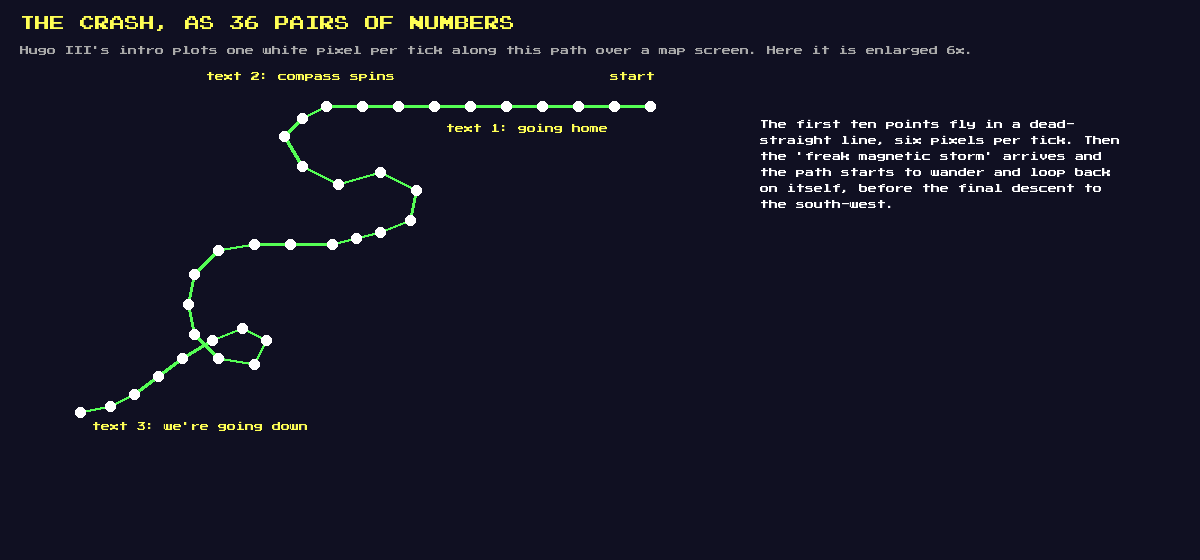
The story it tells: Hugo and Penelope are flying home from Great Uncle Horace's cottage when a freak magnetic storm sends the compass spinning. Lost over the jungle and nearly out of fuel, Hugo spots a clearing. "Hold on Penelope, we're going down...!"
The story (spoilers)
Hugo fiddles with the wrecked plane, and Penelope wanders off and is bitten by a tree spider. The 1992 catalogue blurb gives Hugo 48 hours to find the antidote, though the game never puts a clock on it. He needs water from a magic lagoon (the Pool of Life in Gray's own blurb), but a waterfall is in the way.
Along the way he trades with a village of natives, escapes a witch doctor, borrows a blowpipe with sleeping darts, and puts an elephant to sleep. It drops into the stream, dams it, and the waterfall dries up. He swings on vines and gets past a ghost by exorcising it, and the old man from the first two games turns up once more. Hugo collects the water, saves Penelope, and they fly off into the sunset.
A kinder jungle, in numbers
"Hero cannot be killed" isn't just marketing. You can see it in the script data:
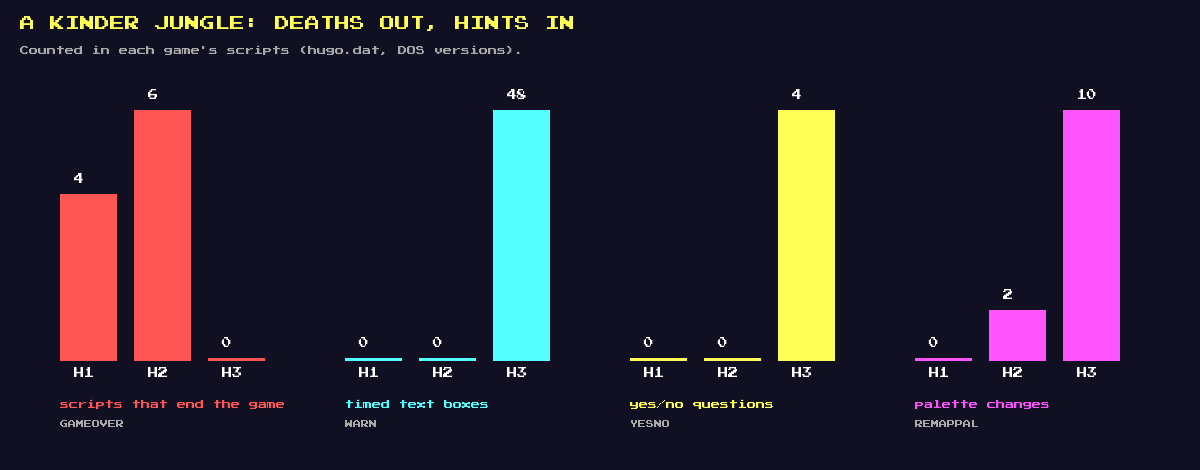
- Zero game-over scripts, after four in Hugo 1 and six in Hugo II. The ghost, the witch doctor and the natives can stop you, but they can't end the game.
- 48 timed message boxes (the new
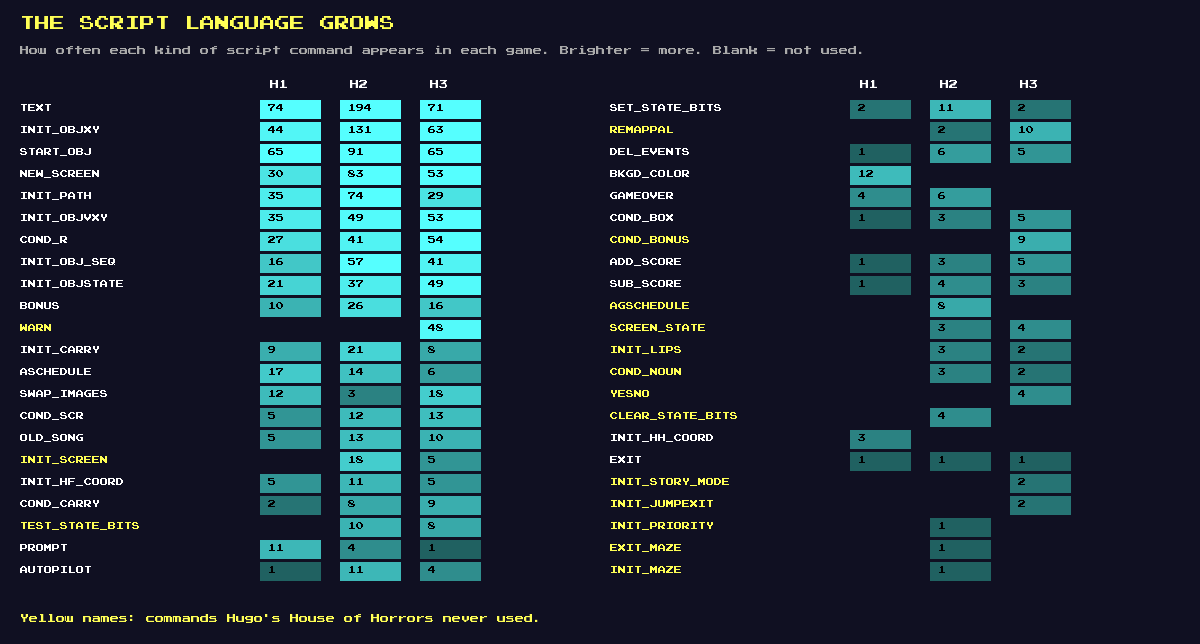
WARNcommand) carry the cutscenes and the story. The four yes/no boxes are the old man's questions (more on those below), and the hints come from a separate system. - A "story mode" (
INIT_STORY_MODE) that hides the prompt during cutscenes, used to open and close the cinematic parts. - Ten palette swaps (
REMAPPAL), several of which flick one colour on and off a tick at a time for flashes and flicker.
Dead ends haven't disappeared entirely. Adventure Classic Gaming noted one early action that you have to do straight away or you'll be stuck later. But this is a game designed to be finished.
The 'perspective' is two drawings of Hugo
Contemporary write-ups praised a new feature: Hugo gets smaller as he walks away from the camera. RGB Classic Games noticed an awkward flash when he changes size. In the data, the database holds two complete hero objects, hero and whero, and Hugo III swaps their sprite sets with the same SWAP_IMAGES command that turned Hugo into Penelope in Hugo II. There's no scaling code in the engine. Gray drew Hugo at a second size, and the flash is the swap.
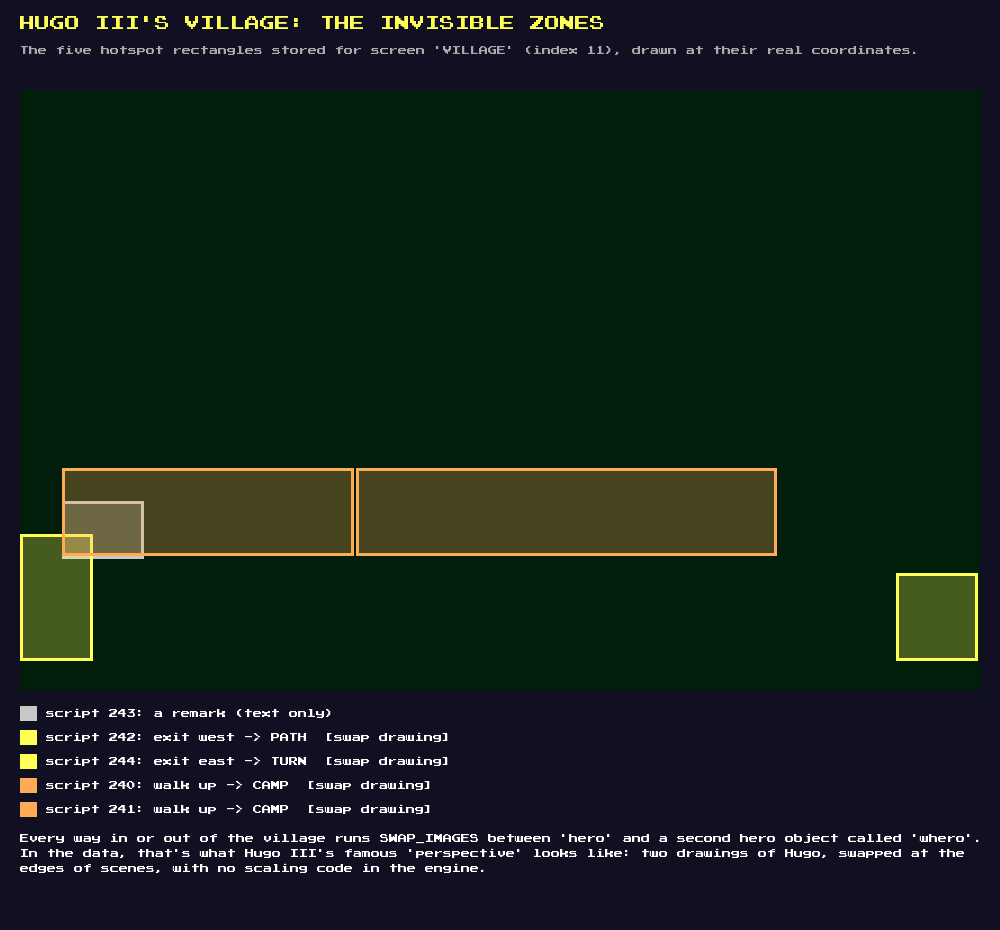
The database has a third Hugo, hero_old, and a swinger sprite set for swinging on a vine across the stream. Gray's Tarzan influence is right there in the object names.
Bell, book and candle
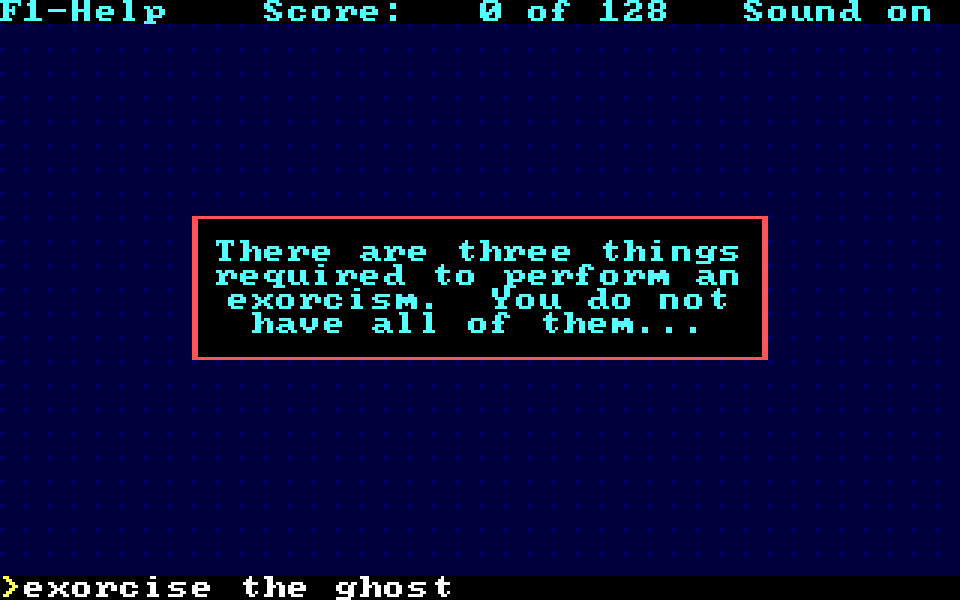
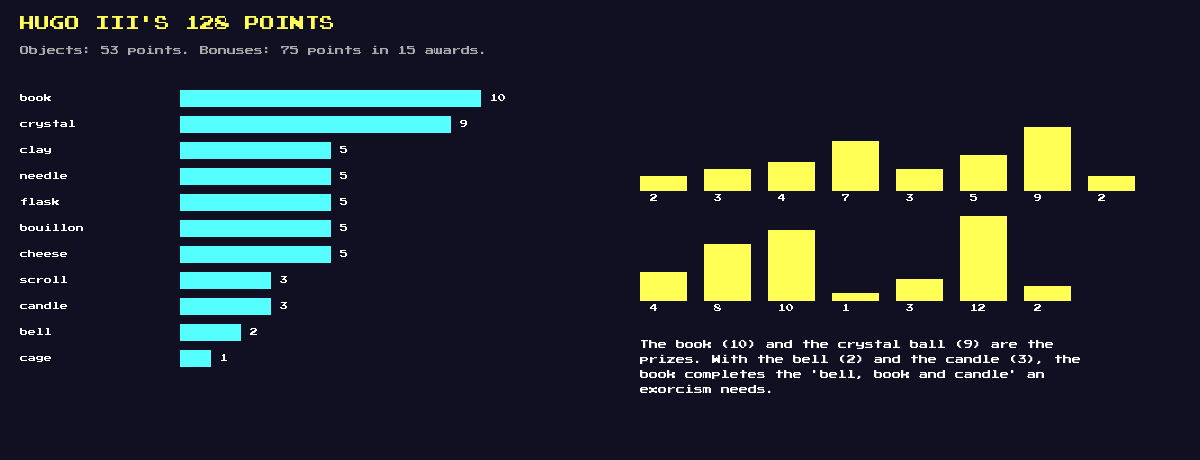
The ghost in the cave is the best example of Hugo III's sense of humour. In the data, the verb exorcise on the ghost needs three objects: the bell, the book and the candle, the traditional bell, book and candle of an excommunication.
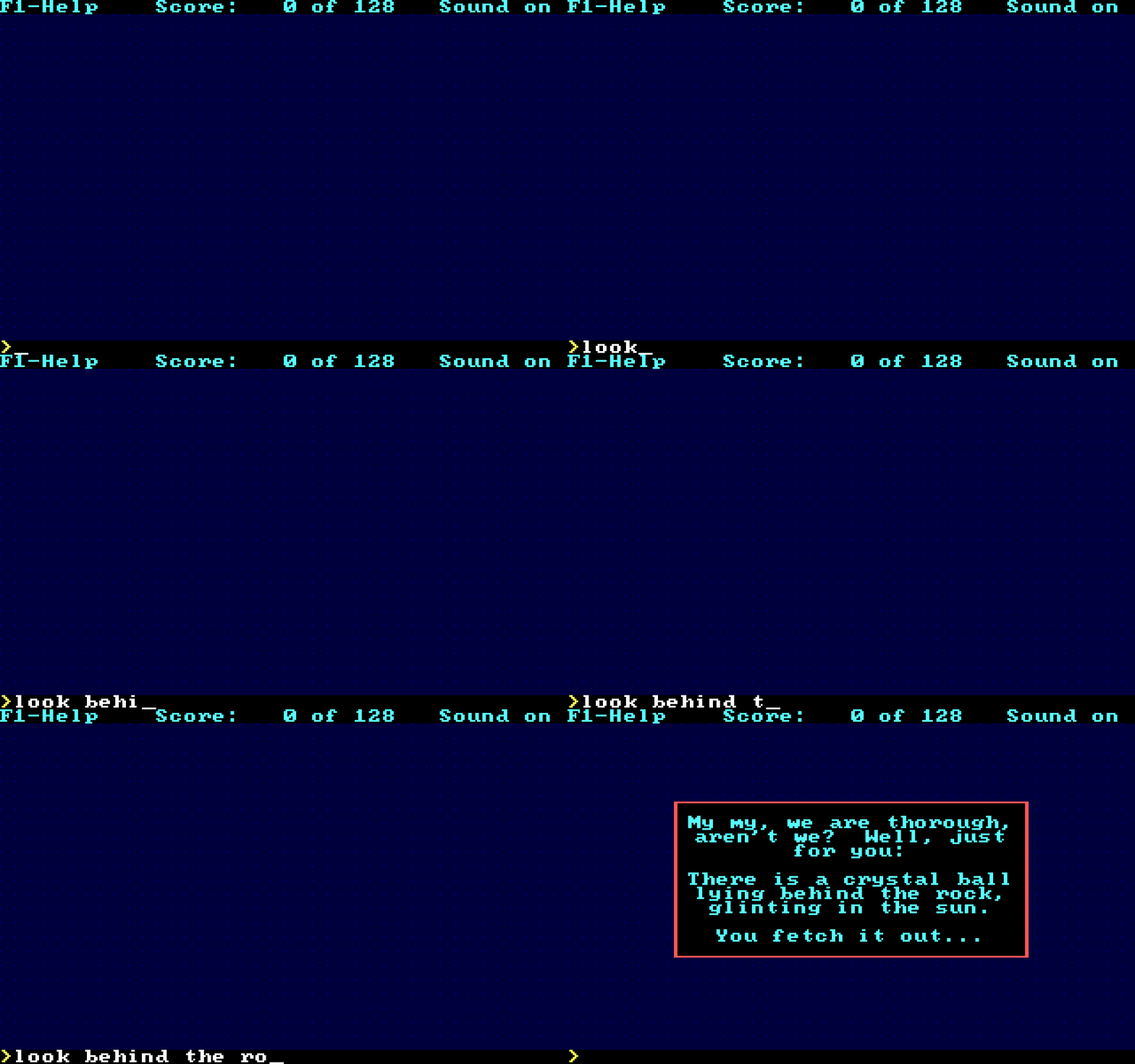
The game also rewards poking around. A scroll carries a little poem signed by the old man, who says he lost his crystal ball near a mighty boulder. If you look behind the rock, the parser has its own verb, behind, and a reply that teases you for being so thorough:
Under the bonnet
Two disks, two scenery files
Hugo III was too big for one floppy disk. Gray's vendor letter warns distributors that they'll need two. The engine shows how that was handled: Hugo II's single scenery database is split in two, and ScummVM's FileManager_v3d chooses between them with one test, if (screenIndex < 20).
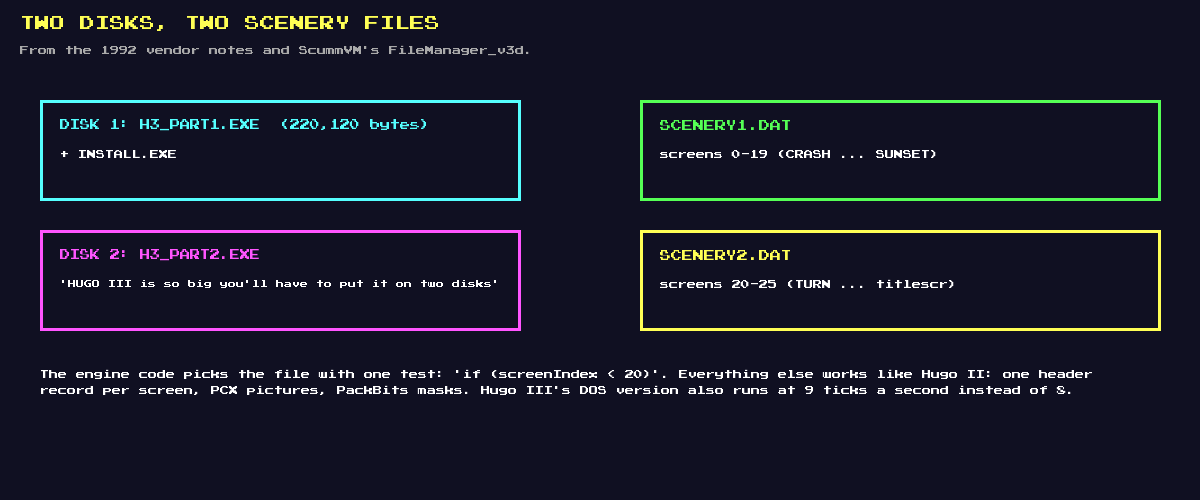
Small things that changed
- A slightly faster clock. ScummVM runs Hugo III's DOS version at 9 ticks a second, against 8 for the first two DOS games. The Windows versions all use 9.
- The parser. Hugo III gets its own parser class. In it, "verb-only" objects in the room can react to a verb with no noun, and a bare
LOOKalso lists the things you could pick up. - Its own glitches. ScummVM removes a stray wall in the crash-site screen that blocked its click-to-walk route finder, and special-cases Hugo III's inventory box text.
- Scripted transitions. A new command,
INIT_JUMPEXIT, lets a mouse click on an exit take effect immediately while the hero is invisible, as during the plane crash.
Over the trilogy, the number of different script commands actually used went from 28 in Hugo 1 to 37 in Hugo II and 36 in Hugo III. Hugo III dropped the maze and bit-flag commands and added hints and story mode:
Secrets from the source code
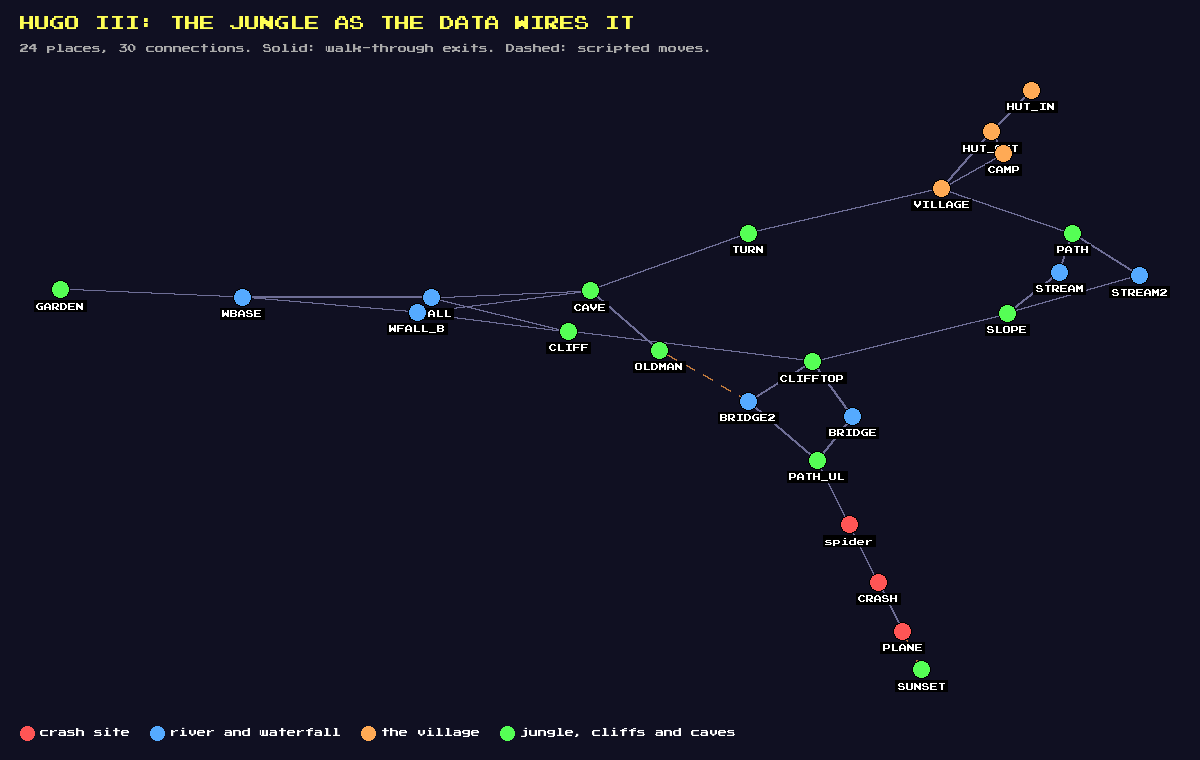
ScummVM's data generator, create_hugo, keeps Gray's original identifiers and comments, so all of Hugo III's scripts have names. Here's what they reveal.
- How the hint system works. Nine scripts,
kALac2tokALac9, form a chain. Each asks whether you've earned one particular bonus. The first one you're missing triggers its tip:planetip,modeltip,sticktip,mousetip,cubestip,dammedtip,magictip,oldmantip, and finallyremedytip. The hints follow the order of the puzzles. - A voodoo doll.
kALmakeclayturns the clay into a model of the witch doctor, but only inside his hut.kALstickpinthen makes him leap 20 pixels in a single tick and collapse, for 5 points. - The elephant is two bits. A sleeping dart sets bit 1 and the mouse from the cage (
kALscare) sets bit 2. Only when both are set (mask 3) does the stream get dammed. - The old man's quiz was changed for ScummVM. The data has a comment marked
HACK. The original asked typed questions (PROMPT), but ScummVM replaced them with yes/no boxes because its prompt box wasn't implemented, so that it could test whether the game could be finished. Get one wrong andkALwrongsends you back to the cave. - The crash site's 'horizon'. In the Windows data a two-tick loop,
kALhorizon, swaps between the near and far drawings of Hugo whenever he crosses y = 151. ScummVM copied it into the DOS data to make mouse play work. - Seven dead scripts.
kALcrashNoStory(a start without the intro story),kALmap0andkALmap1(palette tweaks inherited from Hugo II),kALsong3,kALgotit,kALempty2andkALnopurpsare never called. Hugo 1 and Hugo II have none. - Other details. The old man's screen runs
kALflash, which reschedules itself every 10 ticks to flicker one colour. The garden is commented as "The secret garden". Three of the 265 scripts (the horizon loop) were added by ScummVM, not Gray.
The music
Hugo III's DOS sound is still the PC speaker. Adventure Classic Gaming summed it up as bleeps, bloops and short melodies. There are thirteen songs in its table, but only seven are ever played. The other six are leftovers from earlier games, including the dog and mummy tunes from Hugo's House of Horrors.
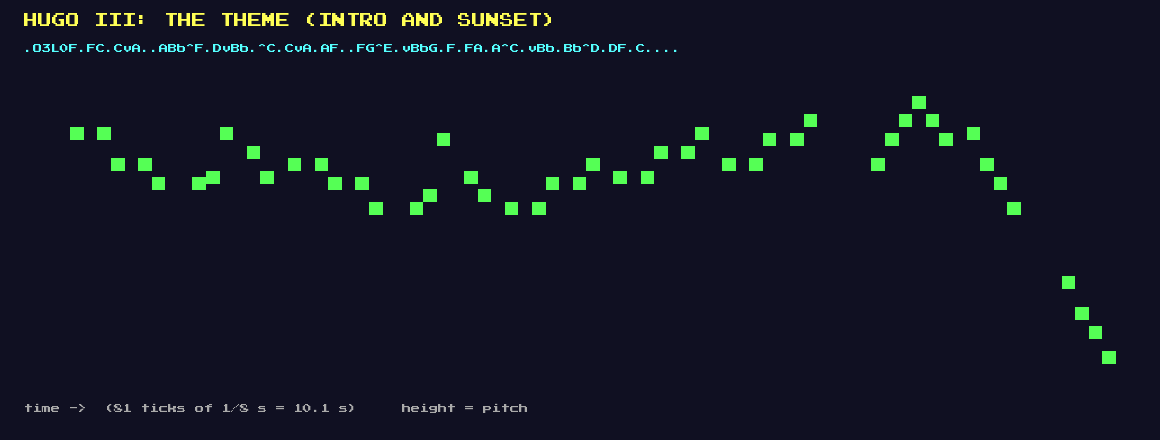
One technical note for anyone reimplementing it. Hugo III uses a note length of zero (L0), which the first two games never do. In the original player that leaves the timer at −1, so the next note starts on the very next tick, the same as L1. Our part-1 renderer didn't expect it and crashed, which is how we found out.
Was it any good?
Adventure Classic Gaming gave it 3 out of 5, loving Sirois's art (lush shrubs, rippling water, the animated village fire) and the humour, but calling it a pit stop rather than an adventure. PC Gamer's Richard Cobbett liked the art but not the game. RGB Classic Games liked the hint system and the perspective, awkward flash and all. Everyone mentions the length.
For the series, it's a happy ending: Hugo and Penelope fly into the sunset with nobody dead. Hugo III had no sequel in the same style, and when Hugo came back two years later, he was carrying a plasma gun. That's part 4.
What we learned
- Art changes everything, including the budget. A professional artist made the game beautiful and short at the same time, and Gray said so himself.
- Difficulty is a design choice you can see in data. Zero GAMEOVER commands, 48 timed messages and four yes/no hint prompts are a philosophy, not an accident.
- Old tricks get new jobs. The sprite swap that made Penelope playable became the perspective system.
- Floppies shape code. One
ifstatement exists because the game didn't fit on one disk. - Data outlives intentions. Six unused songs and an extra Hugo sprite set ride along in the database 34 years later.
Sources
- Hugo III vendor letter and PC-SIG catalogue text (disk #3042, 1992), via the PCjs archive.
- Interview with David P. Gray, RGB Classic Games, 2008; RGB's Hugo III page.
- Hugo III review and Gray interview, Adventure Classic Gaming.
- Wikipedia; ScummVM wiki.
- ScummVM's Hugo engine and
hugo.dat, which all counts, maps and diagrams here come from.
The Hugo series on this blog: Part 1: Hugo's House of Horrors (1990) · Part 2: Hugo II, Whodunit? (1991) · Part 3: Hugo III, Jungle of Doom! (1992) (you are here) · Part 4: Nitemare-3D (1994)
Related articles
 Retro Games & Reverse Engineering
Cracking Fire Ant: Reverse Engineering a Commodore 64 Game with an AI Pair-Programmer
How a 17 KB Commodore 64 game gave up its secrets: infinite lives in three bytes, a level editor, a cheat key, and a short list of humbling bugs along the way.
- Retro Games & Reverse Engineering
Game Gear Secrets
Secret passwords, hidden level selects, cheat codes and developer leftovers: what turned up when every Sega Game Gear game was taken apart. Start here for the full guide.
 Electronics & ESP32
Bluetooth Joypads on a Real Commodore 64: Designing an ESP32 Joystick Adapter
Modern wireless controllers on 1982 hardware: an ESP32 receives Bluetooth gamepads and drives the C64's joystick ports through open-collector transistors. Schematic, hardware list, wiring, software and test plan.